The discovery, explained · Chemist no. 276 of 350
Emilio Segrè and the Discovery of Technetium and Astatine: Elements Made by Humans
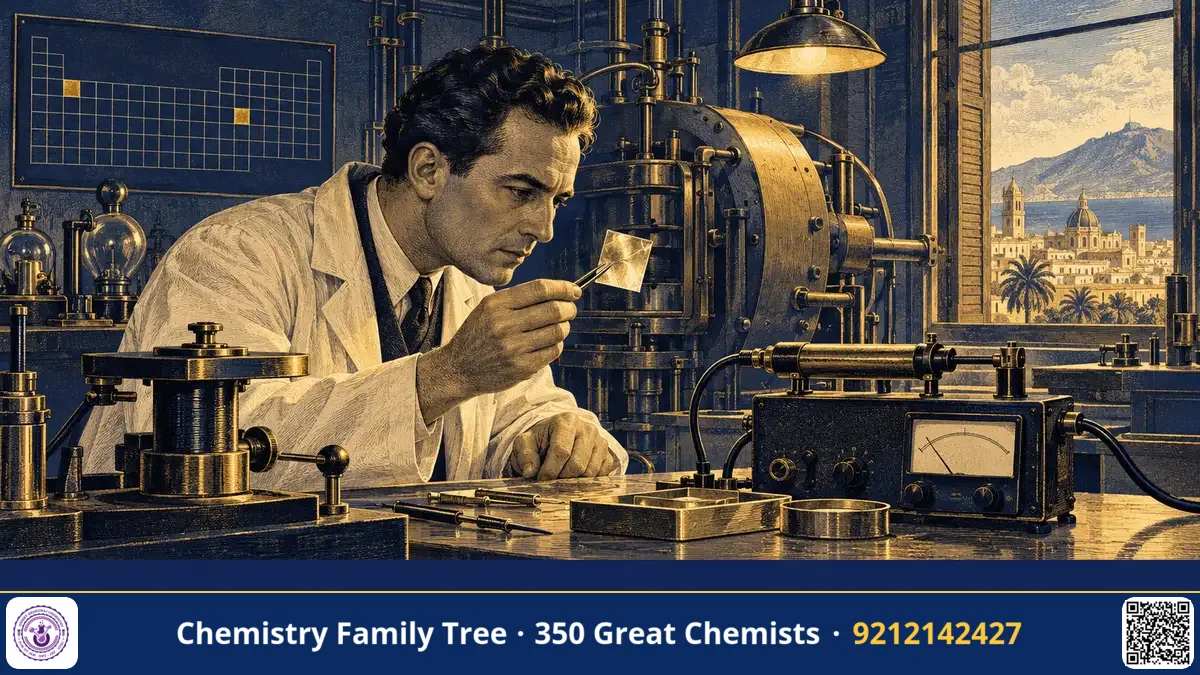
For decades, the periodic table had gaps at atomic numbers 43, 61, 85 and 87. These elements are radioactive and have no stable isotopes, so they were never found in ordinary ores in useful amounts. The Italian-American scientist Emilio Segrè was involved in the discovery of two of them: technetium (Tc, Z = 43), in 1937, and astatine (At, Z = 85), in 1940. Technetium was the first element to be produced artificially, and its name means "artificial" in Greek. Segrè later received the 1959 Nobel Prize in Physics (not Chemistry) for the discovery of the antiproton. This article focuses on the chemistry of his element discoveries.
The Scientific Problem Before the Discovery
Mendeleev had predicted eka-manganese (element 43) under manganese, and a heavy halogen (eka-iodine, element 85) under iodine. Many researchers claimed to have found element 43 in ores, with names such as masurium, ilmenium and davyum, but none of the claims were confirmed. The reason is that no isotope of technetium is stable, and the longest-lived ones, such as ⁹⁸Tc (about 4.2 million years) and ⁹⁷Tc, are too short-lived to survive from the formation of the Earth in measurable amounts. Without a new method, the elements could not be found.
The invention of the cyclotron by Ernest Lawrence at Berkeley in the 1930s gave scientists a tool to make new nuclei by bombarding targets with fast charged particles. Segrè, who had worked in Rome with Enrico Fermi's group on neutron-induced radioactivity, understood the potential.
The Discovery: Step by Step
Technetium (1937). Segrè visited Berkeley in 1936 and talked to Lawrence about radioactive materials. Lawrence later sent him pieces of molybdenum foil that had been part of the cyclotron's deflector and had been exposed to a strong beam of deuterons (heavy hydrogen nuclei). Back in Palermo, Sicily, where he was a professor, Segrè and the mineralogist-chemist Carlo Perrier analysed the foil.
- Radioactivity measured: The foil was radioactive with activities that could not be explained by molybdenum or neighbouring elements.
- Chemical separation: They dissolved the foil and carried out standard separation tests for elements near molybdenum (niobium, zirconium, ruthenium and others). The radioactive material followed none of these.
- Comparison with manganese and rhenium: They found it behaved like a Group 7 element, between manganese and rhenium, forming a volatile oxide and a sulfide that could be precipitated from acidic solution.
- Conclusion: The activity was due to isotopes of element 43, formed by deuteron capture on molybdenum.
⁹⁶₄₂Mo + ²₁H → ⁹⁷₄₃Tc + ¹₀n
(several technetium isotopes were formed, for example ⁹⁵Tc, ⁹⁶Tc and ⁹⁷Tc)
The new element was named technetium from the Greek technetos, "artificial", in 1947.
Astatine (1940). After moving to Berkeley, Segrè worked with Dale Corson and Kenneth MacKenzie. They bombarded bismuth with alpha particles accelerated in the cyclotron:
²⁰⁹₈₃Bi + ⁴₂He → ²¹¹₈₅At + 2 ¹₀n
The product ²¹¹At has a half-life of about 7.2 hours and emits alpha particles. It showed chemical behaviour somewhere between iodine and a metal: it could be extracted into organic solvents like iodine, but it also showed metallic properties. The name astatine comes from the Greek astatos, "unstable".
The Chemistry Behind It
Technetium (Group 7, [Kr] 4d⁵ 5s²) has chemistry that falls between manganese and rhenium. The most stable oxidation state is +7, as the pertechnetate ion, TcO₄⁻, which is colourless and a weaker oxidising agent than permanganate. Tc₂O₇ is a volatile yellow oxide. The Tc–Tc bonded complexes are known, like those of rhenium.
Technetium is a clear example of the stability rule of the nucleus: elements 43 and 61 lie in regions where every isotope is radioactive, because of the nuclear pairing and the Mattauch isobar rule (neighbours Mo and Ru have stable isobars with the same mass number).
Astatine is the heaviest halogen (Group 17, [Xe] 4f¹⁴ 5d¹⁰ 6s² 6p⁵). Its longest-lived isotope, ²¹⁰At, has a half-life of 8.1 hours. It is predicted to be a solid with metallic character, forming At⁻ (astatide), At⁺ and compounds such as HAt and AtI. Trends: electronegativity decreases and metallic character increases down the group F < Cl < Br < I < At.
Applications Today
- Medical imaging: Technetium-99m (half-life 6 hours, gamma emitter at 140 keV) is the most widely used radioisotope in nuclear medicine, used in tens of millions of scans per year, including heart, bone and thyroid imaging. In India, ⁹⁹Mo/⁹⁹ᵐTc generators are supplied to hospitals.
- Corrosion inhibitor: Pertechnetate can protect steel from corrosion in closed systems, though its radioactivity limits its use.
- Targeted alpha therapy: Astatine-211 attached to antibodies or small molecules is being studied to kill cancer cells selectively, because alpha particles travel only a few cell diameters.
- Nuclear waste: ⁹⁹Tc is a long-lived fission product (half-life about 211,000 years), so chemists study its behaviour in waste storage.
- Astronomy: Technetium in the spectra of some red giant stars shows that nuclear synthesis of elements is going on in stars today.
Exam Corner
- Technetium (Z = 43) was first made artificially in 1937 by Segrè and Perrier from molybdenum bombarded with deuterons; it was the first artificially produced element.
- Astatine (Z = 85) was made in 1940 by Corson, MacKenzie and Segrè: ²⁰⁹Bi + α → ²¹¹At + 2n.
- ⁹⁹ᵐTc is the radiopharmaceutical used for imaging; half-life 6 h, gamma emitter, made from ⁹⁹Mo generator.
- Pertechnetate TcO₄⁻ is the stable form of Tc in water; Tc is a Group 7 element.
- Astatine is the rarest naturally occurring element in the Earth's crust, with less than 1 g present at one time; it is a heavy halogen with metallic traits.
Common Misconceptions
- "Segrè won a Chemistry Nobel." He won the 1959 Nobel Prize in Physics with Owen Chamberlain for the antiproton, not for the elements.
- "Technetium does not exist in nature." Traces are formed in uranium ores by spontaneous fission, and it has been detected in stars. But its amount is so small that the first usable samples were made artificially.
- "Astatine is a non-metal like the other halogens." It is expected to show a mix of halogen and metallic behaviour.
Quick Revision Box
- Technetium, Tc, Z = 43, Group 7; discovered 1937 by Perrier and Segrè; no stable isotope.
- Source: cyclotron-irradiated molybdenum foil (deuteron bombardment).
- Astatine, At, Z = 85, Group 17; discovered 1940 at Berkeley.
- Reaction: ²⁰⁹Bi(α,2n)²¹¹At.
- Tc-99m is the most used medical radioisotope; At-211 is a candidate for alpha therapy.
- Segrè's Nobel Prize (1959) was in Physics for the antiproton.
FAQ
Why does technetium have no stable isotope?
Its neighbouring elements molybdenum (42) and ruthenium (44) have stable isobars for each mass number, so any technetium nucleus can decay to them.
What does astatine mean?
The name comes from Greek astatos, meaning unstable.
Why is Tc-99m so useful for hospitals?
It has a convenient half-life (6 hours), emits low-energy gamma rays, and can be attached to many carrier molecules.
What else is Segrè known for?
The discovery of the antiproton (1955) with Owen Chamberlain, Clyde Wiegand and Thomas Ypsilantis, for which he and Chamberlain received the Physics Nobel.
Published by ABC Chemistry — IIT-JAM | CSIR-NET | GATE Chemistry Coaching. Visit abcchemistry.com
About the chemist
Emilio Segrè
1905-1989 · Italy · Nobel Physics 1959
Discovered technetium, astatine, antiproton