The discovery, explained · Chemist no. 217 of 350
Emmanuelle Charpentier and CRISPR-Cas9: Programmable Scissors for DNA
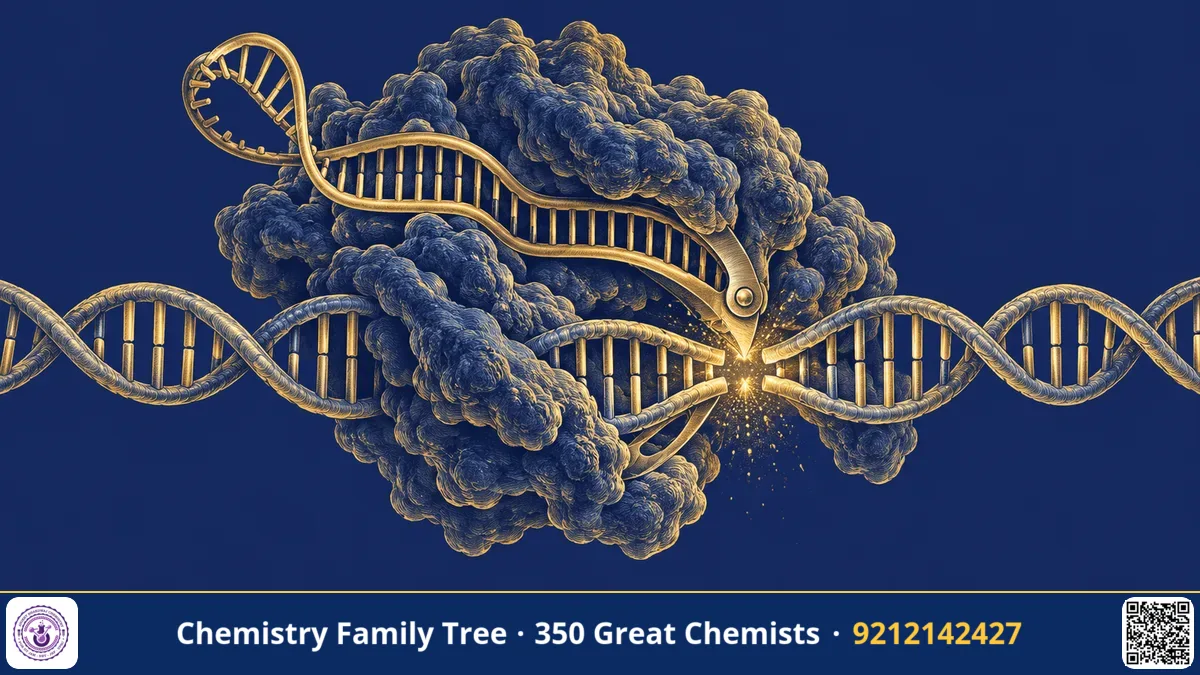
Imagine a pair of molecular scissors that can be told exactly where in a three-billion-letter genome to cut. In 2012, Emmanuelle Charpentier, then at Umeå University in Sweden, and Jennifer Doudna of the University of California, Berkeley, showed how to make that tool from a bacterial immune system called CRISPR-Cas9. Their paper, published in the journal Science in June 2012, showed that the system could be programmed with a short RNA to cut any DNA sequence. For this, they received the 2020 Nobel Prize in Chemistry, "for the development of a method for genome editing". It was the first science Nobel Prize awarded to two women alone.
The Scientific Problem Before the Discovery
Genetic engineering needs tools that can change DNA at a chosen location. Earlier tools, such as restriction enzymes, cut at fixed short sequences that occur many times. Zinc-finger nucleases and TALENs could target longer, chosen sequences but required designing a new protein for every target, which was slow and expensive.
Meanwhile, microbiologists had noticed odd repeating sequences in bacterial genomes, called CRISPR (clustered regularly interspaced short palindromic repeats). Between the repeats were "spacer" sequences that matched viral DNA. Work by researchers including Francisco Mojica, Rodolphe Barrangou and Philippe Horvath showed that these sequences form an adaptive immune memory: bacteria store pieces of invading viral (phage) DNA and use them to recognise and destroy the same virus later. How the destruction occurred was still unclear.
The Discovery: Step by Step
Step 1: Finding tracrRNA (2011)
Charpentier studied Streptococcus pyogenes, a bacterium that causes throat infections. While investigating small RNAs in this bacterium, her team discovered an unexpected RNA molecule that she named tracrRNA (trans-activating CRISPR RNA). It is partly complementary to the repeat sequence of CRISPR RNA. They showed in 2011 that tracrRNA is essential for processing the CRISPR transcript into mature guide RNAs (crRNAs) and for the immune function of the system.
Step 2: Collaboration with Doudna
Charpentier and Doudna, a structural biochemist, met in 2011 and decided to collaborate. Doudna's group brought expertise with RNA-protein biochemistry. Together they purified the Cas9 protein from S. pyogenes and studied what it does in a test tube.
Step 3: Reconstitution and programming
They showed that Cas9, together with a crRNA and tracrRNA, cuts DNA that matches the crRNA's 20-nucleotide guide sequence. The crucial points were:
- The crRNA base-pairs with the target DNA strand, while the tracrRNA binds Cas9 and the crRNA.
- Cas9 has two nuclease domains: HNH cuts the DNA strand complementary to the guide, and RuvC cuts the other strand. Together they make a blunt double-strand break, about three base pairs upstream of the PAM.
- Cutting requires a short protospacer adjacent motif (PAM), 5'-NGG-3' for S. pyogenes Cas9, next to the target.
- The two RNAs can be fused into a single guide RNA (sgRNA), simplifying the tool to just two components: Cas9 protein plus one RNA.
By changing the 20-nucleotide guide sequence, one can aim Cas9 at nearly any DNA sequence that is next to a PAM. In 2013, other groups, including those of Feng Zhang and George Church, showed it works in human cells.
sgRNA (20-nt guide + scaffold) + Cas9 → ribonucleoprotein
Target DNA: 5'-...[20-nt protospacer]-NGG-...-3'
Cas9/sgRNA binds, unwinds DNA (R-loop), HNH + RuvC cut → blunt double-strand break
The Chemistry Behind It
- Watson-Crick base pairing: The guide RNA recognises DNA through A-T(U) and G-C pairing, which gives the system its specificity.
- Nuclease chemistry: Both nuclease domains hydrolyse phosphodiester bonds with the help of divalent metal ions such as Mg²⁺, which activate water for nucleophilic attack on phosphorus.
- Protein-RNA recognition: Cas9 undergoes large conformational changes on binding RNA and DNA, positioning the catalytic sites.
- PAM recognition: Hydrogen bonding between arginine side chains of Cas9 and the guanines of the NGG motif makes the first check before DNA unwinding.
- DNA repair after the cut: The cell repairs the break either by non-homologous end joining (NHEJ), which often introduces small insertions or deletions that disable a gene, or by homology-directed repair (HDR), which can copy in a supplied template to write a precise change.
Applications Today
- Medicine: In 2023 and 2024, regulators approved the first CRISPR-based therapy for sickle cell disease and beta-thalassaemia, which are important health problems in India as well. Cells from patients are edited to restore fetal haemoglobin production.
- Agriculture: Developing crops that are disease-resistant or more nutritious; India has released genome-edited rice varieties for research and cultivation approvals.
- Diagnostics: CRISPR-based tests detect viral RNA or DNA, such as the FELUDA test developed in India for COVID-19.
- Research: Gene knockouts in cells and animals to study function.
- Ethical debate: Editing of human embryos raises serious questions, and international discussion on regulations continues.
Exam Corner
- CRISPR stands for clustered regularly interspaced short palindromic repeats.
- Components of the basic Cas9 tool: Cas9 nuclease and guide RNA (crRNA + tracrRNA or fused sgRNA).
- PAM sequence for SpCas9: 5'-NGG-3'.
- Two nuclease domains: HNH and RuvC; product is a double-strand break.
- Nobel 2020 Chemistry: Charpentier and Doudna. (Not Physiology or Medicine.)
Common Misconceptions
- "CRISPR is an enzyme." CRISPR refers to the repeat array in the genome; Cas9 is the enzyme.
- "CRISPR edits genes without errors." Off-target cuts can occur, and improved variants try to reduce them.
- "Charpentier discovered CRISPR." CRISPR sequences were first noticed earlier; her key contributions were tracrRNA and turning Cas9 into a programmable tool.
Quick Revision Box
- tracrRNA discovered by Charpentier's group in 2011.
- Charpentier and Doudna reported programmable Cas9 in 2012.
- Guide RNA: 20 nt that base-pair with the DNA target.
- PAM: NGG for S. pyogenes Cas9.
- HNH and RuvC domains cut the two strands.
- Nobel Prize in Chemistry 2020 (shared with Doudna).
FAQ
Why was the Nobel Prize in Chemistry given for CRISPR?
The prize honoured the development of a chemical tool for editing DNA, based on RNA-guided nuclease chemistry.
What is a PAM?
A short DNA sequence next to the target that Cas9 must recognise before it cuts; it helps the bacterium avoid cutting its own CRISPR array.
How is CRISPR different from restriction enzymes?
Restriction enzymes recognise fixed short sequences, while Cas9 can be directed to a chosen 20-nucleotide sequence by changing the guide RNA.
Is CRISPR used in India?
Yes. Indian researchers use it in diagnostics, agriculture and disease research, and there are national efforts in sickle cell therapy.
Published by ABC Chemistry — IIT-JAM | CSIR-NET | GATE Chemistry Coaching. Visit abcchemistry.com
About the chemist
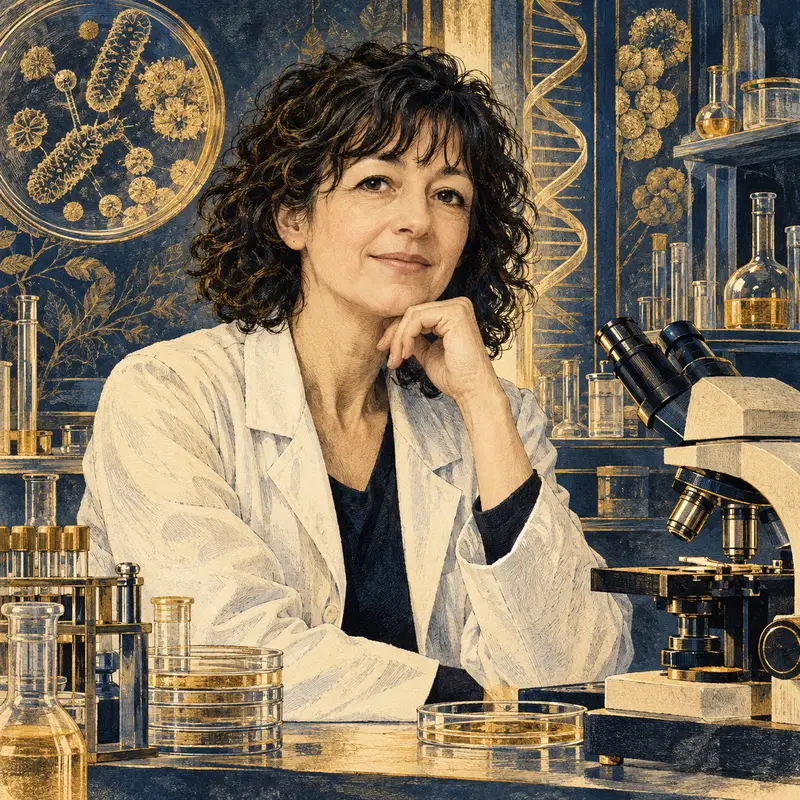
Emmanuelle Charpentier
1968- · France · Nobel Chemistry 2020
CRISPR-Cas9 genome editing