Biography · Chemist no. 303 of 350
Erich Hückel (1896–1980): The Physicist Who Taught Chemists About Aromaticity
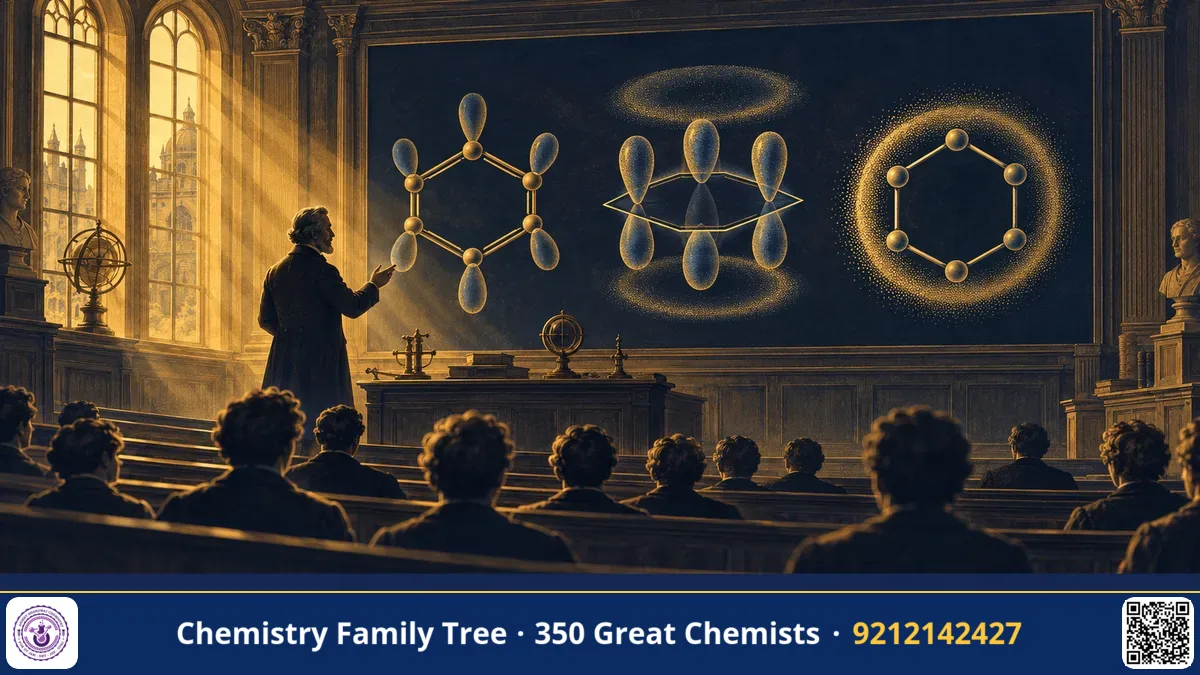
Erich Hückel was a German physicist who spent his career building a bridge between quantum mechanics and chemistry. He is remembered by every chemistry student for two contributions that carry his name: the Debye–Hückel theory of electrolyte solutions and the Hückel rule (4n+2) of aromaticity, along with the simple Hückel molecular orbital (HMO) method behind it. His legacy in one line: he made the quantum theory of the chemical bond usable with pencil and paper.
Early Life and Family
Erich Armand Arthur Joseph Hückel was born on 9 August 1896 in Berlin-Charlottenburg, Germany. He grew up in an educated family in which science was part of daily conversation. His elder brother Walter Hückel became a well-known organic chemist,. Erich's childhood coincided with the golden age of German science, when Berlin and Göttingen were world leaders in physics and chemistry. His studies were disrupted by the First World War years before he completed his degree.
Education and Mentors
Hückel studied physics and mathematics at the University of Göttingen, one of the greatest centres of theoretical science in Europe. He completed his doctorate in physics there in 1921 and worked as an assistant to Max Born, who was building the foundations of quantum mechanics. In 1922 he moved with Peter Debye to the Eidgenössische Technische Hochschule (ETH) in Zurich. Debye was a physical chemist and physicist who studied dipole moments, X-ray scattering and electrolyte solutions. The collaboration between the two produced one of the most cited theories in physical chemistry. Later he also worked in Leipzig, again among leading theoretical physicists.
Career Timeline
| Year | Event |
|---|---|
| 1896 | Born in Berlin-Charlottenburg |
| 1921 | Doctorate in physics at Göttingen |
| 1923 | With Peter Debye in Zurich, publishes the theory of strong electrolytes (Debye–Hückel theory) |
| 1930 | Works on the quantum theory of double bonds and introduces the sigma-pi description of ethene-type bonds |
| 1931 | Publishes the papers on pi electrons in benzene and the 4n+2 rule |
| 1937 | Appointed professor of theoretical physics at the University of Marburg |
| 1980 | Dies in Marburg on 16 February |
Major Scientific Contributions
1. Debye–Hückel theory (1923). Strong electrolytes such as NaCl are completely dissociated, yet their conductivity and colligative properties did not match ideal predictions. Debye and Hückel proposed that each ion is surrounded by a cloud, or "ionic atmosphere", of oppositely charged ions. This reduces the effective concentration, called activity. The limiting law, log γ± = −A|z₊z₋|√I, was a milestone and underlies activity corrections in electrochemistry, pH measurement and solubility calculations. It is related to Kohlrausch's law and to Onsager's later conductance equation.
2. Sigma and pi bonds (1930). In his analysis of the double bond in ethene, Hückel showed that electrons in the plane-symmetric sigma orbitals could be treated separately from those in the perpendicular pi orbitals. This split is the basis of all modern organic bonding pictures.
3. HMO theory and the 4n+2 rule (1931). Using a very simple model of linear combinations of p orbitals, Hückel calculated the pi energy levels of benzene: α + 2β, α + β (twice), α − β (twice) and α − 2β. He then generalised to rings and found that stability is strongest when there are 2, 6, 10, 14 … pi electrons. The full chemistry is explained in our companion discovery article.
Awards, Honours and Nobel Prize
Hückel never received a Nobel Prize, and this is a point that students sometimes get wrong. His ideas were adopted slowly by organic chemists, partly because they came from a physicist and used unfamiliar mathematics. Wider recognition grew in the years after the Second World War, when Robert Robinson, Linus Pauling, Robert Mulliken and the next generation of theoretical chemists embraced simple molecular orbital methods. Specific later honours are not listed here because they cannot be stated with confidence.
Personality, Struggles and Lesser-Known Facts
- A theorist in a chemist's world. Hückel often said, in his own later writings, that his work was met with little interest from organic chemists in the 1930s. The 4n+2 rule became famous only after other chemists tested it on new ring systems.
- Slow academic ascent. Despite his early success with Debye, Hückel held junior and lecturing posts for many years before becoming a full professor at Marburg in 1937.
- Family of scientists. His brother Walter Hückel, an organic chemist at Tübingen, wrote influential textbooks; the two brothers represented the two sides, theory and experiment, of the same subject.
- A reflective writer. In his later years he wrote an autobiographical book, "Ein gelehrtes Leben" (A Scholar's Life), looking back on his career and the difficulties of being a theorist.
- Rule named after him, not by him. The phrase "Hückel's rule" was applied later by chemists such as Doering and Detert, who tested aromaticity in the tropylium ion in the 1950s.
Legacy and Influence on Modern Chemistry
Hückel's approximations are still used in teaching because they give correct qualitative answers with almost no computation. Concepts like pi-electron density, bond order and frontier orbitals trace back to his framework. Fukui's frontier orbital theory and the Woodward–Hoffmann rules both use ideas that start with simple Hückel orbitals. Extended Hückel theory, developed by Roald Hoffmann in the 1960s, uses the same philosophy for all valence electrons and helped Hoffmann share the 1981 Nobel Prize in Chemistry. Today, solid-state physicists also use "tight-binding" models, which are Hückel theory under another name, to describe graphene and conducting polymers.
Lessons for Students
- Simple models can be powerful. Hückel ignored most of the complexity of quantum mechanics and still found a rule that works across hundreds of molecules.
- Cross disciplinary boundaries. A physicist solved a chemistry problem. Learn the maths and physics behind chemistry.
- Be patient with ideas. His work took years to be accepted. Good science often does.
- Exam strategy. For JAM, NET and GATE, remember the HMO energies for ethene, butadiene and benzene.
Quick Facts Box
- Born: 9 August 1896, Berlin-Charlottenburg, Germany
- Died: 16 February 1980, Marburg, Germany
- Nationality: German
- Field: Theoretical physics and quantum chemistry
- Famous for: Debye–Hückel theory (1923), Hückel rule 4n+2 and HMO theory (1931)
- Nobel Prize: None
FAQ
Was Erich Hückel a chemist or a physicist?
He was trained and employed as a physicist, with a doctorate in physics and a professorship in theoretical physics. His influence, however, is greatest in chemistry.
Did Hückel win a Nobel Prize?
No. Peter Debye, his collaborator on electrolyte theory, won the Nobel Prize in Chemistry in 1936, but Hückel did not receive one.
Is Walter Hückel the same person?
No. Walter Hückel was Erich's brother, an organic chemist at the University of Tübingen, known for work on decalins and a textbook of organic chemistry.
Why is Hückel important for the exam syllabus?
Aromaticity, HMO energies of simple systems and the Debye–Hückel limiting law all appear regularly in IIT-JAM, CSIR-NET and GATE chemistry papers.
Published by ABC Chemistry — IIT-JAM | CSIR-NET | GATE Chemistry Coaching. Visit abcchemistry.com
About the chemist
Erich Hückel
1896-1980 · Germany
Hückel molecular orbital theory; 4n+2 rule