The discovery, explained · Chemist no. 303 of 350
Erich Hückel and the 4n+2 Rule: Why Benzene Is So Stable
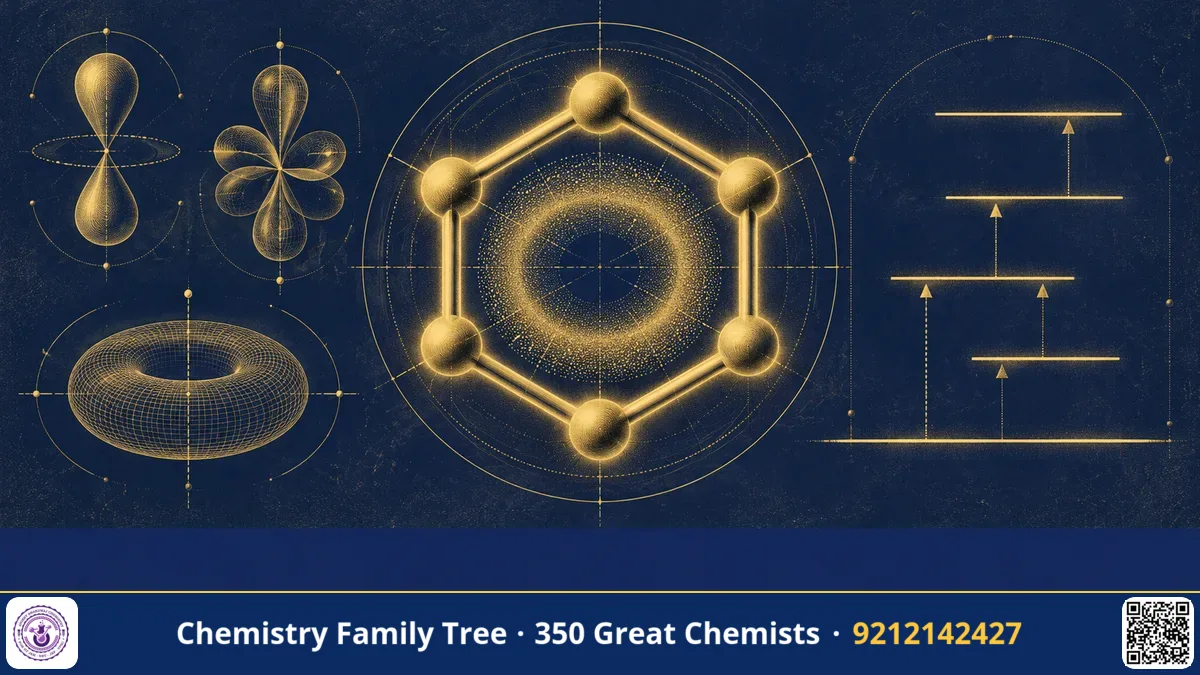
Why is benzene so unreactive compared with an ordinary alkene, even though it appears to have three double bonds? Why is cyclobutadiene so unstable that it cannot be isolated at room temperature, while the cyclopentadienyl anion is quite comfortable? In 1931 the German physicist and chemist Erich Hückel gave a simple, powerful answer. By applying quantum mechanics to the pi electrons of conjugated rings, he showed that a flat, cyclic, fully conjugated ring is specially stable when it contains 4n+2 pi electrons. This idea, now called Hückel's rule, is one of the first things every student of organic chemistry learns, and the method behind it, Hückel molecular orbital (HMO) theory, remains a favourite topic in IIT-JAM, CSIR-NET and GATE papers.
The Scientific Problem Before the Discovery
By the 1860s, Kekulé had proposed a ring structure for benzene (C₆H₆) with alternating single and double bonds. This explained the formula, but not the behaviour. Benzene does not decolorise bromine water, it prefers substitution to addition, and all six C–C bonds are equal in length (about 139 pm), which lies between a C–C single bond (154 pm) and a C=C double bond (134 pm). Kekulé later suggested that the double bonds rapidly oscillate, and the idea of resonance was developed afterwards by Pauling and others.
Chemists also had a growing list of puzzles. Naphthalene and anthracene were stable, but cyclooctatetraene behaved like a normal polyene. The heat of hydrogenation of benzene was about 150 kJ/mol, much less than three times that of cyclohexene (about 3 × 120 = 360 kJ/mol), whereas the observed value is about 208 kJ/mol. The extra stability, roughly 150 kJ/mol, was called the resonance or delocalisation energy. What was missing was a general rule that predicted which rings would show this stability.
The Discovery: Hückel's Approach Step by Step
Hückel was trained as a physicist and worked on the new quantum mechanics. In the early 1930s he treated the electrons of unsaturated molecules in a very simple manner. His key steps were:
- Separate sigma and pi electrons. The sigma framework (C–C and C–H bonds) is treated as fixed. Only the pi electrons, which lie in p orbitals perpendicular to the molecular plane, are studied. Hückel is credited with this sigma-pi separation.
- Use the LCAO idea. Each pi molecular orbital is written as a linear combination of atomic p orbitals: ψ = c₁φ₁ + c₂φ₂ + … + c₆φ₆ for benzene.
- Make drastic simplifications. Every carbon has the same Coulomb integral α. If two carbons are bonded, the resonance integral between them is β. If they are not bonded, the interaction is zero. Overlap between neighbouring orbitals is ignored (S = 0).
- Solve the secular determinant. Setting the determinant of the matrix to zero gives the allowed energies.
For benzene the determinant gives six energy levels:
E = α + 2β   (one level, lowest)
E = α + β    (two degenerate levels)
E = α − β    (two degenerate levels)
E = α − 2β   (one level, highest)
Here β is negative, so α + 2β is the most stable level. Six pi electrons fill the three bonding orbitals (two each), so the total pi energy is 2(α + 2β) + 4(α + β) = 6α + 8β. Three isolated ethene-type double bonds would give 6α + 6β. The difference, 2β, is the delocalisation energy of benzene.
Generalising to Rings: The 4n+2 Rule
For a planar monocyclic ring of N carbons, the Hückel energies are E = α + 2β cos(2πk/N), where k = 0, 1, 2 … N−1. There is always one lowest orbital, and above it the levels occur in degenerate pairs. A closed-shell, fully filled set of bonding orbitals therefore needs 2 electrons for the lowest level and 4 more for each extra pair. That gives 2, 6, 10, 14 … electrons, which is exactly 4n+2 with n = 0, 1, 2, 3.
If a ring has 4n pi electrons (4, 8, 12), the last pair of electrons must go into two degenerate non-bonding orbitals, one electron each (Hund's rule), giving a diradical-like, unstable situation. Such rings are called antiaromatic. Cyclobutadiene (4 electrons) is the classic example.
| Species | Pi electrons | Hückel classification |
|---|---|---|
| Benzene | 6 | Aromatic (n = 1) |
| Cyclopentadienyl anion | 6 | Aromatic |
| Tropylium cation (C₇H₇⁺) | 6 | Aromatic |
| Cyclopropenyl cation | 2 | Aromatic (n = 0) |
| Cyclobutadiene | 4 | Antiaromatic |
| Cyclooctatetraene (planar form) | 8 | Antiaromatic, so it puckers into a tub shape and behaves non-aromatically |
The Chemistry Behind It
Four conditions must be satisfied for Hückel's rule to apply: the molecule must be cyclic, planar, fully conjugated (a continuous cycle of p orbitals) and contain 4n+2 pi electrons. Remove any condition and the rule fails. Cyclooctatetraene is not planar. Cyclohexane is not conjugated. A ring with an sp³ carbon, like cyclopentadiene, breaks the cycle.
A trick to remember: draw the polygon with one vertex pointing down, and the Frost circle shows the orbital energies. Bonding orbitals lie below the horizontal line through the centre, non-bonding on the line and antibonding above it. A closed-shell filled bonding set means aromatic.
The rule works for ions as well. Cyclopentadiene (pKa about 16) is unusually acidic for a hydrocarbon because loss of H⁺ produces the six-electron cyclopentadienyl anion. Likewise, cycloheptatrienyl bromide is ionic because the tropylium cation is aromatic. Heterocycles such as pyrrole (the nitrogen lone pair contributes 2 electrons, total 6), furan, thiophene and pyridine all obey the rule. Fused systems such as naphthalene (10 pi electrons) and anthracene (14) fit the 4n+2 pattern when analysed as a whole.
Another Hückel Discovery: Debye–Hückel Theory
Early in his career, in 1923, Hückel worked with Peter Debye in Zurich on strong electrolytes. The Debye–Hückel theory explains why ions in solution do not behave ideally: each ion is surrounded by an "ionic atmosphere" of opposite charge. For very dilute solutions the limiting law is:
log γ± = − A |z₊ z₋| √I
where γ± is the mean activity coefficient, z are the ion charges and I is the ionic strength. At 25 °C in water, A is about 0.509. This law is a standard topic for physical chemistry and electrochemistry questions.
Applications Today
- Drug design: Many drugs contain aromatic rings (paracetamol, aspirin, pyridine-based drugs). Aromatic stability controls their metabolism and binding.
- Organometallic chemistry: Ferrocene, with two aromatic cyclopentadienyl anions bound to Fe²⁺, follows an 18-electron count.
- Dyes and materials: Conjugated polymers, organic LEDs and graphene are understood through Hückel-type band models.
- Electrochemistry and industry: Debye–Hückel theory is used for activity corrections in batteries, desalination and effluent treatment, including Indian industrial water plants.
- Computational chemistry: Modern software for pi systems still begins with HMO-style ideas such as bond order and charge density.
Exam Corner: 5 Likely Points
- State Hückel's rule and the four conditions; identify aromatic, antiaromatic and non-aromatic species in a list of rings and ions.
- Write the HMO energy levels of benzene (α ± 2β, α ± β, twice) and compute the delocalisation energy (2β).
- Explain why cyclopentadiene is more acidic than cyclohexene and why tropylium bromide is ionic.
- For ethene HMO energies are α ± β; for butadiene they are α ± 1.618β and α ± 0.618β.
- Write the Debye–Hückel limiting law and say when it is valid (dilute solutions, I below about 0.01 mol/kg).
Common Misconceptions
- "Every ring with alternating double bonds is aromatic." Wrong. Cyclobutadiene and cyclooctatetraene are not.
- "Aromatic means it has a smell." The name is historical; today it means 4n+2 delocalised pi electrons.
- "The 4n+2 count includes sigma electrons." Only pi electrons in the conjugated cycle are counted, and a lone pair counts only if it lies in a p orbital that is part of the cycle.
Quick Revision Box
- Hückel's rule (1931): planar, cyclic, fully conjugated ring with 4n+2 pi electrons is aromatic.
- 4n pi electrons in such a ring means antiaromatic (unstable).
- Benzene HMO energies: α+2β, α+β (×2), α−β (×2), α−2β; delocalisation energy 2β.
- Aromatic ions: cyclopentadienyl anion, tropylium cation, cyclopropenyl cation.
- Debye–Hückel limiting law: log γ± = −A|z₊z₋|√I.
- HMO assumptions: same α for all carbons, β for neighbours only, S = 0.
FAQ
What does n mean in 4n+2?
n is a whole number (0, 1, 2, 3 …). It simply generates the series 2, 6, 10, 14 electrons that correspond to completely filled sets of bonding orbitals.
Is naphthalene aromatic by Hückel's rule even though it is bicyclic?
Yes. Hückel's rule is derived for monocycles, but fused benzenoid systems such as naphthalene (10 pi electrons) are aromatic, as the perimeter of the molecule is a conjugated 4n+2 cycle.
Why is β negative?
β represents the stabilising energy of an electron shared between two bonded atoms. Since bonding lowers energy, β is a negative quantity, which makes α + 2β the lowest level.
Are Debye–Hückel theory and Hückel's rule related?
They share only the name of their discoverer. One concerns ions in solution (physical chemistry), the other concerns pi electrons in rings (organic and theoretical chemistry).
Published by ABC Chemistry — IIT-JAM | CSIR-NET | GATE Chemistry Coaching. Visit abcchemistry.com
About the chemist
Erich Hückel
1896-1980 · Germany
Hückel molecular orbital theory; 4n+2 rule