Biography · Chemist no. 17 of 350
Ernest Rutherford: The Farm Boy Who Found the Nucleus
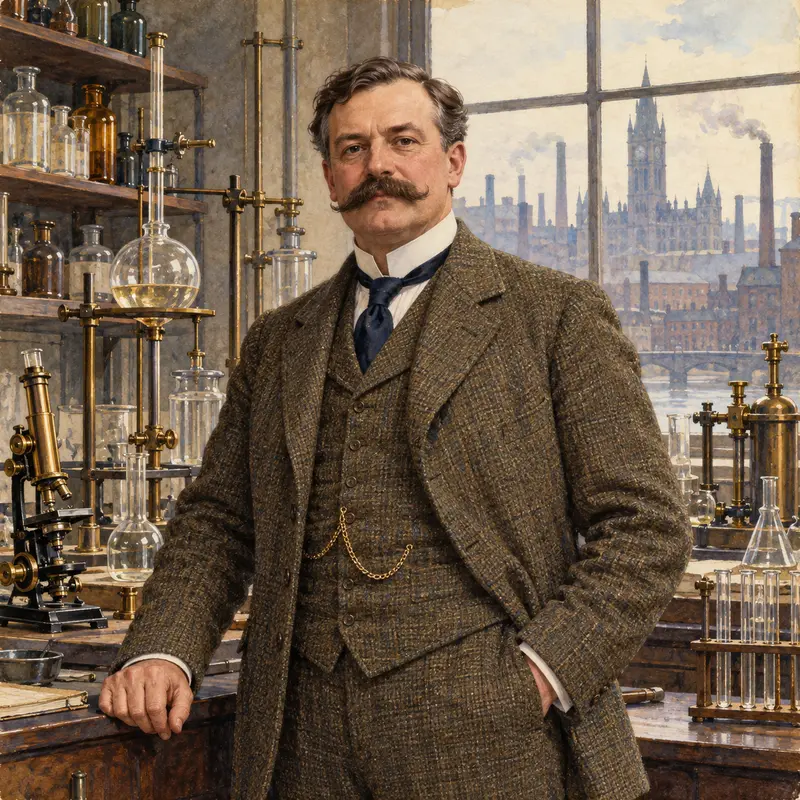
Ernest Rutherford (1871–1937) was a New Zealand-born physicist who worked in Canada and Britain, and is widely called the "father of nuclear physics". He explained radioactivity as the transformation of elements, discovered the atomic nucleus, and carried out the first artificial transmutation. He won the Nobel Prize in Chemistry in 1908. His legacy includes not only discoveries but also a remarkable number of students who became Nobel laureates.
Early Life and Family
Ernest Rutherford was born on 30 August 1871 at Brightwater, near Nelson, on the South Island of New Zealand. His father, James Rutherford, was a wheelwright and flax miller who had come from Scotland, and his mother, Martha Thompson, was a schoolteacher. Ernest was the fourth of twelve children. He grew up in a hard-working rural family, helping on the farm and attending local schools. These roots gave him a practical, direct style that he kept throughout his life.
In 1900 he married Mary Newton, whom he had met in Christchurch, and the couple had one daughter, Eileen. She later married the physicist Ralph Fowler, and died in 1930 after the birth of her fourth child.
Education and Mentors
Rutherford won scholarships to Nelson College and then Canterbury College in Christchurch, part of the University of New Zealand, where he studied mathematics and physical science and obtained several degrees. He carried out research on magnetic detection of radio waves, using a magnetic detector he built himself. In 1895 he won an 1851 Exhibition Scholarship and went to the Cavendish Laboratory at Cambridge, where he worked under J. J. Thomson. Together they studied the effect of X-rays on gases, and Rutherford then turned to the newly discovered rays from uranium.
Career Timeline
| Year | Event |
|---|---|
| 1871 | Born near Nelson, New Zealand, 30 August |
| 1895 | Goes to Cambridge as a research student under J. J. Thomson |
| 1898 | Professor of physics at McGill University, Montreal |
| 1899 | Names alpha and beta radiation |
| 1902–1903 | With Frederick Soddy, proposes the theory of radioactive disintegration |
| 1907 | Moves to the University of Manchester |
| 1908 | Awarded the Nobel Prize in Chemistry; shows alpha particles are helium nuclei |
| 1909–1911 | Alpha scattering experiments and the nuclear atom |
| 1914 | Knighted |
| 1919 | Reports transmutation of nitrogen; becomes Cavendish Professor at Cambridge |
| 1931 | Created Baron Rutherford of Nelson |
| 1937 | Dies in Cambridge, 19 October |
Major Scientific Contributions
- Classification of radiation. He distinguished alpha and beta rays from their ability to penetrate matter.
- Theory of radioactive decay. With Soddy, he showed that radioactive elements change into other elements and that decay is a first-order process with a characteristic half-life.
- Nature of alpha particles. With Thomas Royds he showed in 1908 that they are helium ions.
- The nuclear atom (1911). Based on the alpha scattering results from Geiger and Marsden. See our discovery post for the experiment.
- Artificial transmutation (1919).
¹⁴N + ⁴He → ¹⁷O + ¹H, and the naming of the proton. - Prediction of the neutron. He proposed a neutral particle in 1920, which Chadwick later found.
Awards, Honours and Nobel Prize
Rutherford received the Nobel Prize in Chemistry in 1908 "for his investigations into the disintegration of the elements, and the chemistry of radioactive substances". He was knighted in 1914, awarded the Order of Merit in 1925, and made Baron Rutherford of Nelson in 1931. He served as President of the Royal Society from 1925 to 1930. After his death his ashes were placed in Westminster Abbey, near the graves of Isaac Newton and Lord Kelvin. The element rutherfordium (Rf, atomic number 104) is named in his honour.
Personality, Struggles and Lesser-Known Facts
- A Chemistry Nobel for a physicist. Rutherford is said to have joked that he had seen many transformations in his work, but the quickest was his own, from physicist to chemist.
- Loud and encouraging. He was known for a booming voice and a habit of singing "Onward, Christian Soldiers" while working. Students remembered him as demanding but generous with support.
- Wartime research. During the First World War he worked on detecting submarines with underwater sound, while continuing to think about the nucleus.
- Plain speaking. He believed in simple experiments and had little patience for excessive theory. He was cautious about the idea that nuclear energy could be exploited, and publicly doubted the practical use of atomic power only a few years before its discovery through fission.
- Great eye for talent. His students and collaborators included Niels Bohr, Henry Moseley, Hans Geiger, James Chadwick, Patrick Blackett, John Cockcroft, Ernest Walton and Pyotr Kapitsa. Many of these won Nobel Prizes.
Legacy and Influence on Modern Chemistry
Almost all atomic structure teaching starts with Rutherford: nucleus, protons, neutrons, orbiting electrons, isotopes and radioactivity. His work opened nuclear chemistry, which includes radiochemistry, radiocarbon dating, medical isotopes and nuclear power. Rutherford's way of building a laboratory culture, with small teams, simple apparatus and sharp questions, was copied around the world. In India, early nuclear scientists followed the Cavendish tradition. The nucleus he discovered remains the heart of modern chemistry, since the nuclear charge determines an element's identity and hence its chemical behaviour.
Lessons for Students
- Be ready to be surprised. An unexpected result of a few rebounding particles changed physics.
- Choose good collaborators. Soddy, Geiger, Marsden and Bohr all had a part in his success.
- Simple experiments, well designed, can answer deep questions.
- Great teachers produce great students. Share ideas generously.
Quick Facts Box
- Born: 30 August 1871, Brightwater near Nelson, New Zealand
- Died: 19 October 1937, Cambridge, England
- Nationality: New Zealander (British subject)
- Field: Nuclear physics and radiochemistry
- Famous for: Discovery of the atomic nucleus, radioactive decay theory, first artificial transmutation
- Nobel: Chemistry, 1908
FAQ
Why did Rutherford get the Chemistry prize?
The committee honoured his work on the disintegration of elements and the chemistry of radioactive substances, and so it was placed in chemistry.
Which element is named after Rutherford?
Rutherfordium, symbol Rf and atomic number 104.
Who worked in his laboratory?
Many famous scientists, including Niels Bohr, Henry Moseley, James Chadwick and Frederick Soddy.
Where are his ashes?
In Westminster Abbey, London, near Isaac Newton and Lord Kelvin.
Published by ABC Chemistry — IIT-JAM | CSIR-NET | GATE Chemistry Coaching. Visit abcchemistry.com
About the chemist
Ernest Rutherford
1871-1937 · New Zealand/United Kingdom · Nobel Chemistry 1908
Atomic nucleus; radioactive decay