The discovery, explained · Chemist no. 17 of 350
Rutherford and the Nuclear Atom: What the Gold Foil Revealed
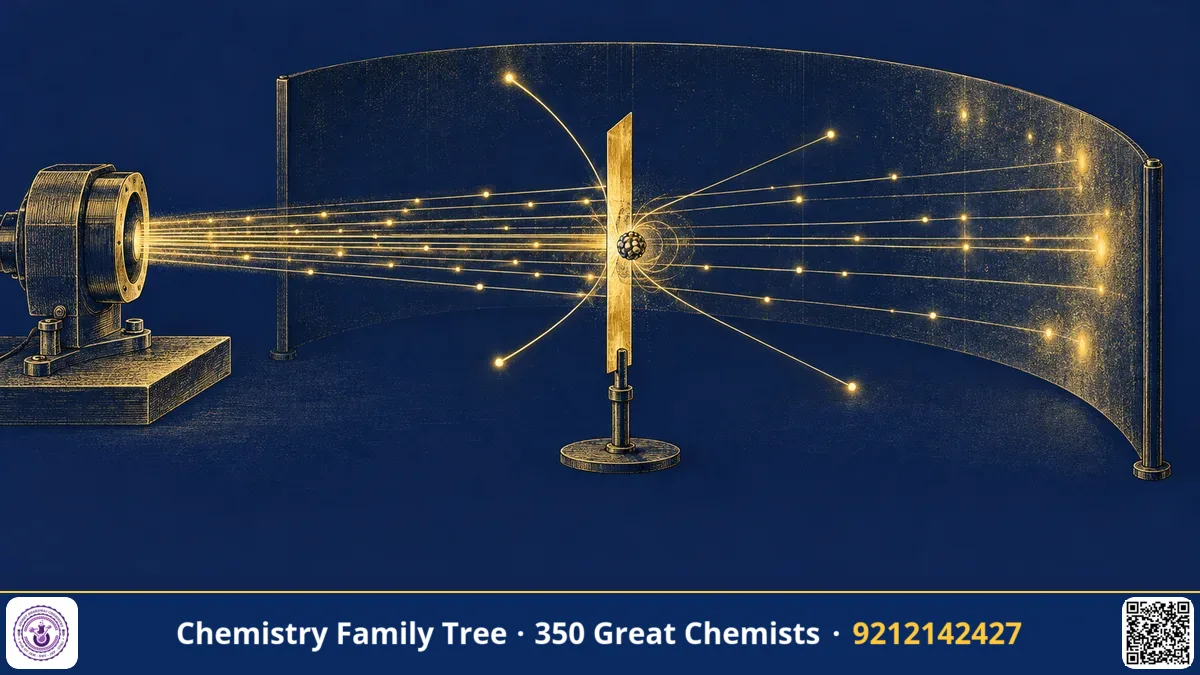
In 1911 Ernest Rutherford announced that an atom is mostly empty space, with almost all its mass and all its positive charge packed into a tiny central core called the nucleus. This picture came from a simple experiment in which alpha particles were fired at a very thin gold foil. A few of them bounced almost straight back. The result destroyed the "plum pudding" model of the atom and began the era of nuclear physics and chemistry. Rutherford also showed that radioactivity is the transformation of one element into another, and in 1919 he produced the first artificial nuclear reaction. Rutherford received the Nobel Prize in Chemistry in 1908, which surprised him, as he often joked.
The Scientific Problem Before the Discovery
After the discovery of the electron in 1897, J. J. Thomson proposed a model in which the atom is a sphere of positive charge with electrons embedded in it, like plums in a pudding or seeds in a watermelon. The model explained electrical neutrality but could not explain several things:
- How could radioactive elements emit particles with large energies?
- What were alpha and beta rays, and where did they come from?
- How were the sharp lines of atomic spectra produced?
Rutherford had already given alpha and beta rays their names around 1899 while studying uranium radiation at McGill University in Montreal. With Frederick Soddy he proposed in 1902–1903 that radioactivity is spontaneous disintegration of atoms into atoms of different elements, a revolutionary claim, since atoms were believed to be unchangeable. He also showed that the decay follows a first-order law and introduced the idea of half-life. In 1908 he and Thomas Royds proved that alpha particles are helium nuclei, He²⁺.
The Discovery: The Alpha Scattering Experiment
At the University of Manchester, Rutherford asked his assistant Hans Geiger and a young student, Ernest Marsden, to study how alpha particles scatter on thin metal foils. The setup was:
- A radioactive source of alpha particles inside a lead box with a narrow slit.
- A very thin foil of gold, only a few thousand atoms thick.
- A movable screen coated with zinc sulphide, which produces a tiny flash of light (a scintillation) when an alpha particle hits it. The observers counted flashes by eye in a dark room.
The results, reported in 1909, were:
| Observation | Meaning |
|---|---|
| Most alpha particles passed straight through | Atoms are mostly empty space |
| Some were deflected through small angles | Positive charge is concentrated and repels alpha particles |
| A very few (about 1 in 8000 in the early experiments) were deflected by more than 90°, some almost back | There is a dense, massive, positively charged centre |
Rutherford later described the surprise in a famous remark that it was as incredible as firing a 15-inch shell at a piece of tissue paper and having it come back and hit you. In 1911 he worked out the mathematics: a heavy, small centre with charge +Ze would repel alpha particles according to Coulomb's law, giving a scattering pattern proportional to 1/sin⁴(θ/2). Geiger and Marsden's later measurements matched the formula.
The Chemistry Behind It
The nuclear model gave these important numbers:
- Atomic radius is about 10⁻¹⁰ m (0.1 nm), while nuclear radius is about 10⁻¹⁵ m (1 fm), roughly 100,000 times smaller.
- Almost all the mass is in the nucleus; electrons move around it.
- The nuclear charge equals the atomic number Z, a concept that Henry Moseley clarified in 1913 while working with Rutherford's group.
The model had a difficulty: according to classical physics, an orbiting electron should radiate energy and spiral into the nucleus. In 1913 Niels Bohr, who had worked in Rutherford's laboratory, solved this by adding quantised orbits. That led to the Bohr model and finally to quantum mechanics.
Radioactive decay. Rutherford and Soddy found that the decay rate is proportional to the number of atoms present:
N = N₀e−λt, and the half-life t½ = 0.693/λ
Artificial transmutation. In 1917–1919 Rutherford bombarded nitrogen gas with alpha particles and observed fast protons. The reaction is:
¹⁴₇N + ⁴₂He → ¹⁷₈O + ¹₁H
This was the first deliberate conversion of one element into another. It also showed that the hydrogen nucleus (the proton) is a building block of other nuclei. In 1920 he suggested that a neutral particle, the neutron, must exist; his student James Chadwick found it in 1932.
Applications Today
- Nuclear energy and research: understanding the nucleus led to nuclear reactors and to India's atomic energy programme, led in its early years by Homi Bhabha.
- Medicine: radioisotopes are used for cancer therapy (for example cobalt-60 and iodine-131) and for diagnosis.
- Dating: radioactive decay laws allow dating of rocks (uranium-lead) and of organic remains (carbon-14).
- Household: smoke detectors use a tiny amount of americium-241, an alpha emitter.
- Analysis: Rutherford backscattering spectrometry is a materials-science technique that uses ion scattering to measure thin film composition.
Exam Corner
- Rutherford's observations: most alpha particles pass undeflected; few deflect at large angles; very few rebound. Know the three conclusions about empty space, a small dense nucleus and positive charge.
- Alpha particle = He²⁺ (mass 4 u, charge +2). Beta = electron; gamma = electromagnetic radiation.
- Limitations: no explanation of stability of the atom (classical collapse), no explanation of line spectra, and no description of electron arrangement.
- Radioactive decay is first order: t½ = 0.693/λ, independent of initial amount.
- Distance of closest approach for an alpha particle: r₀ = (2Ze²)/(4πε₀ × KE) (for head-on approach).
Common Misconceptions
- "Rutherford discovered the proton and neutron." He identified and named the proton and predicted the neutron, but Chadwick discovered it.
- "The gold foil experiment proved electron orbits." It showed a nucleus, not the orbits. The orbits came from Bohr.
- "Rutherford won the Nobel Prize in Physics." He received the Chemistry prize, in 1908, for his work on the disintegration of elements.
Quick Revision Box
- Experiment by Geiger and Marsden (1909) under Rutherford; nuclear model published 1911.
- Nucleus size about 10⁻¹⁵ m; atom about 10⁻¹⁰ m.
- Alpha particles are helium nuclei (shown with Royds, 1908).
- First artificial transmutation: ¹⁴N + α → ¹⁷O + p (1919).
- Radioactive decay is first order: N = N₀e−λt.
- Nobel Prize in Chemistry, 1908.
FAQ
Why was gold chosen for the foil?
Gold is very malleable and can be beaten into extremely thin sheets, and it has a high atomic number, which gives strong scattering.
What was wrong with Thomson's model?
A uniform positive sphere could not deflect fast alpha particles by large angles. The observed large-angle scattering needed a concentrated positive charge.
Did Rutherford split the atom?
In 1919 he transmuted nitrogen into oxygen using alpha particles. The first complete nuclear disintegration using accelerated particles was done in 1932 by his students Cockcroft and Walton.
What did Bohr add to Rutherford's model?
Bohr added quantised stable orbits and explained the hydrogen spectrum.
Published by ABC Chemistry — IIT-JAM | CSIR-NET | GATE Chemistry Coaching. Visit abcchemistry.com
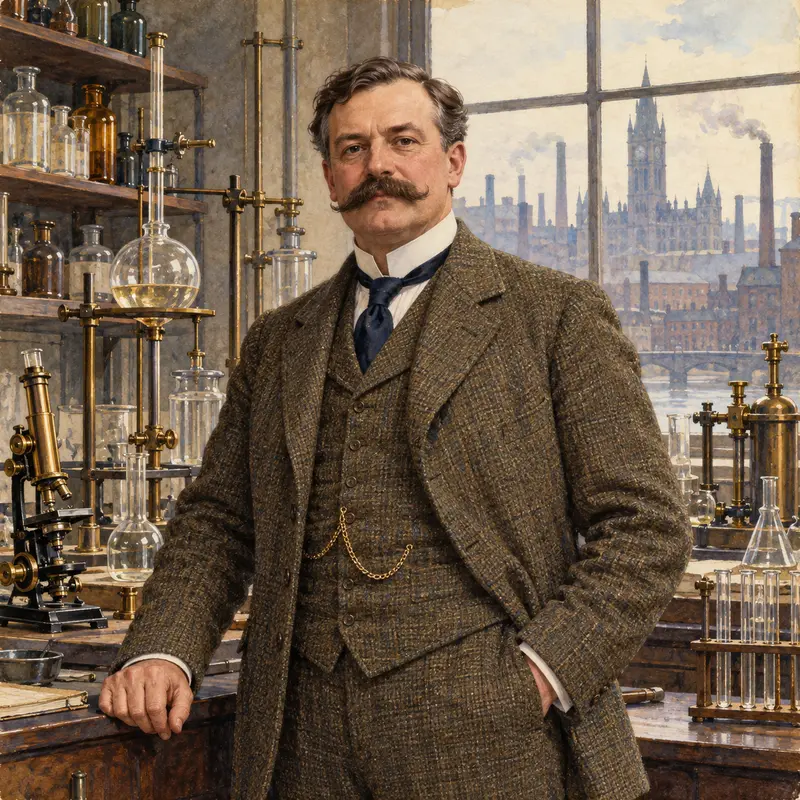
About the chemist
Ernest Rutherford
1871-1937 · New Zealand/United Kingdom · Nobel Chemistry 1908
Atomic nucleus; radioactive decay