Biography · Chemist no. 80 of 350
Ernst Otto Fischer (1918-2007): The Munich Chemist Who Built Molecular Sandwiches
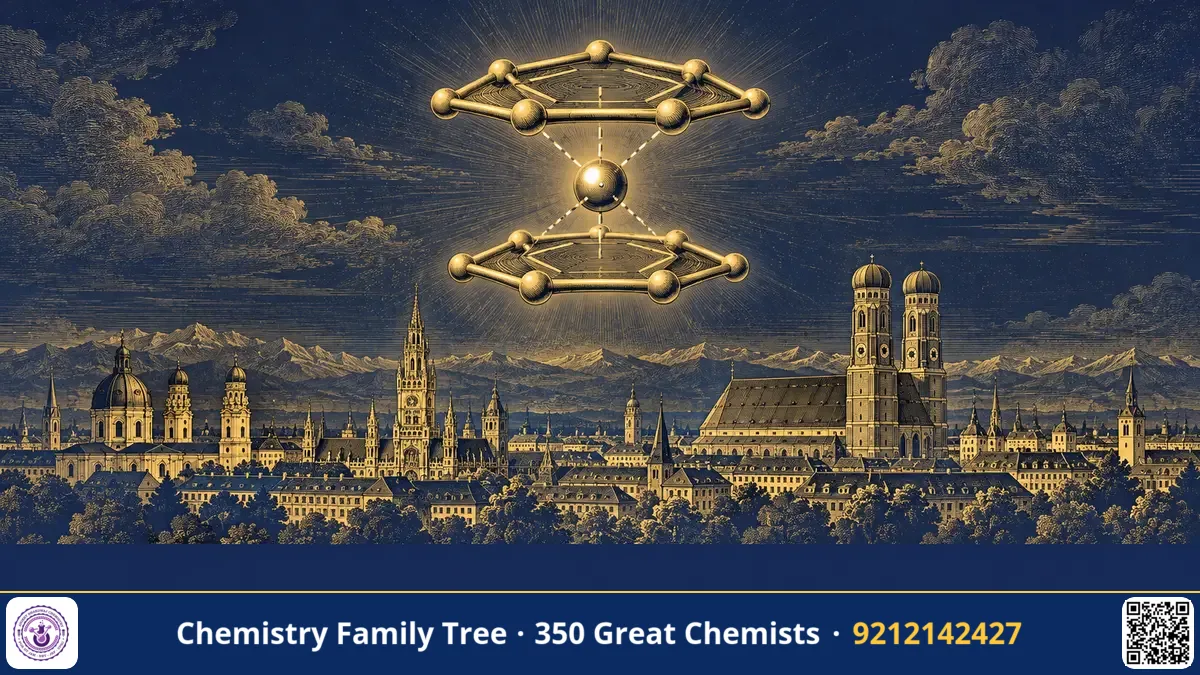
Ernst Otto Fischer was a German inorganic chemist who spent almost his entire working life in Munich. He is remembered for proving that metals can be held between aromatic rings in "sandwich" compounds, and for discovering stable metal-carbene and metal-carbyne complexes. His legacy in one line: he showed that the bond between a metal and carbon can be stable, controllable and useful, opening the way to modern organometallic chemistry. He shared the 1973 Nobel Prize in Chemistry with Geoffrey Wilkinson.
Early Life & Family
Fischer was born on 10 November 1918 in Solln, a suburb of Munich in Bavaria, Germany. He grew up in an academic family. His father, Karl Tillmann Fischer, was a professor of physics at the Technical University of Munich (TU Munich). A home where science was normal conversation helped to give young Ernst early interest in the physical world. His childhood and school years fell in the difficult period between the two World Wars, and his university life was soon shaped by the Second World War.
Education & Mentors
Fischer's studies were interrupted by military service during the war. After the war he returned to the Technical University of Munich, completing his diploma in chemistry around 1949. He then began doctoral work under Walter Hieber, a leading German chemist known for metal carbonyl chemistry. Hieber's laboratory worked with compounds such as Fe(CO)5 and Co2(CO)8, and this background gave Fischer a strong base in handling air-sensitive metal compounds. He received his doctorate in 1952. The same year he began studying cyclopentadienyl metal compounds, just after ferrocene had been reported.
Career Timeline
| Year | Event |
|---|---|
| 1918 | Born in Solln, near Munich (10 November) |
| c. 1949 | Completes diploma studies at TU Munich after the war years |
| 1952 | Doctorate under Walter Hieber; work on ferrocene-type compounds with W. Pfab |
| 1955 | Prepares dibenzenechromium with W. Hafner |
| 1957-1959 | Habilitation and academic posts at the University of Munich |
| 1964 | Becomes professor of inorganic chemistry at TU Munich; reports first stable carbene complex with H. Maasböl |
| 1973 | Reports carbyne complexes; awarded the Nobel Prize in Chemistry |
| 1984 | Retires as a professor but remains scientifically active |
| 2007 | Dies in Munich (23 July) |
Major Scientific Contributions
- Sandwich structure of metallocenes: with Pfab he showed that Fe, Co and Ni form bis(cyclopentadienyl) compounds with the metal between two rings.
- Bis(arene) metal complexes: dibenzenechromium, Cr(C6H6)2, was the first stable sandwich compound with benzene as a ligand.
- Carbene complexes: (CO)5W=C(OMe)Ph, with a tungsten-carbon double bond, proved that metal carbenes could be isolated. These are now called Fischer carbenes.
- Carbyne complexes: compounds with a formal metal-carbon triple bond, M≡C-R.
- Bonding concepts: his experimental results supported the 18-electron rule and the model of sigma donation with pi back-donation.
You can read the experiments and equations in the companion discovery blog on sandwich compounds and Fischer carbenes.
Awards, Honours & Nobel Prize
The Nobel Prize in Chemistry 1973 was shared by Fischer and Geoffrey Wilkinson "for their pioneering work, performed independently, on the chemistry of the organometallic, so called sandwich compounds". Fischer's Nobel lecture was titled "On the Way to Carbene and Carbyne Complexes", which shows that he saw his own work as a path from sandwich compounds to carbenes and carbynes. He received many other honours, including honorary doctorates and membership in scientific academies, and he was a respected figure in German chemistry.
Personality, Struggles & Lesser-Known Facts
- His father was a physics professor at the same university where he later became a chair holder, so Fischer literally followed a family academic path in Munich.
- His education was disturbed by wartime service, so he started serious research later than many scientists. He still won a Nobel Prize 21 years after his doctorate.
- He and Wilkinson reached the sandwich structure independently, in different countries, in the same period. This is a good example of how science can progress in parallel.
- Fischer remained in Munich for most of his career and built a large research school. Many of his students became professors in Germany and abroad.
- His carbene discovery in 1964 came from a clever combination of two simple steps: nucleophilic attack on coordinated CO, followed by alkylation.
Legacy & Influence on Modern Chemistry
Fischer's carbene complexes led chemists to think of metal-carbon double bonds as normal, isolable species. This idea was crucial for the later development of olefin metathesis, in which a metal carbene exchanges alkylidene groups between alkenes. The Nobel Prize in 2005 to Yves Chauvin, Robert Grubbs and Richard Schrock recognised metathesis, and the Chauvin mechanism with metal carbene intermediates owes a great deal to the earlier carbene chemistry. Sandwich compounds also led to metallocene polymerisation catalysts, used to make polyethylene and polypropylene with controlled structures. In teaching, the 18-electron rule and the concept of hapticity remain a standard part of the inorganic chemistry curriculum at B.Sc. and M.Sc. level, including in India.
Lessons for Students
- Do not be afraid to start late. A war interrupted his education, but sustained work brought success.
- Use a strong mentor's skills. Hieber's carbonyl chemistry gave Fischer the experimental tools for the next step.
- Ask simple "what if" questions: what if benzene bonds like Cp? What if a carbonyl carbon can be attacked and alkylated?
- Be patient with air-sensitive chemistry. Careful technique is often the secret of discovery.
Quick Facts Box
- Born: 10 November 1918, Solln (Munich), Germany
- Died: 23 July 2007, Munich
- Nationality: German
- Field: Inorganic and organometallic chemistry
- Famous for: Sandwich compounds, Fischer carbene and carbyne complexes
- Nobel Prize: Chemistry, 1973 (shared with Geoffrey Wilkinson)
FAQ
Was Fischer's father also a scientist?
Yes. His father, Karl Tillmann Fischer, was a professor of physics at the Technical University of Munich.
Who was Fischer's doctoral supervisor?
Walter Hieber, a well-known German specialist in metal carbonyl chemistry.
What is the difference between a carbene and a carbyne complex?
A carbene complex has a formal M=C double bond, while a carbyne complex has a formal M≡C triple bond.
Why does Fischer appear in the olefin metathesis story?
His carbene complexes showed that stable metal-carbon double bonds exist, which supported the metal carbene mechanism of metathesis proposed later by Chauvin.
Published by ABC Chemistry — IIT-JAM | CSIR-NET | GATE Chemistry Coaching. Visit abcchemistry.com
About the chemist
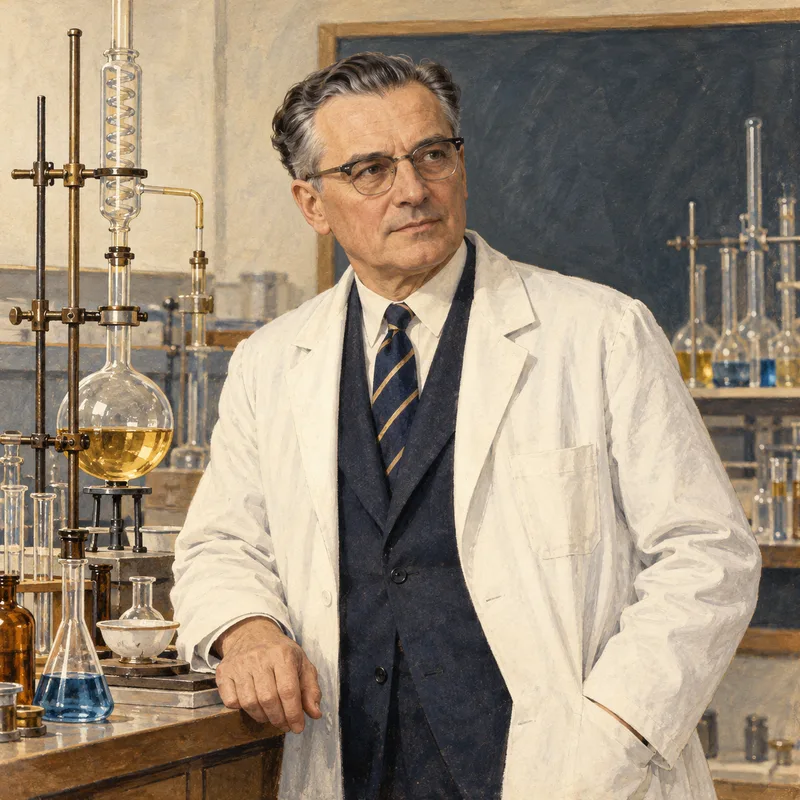
Ernst Otto Fischer
1918-2007 · Germany · Nobel Chemistry 1973
Ferrocene and sandwich compounds