The discovery, explained · Chemist no. 80 of 350
Sandwich Compounds and Fischer Carbenes: Ernst Otto Fischer's Discovery
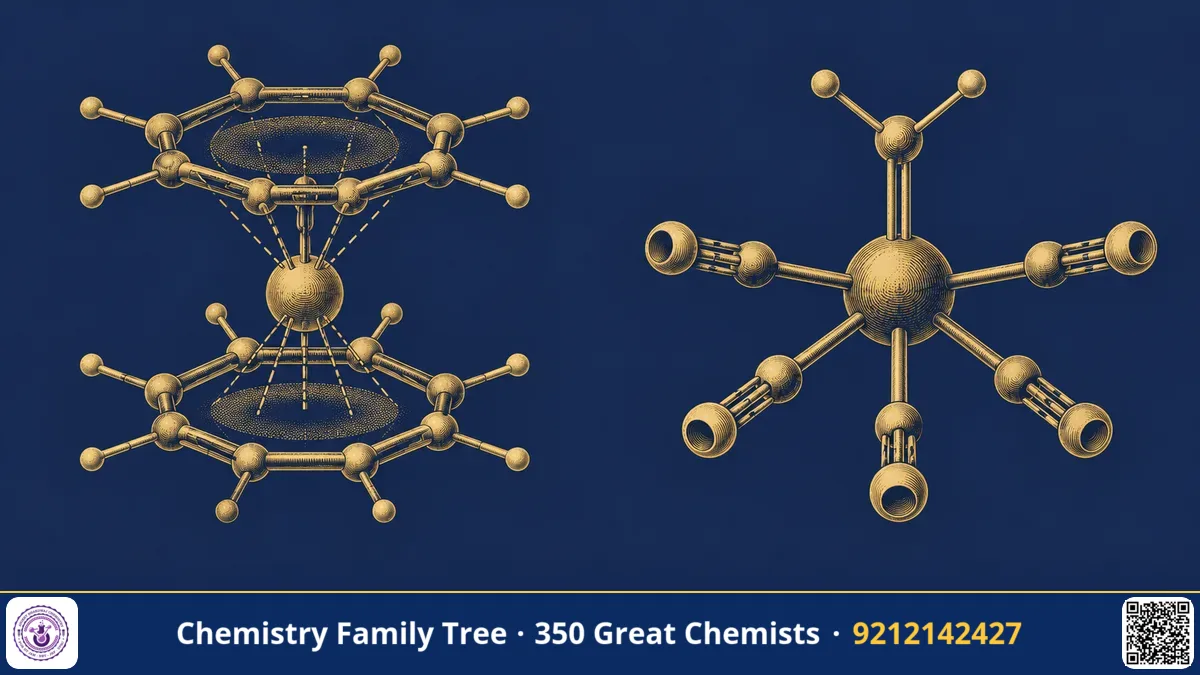
Imagine a metal atom held between two flat rings of carbon atoms, like cheese between two slices of bread. Imagine also a metal atom joined by a double bond to a carbon atom that has only two other substituents. Both structures looked impossible to chemists in the early 1950s. Ernst Otto Fischer of the Technical University of Munich proved that they exist and are stable. His work on sandwich compounds and later on metal carbene complexes created the modern field of organometallic chemistry. He shared the 1973 Nobel Prize in Chemistry with Geoffrey Wilkinson. For students of inorganic chemistry, Fischer's name is attached to the 18-electron rule, to metallocenes and to the famous Fischer-type carbene.
The Scientific Problem Before the Discovery
Until about 1950, organometallic compounds were mostly main-group alkyls and aryls, such as Grignard reagents and organolithiums. They were reactive and unstable in air. Transition-metal alkyls were rare and fragile. In 1951 the iron compound Fe(C5H5)2, now called ferrocene, was prepared unexpectedly and found to be very stable, but its structure was unknown. The first suggestion, with each ring bound to iron by one carbon, did not fit its properties.
At the same time, chemists wanted to know whether transition metals could bond to the entire pi cloud of an aromatic ring, and whether metals could form double bonds to carbon in a stable molecule. These were open questions, and Fischer's answers came through patient, careful synthesis.
The Discovery / Experiment — Step by Step
Step 1: Ferrocene structure (1952)
Fischer and his student Wolfgang Pfab studied cyclopentadienyl complexes of iron, cobalt and nickel. They used X-ray methods and magnetic measurements to show that the metal sits between two parallel Cp rings. Independently, Wilkinson and Woodward reached the same conclusion. Fischer and Pfab also prepared nickelocene, Ni(C5H5)2, and cobaltocene, Co(C5H5)2. These have 20 and 19 valence electrons, which is why they are paramagnetic and why cobaltocene is easily oxidised to the 18-electron cobaltocenium cation.
Step 2: Bis(arene) sandwiches (1955)
Fischer asked whether benzene itself could act as a ligand. With Walter Hafner he reacted chromium(III) chloride with benzene in the presence of aluminium chloride and aluminium powder, then reduced the cation formed:
3 CrCl3 + 2 Al + AlCl3 + 6 C6H6 → 3 [Cr(C6H6)2]+ [AlCl4]-
2 [Cr(C6H6)2]+ + S2O4(2-) + 4 OH- → 2 Cr(C6H6)2 + 2 SO3(2-) + 2 H2O
The product, dibenzenechromium, Cr(η6-C6H6)2, is a dark brown, air-sensitive solid. Each benzene is a six-electron donor, and chromium has six valence electrons, so the total is 6 + 6 + 6 = 18. This again supported the idea that stable organometallic compounds tend to reach the electron count of the next noble gas, now called the 18-electron rule.
Step 3: Metal carbene complexes (1964)
In 1964 Fischer and Maasböl treated tungsten hexacarbonyl with phenyllithium. The carbanion attacks a carbonyl carbon, giving an acyl metalate. Alkylation with methyl cation sources then gives the first stable carbene complex:
W(CO)6 + PhLi → [(CO)5W–C(O)Ph]- Li+
[(CO)5W–C(O)Ph]- + [Me3O]+ → (CO)5W=C(OMe)Ph
The product, (CO)5W=C(OCH3)Ph, is a stable compound with a real tungsten-carbon double bond. Such complexes are now called Fischer carbenes. In 1973 Fischer also reported the first carbyne (M≡C) complexes, with a metal-carbon triple bond.
The Chemistry Behind It
Hapticity and electron counting
The symbol η (eta) with a superscript, such as η5 or η6, tells how many ligand atoms are bonded to the metal. Cp is η5 and benzene is η6 in sandwich compounds. Using the neutral-atom method, Cp counts as 5 electrons and benzene as 6. Add the metal's group number and subtract or add for charge:
- Fe(Cp)2: 8 + 5 + 5 = 18
- Cr(C6H6)2: 6 + 6 + 6 = 18
- Ni(Cp)2: 10 + 5 + 5 = 20 (paramagnetic, two unpaired electrons)
- Co(Cp)2: 9 + 5 + 5 = 19
Bonding in Fischer carbenes
In a Fischer carbene, the carbene carbon carries a heteroatom substituent (such as O or N) and the metal is in a low oxidation state with pi-accepting ligands (CO). The carbene carbon is electrophilic. The M=C bond is described as sigma donation from the carbene lone pair to the metal, plus weak pi back-donation from filled metal d orbitals into the empty p orbital of carbon, which is also stabilised by the lone pair of oxygen. This contrasts with Schrock carbenes (discovered later by Richard Schrock), where the carbene carbon is nucleophilic, bears alkyl or hydrogen groups, and the metal is in a high oxidation state.
| Property | Fischer carbene | Schrock carbene |
|---|---|---|
| Metal | Low oxidation state, late transition metal | High oxidation state, early transition metal |
| Carbene carbon | Electrophilic | Nucleophilic |
| Substituents on carbene C | Pi-donor (OR, NR2) | H or alkyl |
| Other ligands | Pi-acceptors (CO) | Non-acceptors (Cp, alkyl) |
Applications Today
- Organic synthesis: Fischer carbenes take part in Dötz benzannulation, which builds substituted phenols and quinones from aryl carbenes, alkynes and CO.
- Catalysis and polymerisation: metallocene catalysts, related to the sandwich structure, are used for stereoselective polymerisation of propene. These are the basis of Ziegler-Natta-type single-site catalysts.
- Olefin metathesis: the metal carbene idea underlies Grubbs and Schrock catalysts, honoured by the Nobel Prize in 2005.
- Materials and electrochemistry: ferrocene and cobaltocene are used as redox reference systems, and chromium arene complexes are used in vapour deposition and in arene activation chemistry.
Exam Corner — 5 Likely Points
- Dibenzenechromium: Cr(η6-C6H6)2, 18 electrons, diamagnetic.
- Nickelocene has 20 electrons and is paramagnetic with two unpaired electrons; cobaltocene (19 e) is a strong reducing agent.
- Fischer carbene carbon is electrophilic; Schrock carbene carbon is nucleophilic.
- First carbene complex: (CO)5W=C(OMe)Ph, 1964.
- Hapticity (η) counts the number of ligand atoms attached to the metal; Cp in ferrocene is η5.
Common Misconceptions
- "Fischer discovered ferrocene." Ferrocene was first made in 1951 by others; Fischer, like Wilkinson, helped to establish the sandwich structure.
- "All carbenes are unstable." Free carbenes are very reactive, but metal-stabilised carbenes can be isolated and stored.
- "The 18-electron rule is never broken." It is a strong guide, not a law. Square-planar d8 complexes have 16 electrons and are stable, and nickelocene has 20.
Quick Revision Box
- Sandwich compounds: metal between two pi-bonded rings (metallocenes, bis(arene) complexes).
- 1955: Fischer and Hafner prepared dibenzenechromium.
- 1964: First stable carbene complex (CO)5W=C(OMe)Ph.
- 1973: First carbyne complexes reported.
- Fischer carbene: low-valent metal, CO ligands, electrophilic carbon.
- Nobel Prize in Chemistry 1973 shared with Geoffrey Wilkinson.
FAQ
What does the letter eta mean in Cr(η6-C6H6)2?
It is the hapticity. It says that all six carbon atoms of each benzene ring are bonded to chromium.
Why is dibenzenechromium air-sensitive but ferrocene is not?
Both have 18 electrons, but the chromium compound has a much easier oxidation to the cation, because chromium is in a low oxidation state with a high-energy filled orbital. Ferrocene is oxidised only with stronger oxidants.
What is a Fischer carbene used for?
It is a useful reagent in organic synthesis, for example in the Dötz benzannulation, and it helped to explain the carbene mechanism of olefin metathesis.
How is Fischer's work different from Wilkinson's?
Fischer concentrated on the synthesis and bonding of sandwich and carbene compounds, while Wilkinson emphasised structure of ferrocene and applied homogeneous catalysis.
Published by ABC Chemistry — IIT-JAM | CSIR-NET | GATE Chemistry Coaching. Visit abcchemistry.com
About the chemist
Ernst Otto Fischer
1918-2007 · Germany · Nobel Chemistry 1973
Ferrocene and sandwich compounds