Biography · Chemist no. 313 of 350
Erwin Chargaff (1905–2002): The Scientist, Writer and Critic Who Found the Pairing Rules of DNA
Erwin Chargaff was an Austrian-born American biochemist whose analysis of DNA led to the rules that carry his name. He was also an elegant writer and a sharp critic of modern science. His life took him from the multilingual city of Czernowitz through Vienna, Berlin and Paris to New York, where he worked for decades at Columbia University. His legacy in one line: he showed that DNA is species-specific and that its bases come in matched pairs, giving Watson and Crick the clue they needed.
Early Life and Family
Chargaff was born on 11 August 1905 in Czernowitz, then part of the Austro-Hungarian Empire and now Chernivtsi in Ukraine. It was a city of many languages and cultures, where German, Romanian, Ukrainian and Yiddish were spoken. His family was Jewish and cultured, and he grew up reading widely in literature, a habit that later shaped his writing. The family moved to Vienna, where he completed his schooling at a time when the city was a centre of music, medicine and literature.
Education and Mentors
Chargaff studied chemistry at the University of Vienna and earned his doctorate in 1928. After a period in the United States at Yale as a research fellow (1928–1930), he went to Berlin, where he worked at the University of Berlin in the bacteriological laboratory of the Institute of Hygiene. In 1933, when the Nazi regime came to power, he was dismissed because he was Jewish. He moved to Paris to work at the Pasteur Institute and then emigrated to the United States in 1935, where he joined Columbia University's College of Physicians and Surgeons.
Career Timeline
| Year | Event |
|---|---|
| 1905 | Born in Czernowitz, Austria-Hungary |
| 1928 | Doctorate in chemistry, University of Vienna |
| 1928–1930 | Research fellow at Yale University |
| 1930–1933 | Works in Berlin until forced out by the Nazi laws |
| 1933–1934 | Works in Paris at the Pasteur Institute |
| 1935 | Joins Columbia University, New York |
| 1944 | Reads Avery, MacLeod and McCarty's paper and turns to DNA |
| 1949–1950 | Publishes papers showing base composition differs between species and that A = T and G = C |
| 1952 | Meets Watson and Crick in Cambridge |
| 1970s | Retires as professor emeritus and becomes a prominent essayist and critic |
| 2002 | Dies in New York City on 20 June |
Major Scientific Contributions
1. Chargaff's rules. Using paper chromatography and UV spectrophotometry, he found that DNA composition differs from species to species and that, within a species, adenine equals thymine and guanine equals cytosine. These findings overturned the tetranucleotide hypothesis of Levene and indicated that DNA could carry genetic information. For the full details and calculations, see the companion discovery article.
2. Blood clotting and lipids. Before the nucleic acid work, Chargaff did research on the biochemistry of blood coagulation, including the role of thromboplastin and lipids. He also studied the chemistry of lipids and lipoproteins. This earlier work shows that his career was wider than DNA.
3. Early use of chromatography in nucleic acid analysis. He was among the first to apply the new technique of paper chromatography to quantify the bases in DNA hydrolysates, setting a model for quantitative analysis in molecular biology.
Awards, Honours and Nobel Prize
Chargaff did not win a Nobel Prize. The 1962 Nobel Prize in Physiology or Medicine was shared by Watson, Crick and Maurice Wilkins, and Chargaff's contribution was not recognised by the prize. He was a man who spoke bluntly about this and about the way the story of DNA was told. He did receive other honours, including the National Medal of Science in the United States (1974) and foreign memberships of scientific academies, and later literary recognition for his essays. Further details are omitted as they cannot be verified here.
Personality, Struggles and Lesser-Known Facts
- The meeting with Watson and Crick. In 1952, Chargaff met the two young researchers at Cambridge. According to accounts of the meeting, he was unimpressed by what he saw as their lack of chemical knowledge, and he later described them as unprepared. Yet his rules proved to be the key that completed their model.
- Dismissed for being Jewish. His career in Berlin ended when the Nazi government forced Jewish scholars out of their posts. He lost the chance to work in Germany, and he emigrated.
- A writer's voice. He wrote essays and an autobiography, "Heraclitean Fire: Sketches from a Life before Nature" (1978), showing his deep knowledge of literature and his sceptical views on the direction of biology.
- Critic of genetic engineering. In the 1970s, he warned about the risks and ethics of recombinant DNA technology, comparing the new powers with irreversible changes to nature. Many scientists disagreed, but his voice was part of the debate that led to safety guidelines.
- A long life. He lived to the age of 96 and continued to write into his nineties.
Legacy and Influence on Modern Chemistry
Chargaff's rules are in every biology and biochemistry course, and they remain a basis for GC content analysis, PCR design and genome studies. The finding that DNA composition is species-specific showed that DNA can carry the information of heredity. Beyond the science, his life is a case study in the history of science: how data may be crucial but also under-credited, how emigration changed careers during the Nazi period, and how a scientist may be both a pioneer and a critic. For Indian students, the rules appear in NCERT Class 12 Molecular Basis of Inheritance, and in JAM, NET and GATE biochemistry questions.
Lessons for Students
- Measure carefully. Chargaff's accuracy, not a grand theory, made his discovery.
- Follow evidence from other fields. He read Avery's paper and changed his research direction.
- Collaborate and communicate. A clue is useful only if it is connected with other clues; his data and the X-ray work came together in 1953.
- Think about ethics. Chargaff reminds us that science has human consequences.
Quick Facts Box
- Born: 11 August 1905, Czernowitz, Austria-Hungary (now Chernivtsi, Ukraine)
- Died: 20 June 2002, New York City, USA
- Nationality: Austrian-born American
- Field: Biochemistry, nucleic acids
- Famous for: Chargaff's rules (A = T, G = C; species-specific DNA composition)
- Nobel: None
FAQ
Where did Chargaff work?
For most of his career he was at Columbia University in New York.
Did Chargaff and Watson and Crick work together?
Not formally. They met in 1952, and Watson and Crick used Chargaff's published data on base ratios to build their model.
Why did he leave Germany?
Because the Nazi government dismissed Jewish academics from their jobs in 1933.
Was Chargaff a chemist or a biologist?
He was trained as a chemist and became a biochemist; his work belongs to both fields.
Published by ABC Chemistry — IIT-JAM | CSIR-NET | GATE Chemistry Coaching. Visit abcchemistry.com
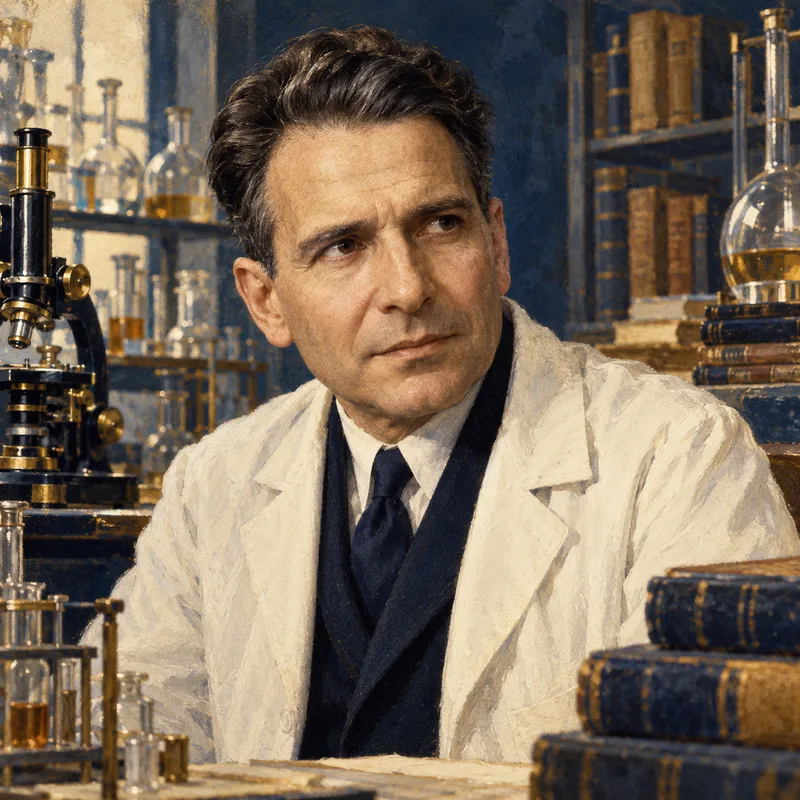
About the chemist
Erwin Chargaff
1905-2002 · United States
Chargaff's rules for DNA base pairing