The discovery, explained · Chemist no. 313 of 350
Erwin Chargaff and the Rules of DNA Base Composition
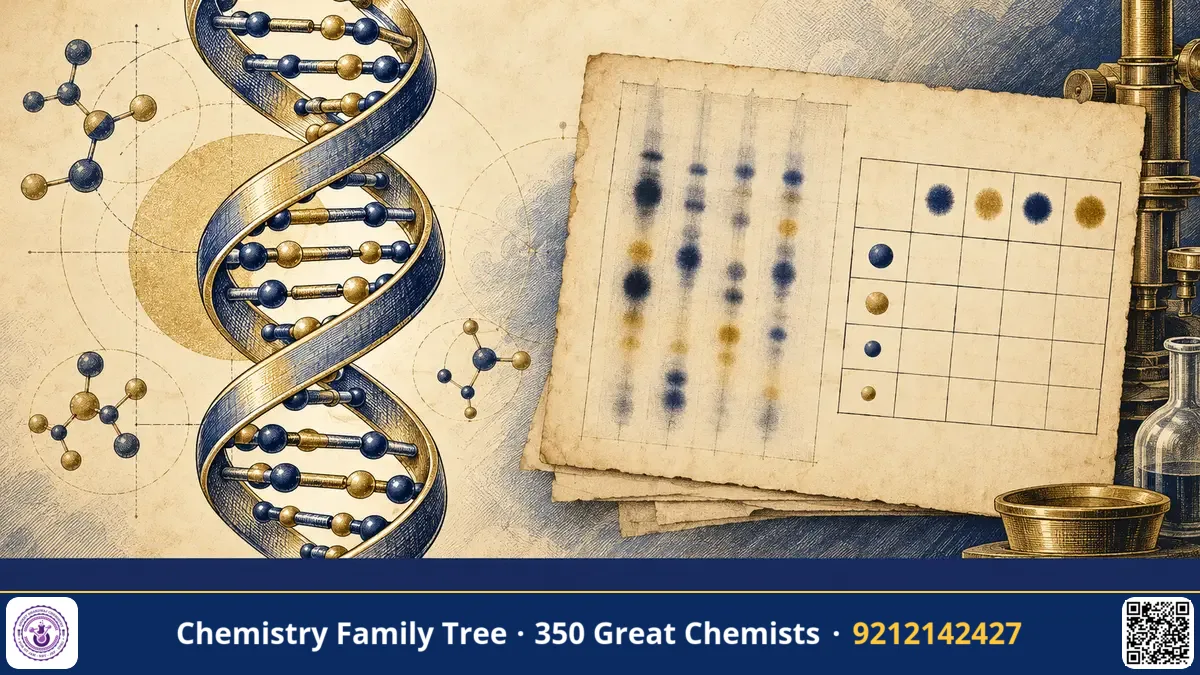
In every DNA double helix, the amount of adenine equals the amount of thymine, and the amount of guanine equals the amount of cytosine. This simple pattern, known as Chargaff's rules, was found by the Austrian-American biochemist Erwin Chargaff in the late 1940s. It was a vital clue for James Watson and Francis Crick when they built their model of the DNA double helix in 1953. Chargaff also showed that the base composition of DNA differs from one species to another, which destroyed the idea that DNA is a boring, repetitive molecule. This article explains how he did the experiments, what the rules mean, and how to use them in numerical problems for JAM, NET and GATE.
The Scientific Problem Before the Discovery
In the early 1940s, most scientists believed that proteins carried genes, because proteins have 20 different amino acids and seemed capable of encoding complex information. DNA was thought to be a monotonous polymer. This view was supported by the tetranucleotide hypothesis of Phoebus Levene, which suggested that DNA consisted of repeating units of the four bases in equal amounts, a structure too simple to carry the information of heredity.
In 1944, Oswald Avery, Colin MacLeod and Maclyn McCarty showed that DNA, not protein, is the "transforming principle" that can change harmless pneumococcus bacteria into a virulent type. Chargaff read this paper and was deeply impressed. He decided to work out the chemical composition of DNA from different sources with the best possible accuracy, to see whether DNA could be specific for each species, as it should be if it carries genes.
The Discovery: Step by Step
- Isolate DNA from various sources. Chargaff and his co-workers at Columbia University prepared DNA from many organisms, such as calf thymus, ox spleen, yeast, the bacterium Mycobacterium tuberculosis, sea urchin and human sperm.
- Hydrolyse DNA to free bases. The DNA was treated with acid (for example, formic acid) to release the purines and pyrimidines.
- Separate by paper chromatography. Using the newly developed paper chromatography of Martin and Synge (1944), the bases were spotted on filter paper and developed in a solvent mixture. Each base travels a different distance, giving separate spots.
- Quantify by UV absorption. Each spot was cut out and eluted, and the amount of each base was measured by its characteristic ultraviolet absorbance near 260 nm.
- Calculate molar ratios. The proportions were expressed as mole percentages and compared.
The results
| Source | A % | T % | G % | C % |
|---|---|---|---|---|
| Human | about 30 | about 30 | about 20 | about 20 |
| Calf thymus | about 28 | about 28 | about 22 | about 22 |
| Yeast | about 31 | about 33 | about 19 | about 17 |
| E. coli | about 25 | about 25 | about 25 | about 25 |
(The values are approximate and vary slightly between reports.) Two key findings emerged:
- First rule: The total number of purines equals the total number of pyrimidines:
A + G = T + C. More specifically,A = TandG = Cwithin experimental error. - Second rule: The ratio
(A + T)/(G + C)is different for different species, but is the same in different tissues of the same species. It does not change with the age, nutrition or environment of the organism.
The second finding showed that DNA has species-specific composition, so it could encode genetic differences. The first finding was a puzzle at the time: why should the amounts be paired? Chargaff noted the pattern but did not explain it. In 1952, Chargaff met Watson and Crick in Cambridge, and the conversation reminded them of the importance of base pairing. In 1953, they used the rules to propose that A pairs with T and G pairs with C in the double helix.
The Chemistry Behind It
The explanation of the rules is complementary base pairing in the double helix:
A = T      (two hydrogen bonds)
G ≡ C      (three hydrogen bonds)
Purine (two rings) always pairs with pyrimidine (one ring)
Since every A in one strand pairs with a T in the other, the total A equals the total T in double-stranded DNA, and likewise G equals C. The pair widths are almost identical, which gives a uniform 2 nm diameter to the helix. The rules apply only to double-stranded DNA. Single-stranded DNA (such as in the virus φX174) and RNA generally do not obey them, which gave early evidence that these are single-stranded.
A related rule, sometimes called Chargaff's second parity rule, states that A ≈ T and G ≈ C even within a single strand of a long DNA sequence. It is an observed statistical property of most genomes.
Some useful calculations:
If A = 30 %, then T = 30 %, so G + C = 40 %, therefore G = C = 20 %.
GC content = (G + C) / total × 100 %.
Melting temperature rises with GC content (G≡C has three H-bonds).
Approximate rule: Tm = 69.3 + 0.41 × (%GC)   (°C, in standard salt)
Applications Today
- PCR primer design: GC content (usually 40–60%) determines the melting temperature and annealing conditions.
- Genomics and taxonomy: GC content is used to characterise bacterial species, and codon usage is linked to it.
- DNA sequencing and bioinformatics: Parity rules are used to check data quality and to detect strand bias.
- Forensics and DNA fingerprinting: Species- and individual-specific sequence variation, a descendant of Chargaff's idea of DNA specificity, is used in forensic labs in India and elsewhere.
- Genetic engineering and diagnostics: Hybridisation methods like Southern blotting and microarrays depend on base complementarity.
Exam Corner: 5 Likely Points
- In ds-DNA: A = T, G = C, A + G = T + C (purines = pyrimidines); the ratio (A + T)/(G + C) varies between species.
- If a ds-DNA has 22% guanine, then C = 22%, A = T = 28%.
- A–T has 2 H-bonds, G–C has 3; high GC raises Tm.
- Chargaff's rules do not hold for single-stranded DNA or for RNA.
- Chargaff used paper chromatography and UV spectrophotometry; he disproved Levene's tetranucleotide hypothesis.
Common Misconceptions
- "A + T always equals G + C." No. Only A = T and G = C. The ratio of AT to GC differs among species.
- "Chargaff discovered the structure of DNA." He supplied a key clue. The structure was proposed by Watson and Crick using X-ray diffraction data from Franklin, Wilkins and colleagues.
- "The rules apply to all nucleic acids." They apply to double-stranded DNA, not to RNA or single-stranded DNA.
Quick Revision Box
- Chargaff's rules (late 1940s): A = T, G = C, purines = pyrimidines in ds-DNA.
- (A + T)/(G + C) is species-specific, same in all tissues of an organism.
- Method: acid hydrolysis, paper chromatography, UV absorption near 260 nm.
- Explained by base pairing: A=T (2 H-bonds), G≡C (3 H-bonds).
- Disproved the tetranucleotide hypothesis; supported Avery's result.
- Do not apply to RNA or single-stranded DNA.
FAQ
Why is the ratio (A+T)/(G+C) important?
It is a signature of a species. Organisms differ in their AT-to-GC ratio, and this is called the base composition or GC content.
How can you test whether DNA is double-stranded using Chargaff's rule?
If the percentages of A and T are equal and those of G and C are equal, then it is likely to be double-stranded. If they are unequal, it is probably single-stranded.
Did Chargaff get a Nobel Prize?
No. He felt strongly that he should have shared in the recognition, but no Nobel Prize was awarded to him.
What is the difference between the two Chargaff rules?
The first rule says A = T and G = C in ds-DNA. The second parity rule says that the same approximate equality holds in a single strand of long DNA.
Published by ABC Chemistry — IIT-JAM | CSIR-NET | GATE Chemistry Coaching. Visit abcchemistry.com
About the chemist
Erwin Chargaff
1905-2002 · United States
Chargaff's rules for DNA base pairing