Biography · Chemist no. 32 of 350
Erwin Schrödinger: The Wave Mechanics Pioneer
Introduction
Erwin Rudolf Josef Alexander Schrödinger (1887-1961) was an Austrian physicist who gave the world the wave equation of quantum mechanics. His 1926 equation describes electrons as waves, and from it came the idea of atomic orbitals, the foundation of modern chemistry. He shared the 1933 Nobel Prize in Physics with Paul Dirac. He was also a philosopher-scientist whose book What Is Life? inspired a generation of biologists. His legacy in one line: he replaced the electron's orbit with a wave function, and in doing so gave chemistry its mathematical language.
Early Life and Family
Schrödinger was born on 12 August 1887 in Vienna, then the capital of the Austro-Hungarian Empire. He was the only child of Rudolf Schrödinger, who ran a family oilcloth business and was keenly interested in botany, and Georgine Emilia Brenda, the daughter of a chemistry professor at the Vienna Technical University. He grew up in an educated, multilingual home. He learned English early, because his mother's family had English connections, and this helped him later when he worked in Britain and Ireland. His father encouraged his interests in science and culture, and Erwin remained a lifelong lover of poetry, philosophy and Eastern thought, including Indian philosophy such as the Vedanta.
Education and Mentors
Schrödinger attended the Akademisches Gymnasium in Vienna, where he was a top student in nearly every subject, including Greek, Latin, mathematics and physics. He entered the University of Vienna in 1906 and studied physics under Friedrich Hasenöhrl, who inspired him with the idea that physics could explain the world through mathematics. He received his doctorate in 1910. He also worked as an assistant in experimental physics at Vienna with Franz Exner. His studies were interrupted by the First World War, when he served as an artillery officer on the Italian front. During this time he continued to read and think about theory.
Career Timeline
| Year | Event |
|---|---|
| 1887 | Born in Vienna (12 August) |
| 1910 | Doctorate from the University of Vienna |
| 1914-18 | Serves in the Austrian army during the First World War |
| 1920 | Marries Annemarie Bertel; works in Jena and Stuttgart, then Breslau |
| 1921 | Becomes professor of theoretical physics at Zurich |
| 1926 | Publishes the wave equation and wave mechanics |
| 1927 | Succeeds Max Planck at the University of Berlin |
| 1933 | Leaves Germany after the Nazis come to power; Nobel Prize in Physics; moves to Oxford |
| 1936 | Takes a post at the University of Graz, Austria |
| 1938 | Flees after the annexation of Austria |
| 1939 | Settles in Dublin, Ireland, at the Institute for Advanced Studies (founded 1940) |
| 1944 | Publishes What Is Life? |
| 1956 | Returns to Vienna |
| 1961 | Dies in Vienna (4 January) |
Major Scientific Contributions
- Wave mechanics and the Schrödinger equation (1926): the foundation of quantum chemistry. It gives energy levels, orbitals and quantum numbers.
- Equivalence with matrix mechanics: he showed that his approach and Heisenberg's were mathematically the same theory.
- Quantum perturbation theory: methods for calculating the effect of small disturbances, later used in spectroscopy and chemistry.
- Schrödinger's cat (1935): a thought experiment to highlight the strangeness of applying quantum rules to everyday objects.
- What Is Life? (1944): he suggested that the genetic material is an "aperiodic crystal" carrying a code in its structure. The book influenced scientists such as James Watson and Francis Crick.
See our companion post "The Schrödinger Equation: From Orbits to Orbitals" for the equation and the chemistry.
Awards, Honours and Nobel Prize
- Nobel Prize in Physics, 1933 (shared with Paul Dirac): for the discovery of new productive forms of atomic theory.
- Max Planck Medal, 1937.
- Foreign member of the Royal Society of London (1949) and member of several European academies.
- Austria honoured him with a prize named for him and issued his portrait on a banknote and stamps.
Personality, Struggles and Lesser-Known Facts
- Anti-Nazi stand. In 1933, although he was not Jewish, Schrödinger left his prestigious post in Berlin because he disliked the Nazi policies. He later said little in public but made his position clear by leaving.
- A restless life of exile. He moved between Oxford, Graz, Rome, Ghent and finally Dublin. His brief return to Austria in 1936 and a hurried escape after 1938 made his life uncertain for years.
- An unconventional household. Schrödinger had an unusual private life, and he lived openly with both his wife and, for a time, another woman. This caused difficulties with employers at Oxford and elsewhere.
- Interest in Indian philosophy. He read the Upanishads and Vedanta and often wrote about the unity of consciousness in his philosophical essays.
- The ideas behind the cat. The cat in the box was never meant as a real experiment. It was a criticism of an interpretation of quantum theory, a point he made together with Einstein's doubts.
Legacy and Influence on Modern Chemistry
Almost every theoretical chemistry tool, from the shapes of orbitals to molecular orbital theory, valence bond theory, density functional theory and computational drug design, begins with the Schrödinger equation. In 1929 Dirac wrote that the underlying laws needed for the whole of chemistry were thus completely known, and that the only difficulty was that solving the equations is too complicated. The growth of computers has made it possible to solve them numerically for ever larger molecules. Schrödinger's ideas about life and information also helped to inspire molecular biology.
Lessons for Students
- Read widely. Schrödinger's knowledge of philosophy, languages and mathematics fed his physics.
- Learn from older ideas. He built on de Broglie's thesis and on classical wave theory.
- Be willing to hold firm. He left a top post rather than accept injustice.
- Cross disciplines. A physicist wrote one of the books that inspired the discovery of DNA's structure.
- Admit puzzles. The cat paradox shows how asking hard questions advances science.
Quick Facts Box
- Born: 12 August 1887, Vienna, Austria
- Died: 4 January 1961, Vienna, Austria
- Nationality: Austrian
- Field: Theoretical physics, quantum mechanics
- Famous for: Schrödinger wave equation, Schrödinger's cat, What Is Life?
- Nobel Prize: Physics, 1933 (shared with Paul Dirac)
FAQ
Why is Schrödinger important in chemistry?
His equation gives the energies and shapes of atomic and molecular orbitals, which explain bonding, spectra and periodic trends.
Did Schrödinger really have a cat?
The cat is only a thought experiment. It was published in 1935 to criticise how quantum superposition is interpreted for large objects.
Where did Schrödinger spend the war years?
He lived in Dublin, Ireland, where he worked at the Dublin Institute for Advanced Studies until 1956.
Which book by Schrödinger influenced biology?
What Is Life?, published in 1944, based on lectures he gave in Dublin.
Published by ABC Chemistry — IIT-JAM | CSIR-NET | GATE Chemistry Coaching. Visit abcchemistry.com
About the chemist
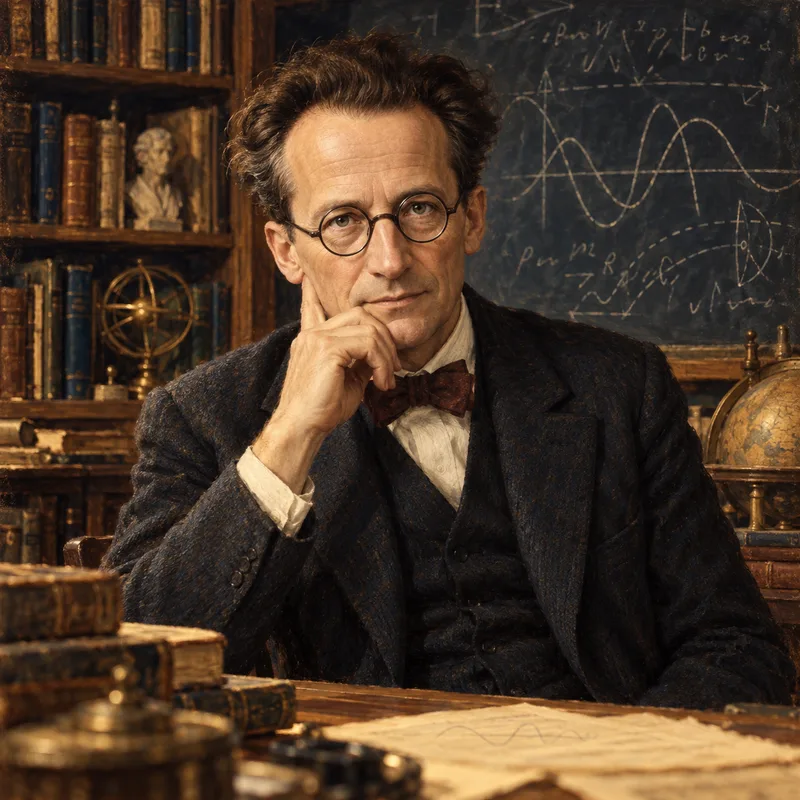
Erwin Schrödinger
1887-1961 · Austria · Nobel Physics 1933
Schrödinger wave equation