The discovery, explained · Chemist no. 32 of 350
The Schrödinger Equation: From Orbits to Orbitals
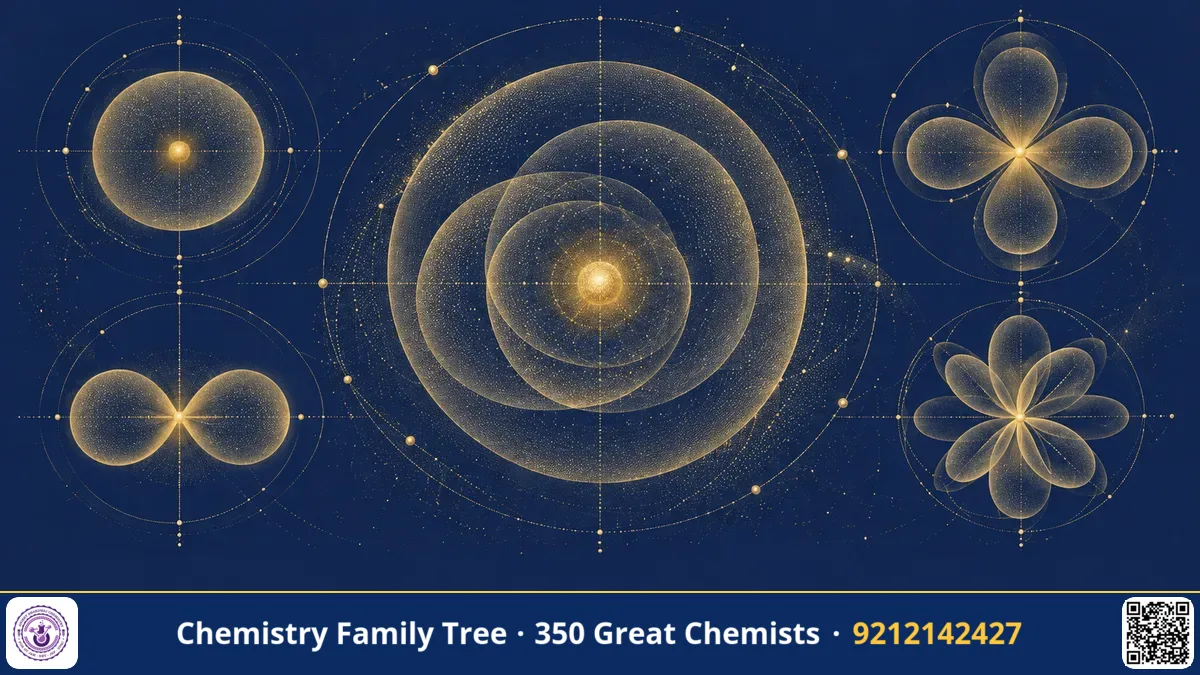
In the winter of 1925-26 the Austrian physicist Erwin Schrödinger wrote down an equation that treats the electron as a wave. Solved for the hydrogen atom, it gave the energy levels that Bohr had guessed, but now they appeared naturally, without any extra postulates. It also gave the shapes of s, p and d orbitals, and the quantum numbers n, l and m that every chemistry student must learn. The Schrödinger equation is the central equation of quantum chemistry. Schrödinger shared the 1933 Nobel Prize in Physics with Paul Dirac for the discovery of new productive forms of atomic theory. This post explains the problem he solved, the main ideas of the equation, and the exam points you need.
The Scientific Problem Before the Discovery
The Bohr model of 1913 explained the hydrogen spectrum but had serious weaknesses. It worked only for one-electron systems. It treated the electron as a particle moving in a definite circular orbit, and its rule of quantised angular momentum was simply assumed. It could not explain the intensities of spectral lines, the splitting of lines in magnetic fields, or the chemistry of atoms with many electrons.
In 1924 Louis de Broglie suggested that matter has wave properties, with wavelength λ = h/mv. Electron diffraction was later demonstrated by Davisson and Germer in 1927. Werner Heisenberg developed matrix mechanics in 1925, a mathematically abstract quantum theory. Physicists needed a theory based on waves, in familiar mathematics, that would give the allowed energies of atoms. If the electron is a wave, what is the equation of this wave?
The Discovery: Step by Step
Schrödinger was professor at the University of Zurich. He read de Broglie's thesis and, after a suggestion from Peter Debye that a wave needs a wave equation, he worked on the problem during a holiday in the Swiss mountains at the end of 1925. In a series of papers in 1926, published in Annalen der Physik under the title "Quantisation as an Eigenvalue Problem", he developed wave mechanics.
- Treat the electron as a standing wave. Like a vibrating guitar string fixed at both ends, a confined wave can have only certain wavelengths. This naturally produces whole numbers, the quantum numbers.
- Write the wave equation. He started from the classical wave equation and put in de Broglie's relation between wavelength and momentum.
- Apply it to hydrogen. For the electron in the Coulomb field of the proton, he solved the equation and found that acceptable solutions exist only for certain energies.
- Compare with experiment. The allowed energies were exactly En = -13.6/n² eV, as in the Bohr model, and further solutions gave the shapes of the orbitals.
- Show the equivalence with Heisenberg's theory. In 1926 Schrödinger showed that his wave mechanics and Heisenberg's matrix mechanics were mathematically equivalent.
The equation
The time-independent Schrödinger equation is
Ĥψ = Eψ
For one particle in one dimension, written in full:
-(ħ²/2m) d²ψ/dx² + V(x) ψ = E ψ
Here ψ is the wave function, Ĥ is the Hamiltonian operator (kinetic plus potential energy), E is the energy, V is the potential energy, m is the mass and ħ = h/2π. The time-dependent form is
iħ ∂Ψ/∂t = ĤΨ
In 1926 Max Born proposed the interpretation of the wave function: ψ itself has no direct physical meaning, but |ψ|² gives the probability density of finding the electron at a point.
The Chemistry Behind It
Boundary conditions and quantisation
Mathematically, the equation has solutions for any energy, but only some are physically acceptable. The wave function must be finite, single-valued, continuous and square-integrable (normalisable). These conditions produce quantised energies. This is the central idea: quantisation arises from boundary conditions, not from extra assumptions.
The particle in a box
The simplest example is a particle confined to a one-dimensional box of length L. The solutions are
ψₙ = √(2/L) sin(nπx/L) Eₙ = n²h² / 8mL² (n = 1, 2, 3, ...)
The lowest energy is not zero (zero-point energy), and energy levels are spaced further apart as n increases. This model is used to understand conjugated polyenes and colour.
The hydrogen atom and quantum numbers
Solving the equation in spherical coordinates gives wave functions ψ(n, l, m) called atomic orbitals. They are described by three quantum numbers:
- Principal quantum number n (1, 2, 3, ...): size and energy of the orbital.
- Azimuthal quantum number l (0 to n - 1): shape of the orbital (s, p, d, f for l = 0, 1, 2, 3).
- Magnetic quantum number m (-l to +l): orientation of the orbital in space.
The fourth quantum number, the electron spin (±½), was added by Uhlenbeck and Goudsmit and incorporated in Dirac's relativistic theory; it does not come from the non-relativistic Schrödinger equation.
Nodes
The total number of nodes in an orbital is n - 1. Radial nodes number n - l - 1, and angular nodes number l. For example, 3s has two radial nodes and 2p has one angular node.
Energy of hydrogen-like atoms
For one-electron species, the energy depends only on n: En = -13.6 Z²/n² eV. So 2s and 2p have the same energy in hydrogen (they are degenerate). In multi-electron atoms, electron-electron repulsion removes this degeneracy, and the energy depends on both n and l.
Why orbitals, not orbits
The orbital is a region of space where the probability of finding the electron is high, in line with Heisenberg's uncertainty principle, Δx · Δp ≥ ħ/2. The 1s orbital is spherical, and its radial probability peaks at 0.529 Å, the Bohr radius.
Applications Today
- Computational chemistry: Methods like Hartree-Fock and density functional theory approximate solutions of the Schrödinger equation to calculate molecular structure, spectra and reaction energies.
- Drug design: Quantum-chemical calculations help to predict how a drug molecule binds to a target.
- Materials and electronics: The band structure of semiconductors, solar-cell materials and quantum dots comes from solving the equation in periodic potentials and confined spaces.
- Spectroscopy: Transition energies and selection rules in UV-visible, IR and NMR spectroscopy are derived from quantum mechanics.
- Tunnelling devices: Scanning tunnelling microscopes and flash memory work because wave functions penetrate barriers.
- India context: Computational chemistry groups in IITs and IISc use quantum-chemical packages to design catalysts and materials.
Exam Corner
- Time-independent equation: Ĥψ = Eψ. ψ is the wave function; |ψ|² is the probability density; ∫|ψ|²dτ = 1 for a normalised function.
- Particle in a 1D box: En = n²h²/8mL². Zero-point energy is h²/8mL².
- Number of radial nodes = n - l - 1; angular nodes = l; total nodes = n - 1.
- Allowed values: l = 0 to n - 1; m = -l to +l; number of orbitals in a subshell = 2l + 1; in a shell = n².
- Schrödinger shared the 1933 Nobel Prize in Physics with Dirac.
Common Misconceptions
- "ψ is the probability." The probability density is |ψ|², not ψ. The wave function itself can be negative or complex.
- "The orbital is the path of the electron." It is a probability distribution.
- "Spin comes from the Schrödinger equation." It appears only in the relativistic Dirac equation, or is added by hand.
Quick Revision Box
- 1926: Schrödinger publishes wave mechanics in Annalen der Physik.
- Equation: Ĥψ = Eψ.
- Quantisation arises from boundary conditions.
- Born: |ψ|² = probability density.
- Quantum numbers n, l, m come from solving the hydrogen atom.
- Nobel Prize in Physics 1933, shared with Dirac.
FAQ
Is the Schrödinger equation derived or postulated?
It is a fundamental postulate of quantum mechanics, motivated by de Broglie's wave idea and supported by experiments.
Can the equation be solved exactly for helium?
No. Exact solutions exist for one-electron systems only. Multi-electron atoms need approximations such as the variation method and perturbation theory.
What is the Hamiltonian operator?
It is the operator for total energy: kinetic energy plus potential energy.
Did Schrödinger win a Nobel Prize in Chemistry?
No. He shared the Nobel Prize in Physics in 1933 with Paul Dirac.
Published by ABC Chemistry — IIT-JAM | CSIR-NET | GATE Chemistry Coaching. Visit abcchemistry.com
About the chemist
Erwin Schrödinger
1887-1961 · Austria · Nobel Physics 1933
Schrödinger wave equation