Biography · Chemist no. 88 of 350
F. Sherwood Rowland (1927-2012): The Chemist Who Gave an Early Warning for the Ozone Layer
Frank Sherwood Rowland, known as "Sherry" to friends and colleagues, was an American physical chemist who led the research that showed that man-made chlorofluorocarbons (CFCs) threaten the stratospheric ozone layer. His legacy in one line: he showed that a scientist who measures carefully and speaks clearly can change the policies of the whole world. He shared the 1995 Nobel Prize in Chemistry with his postdoctoral researcher Mario Molina and with Paul Crutzen.
Early Life & Family
Rowland was born on 28 June 1927 in Delaware, Ohio, in the United States. Rowland was a very bright student, skipped some school grades and entered Ohio Wesleyan University, in his home town, at a young age. His school years took place during the Great Depression, and as a teenager he lived through the Second World War.
Education & Mentors
Rowland earned his bachelor's degree at Ohio Wesleyan University (1948). He then went to the University of Chicago, where he did his doctoral research under Willard F. Libby, the inventor of radiocarbon dating and winner of the 1960 Nobel Prize in Chemistry. In Libby's group he learned radiochemistry, the use of radioactive isotopes as tracers, and the habit of measuring very small quantities with high accuracy. He obtained his PhD in 1952 and began a career in hot atom chemistry, the study of reactions of atoms with high recoil energy produced by nuclear processes. These skills in tracers and trace analysis later became the backbone of his atmospheric research.
Career Timeline
| Year | Event |
|---|---|
| 1927 | Born in Delaware, Ohio (28 June) |
| 1948 | Bachelor's degree, Ohio Wesleyan University |
| 1952 | PhD in chemistry, University of Chicago, under Willard Libby |
| 1952-1956 | Instructor and assistant professor at Princeton University |
| 1956 | Joins the University of Kansas |
| 1964 | Becomes the first chairman of the chemistry department at the University of California, Irvine |
| 1973-1974 | With Mario Molina, develops the CFC-ozone hypothesis |
| 1978 | Elected to the US National Academy of Sciences; the US bans CFC aerosols |
| 1980s-1990s | Runs global sampling programme measuring CFCs, methane and hydrocarbons |
| 1995 | Nobel Prize in Chemistry |
| 2012 | Dies in California (10 March) |
Major Scientific Contributions
- Hot atom chemistry: studies of reactions of tritium, carbon-11 and halogen atoms with organic molecules, such as T + CH4 → CH3T + H.
- CFC-ozone hypothesis: the proposal that CFCs release Cl atoms in the stratosphere which destroy ozone catalytically.
- Global atmospheric measurements: a worldwide network of air sampling to monitor CFCs, methane, carbon monoxide and hydrocarbons, using gas chromatography with electron capture detection.
- Methane trends: showing a steady rise of atmospheric methane and its sources and sinks.
- Science communication: explaining the ozone problem to the public, legislators and industry.
The measurement methods and reactions are given in the companion discovery blog on Rowland and CFCs.
Awards, Honours & Nobel Prize
The Nobel Prize in Chemistry 1995 was awarded to Paul J. Crutzen, Mario J. Molina and F. Sherwood Rowland "for their work in atmospheric chemistry, particularly concerning the formation and decomposition of ozone". He also received the Tyler Prize for Environmental Achievement (1983) and was a member of national academies, including the US National Academy of Sciences. He served as president of the American Association for the Advancement of Science in the early 1990s. Many universities gave him honorary degrees, and his name is attached to prizes and lectures in atmospheric science.
Personality, Struggles & Lesser-Known Facts
- He was trained as a radiochemist and moved into atmospheric science in mid-career. Good training in method allowed him to switch fields.
- Soon after the 1974 paper, he faced strong criticism from parts of the chemical industry and from some scientists. He answered with more data, not with arguments.
- He travelled widely to testify before government committees and to talk to non-scientists, because he believed that the science must be explained to be useful.
- His group asked a simple question that others did not: "where does the CFC go?" Many important discoveries start with such simple questions.
- After the Antarctic ozone hole was reported in 1985, the observation supported the broad idea of his earlier warning, and he saw the Montreal Protocol (1987) take effect during his lifetime.
- He died in 2012 at the age of 84.
Legacy & Influence on Modern Chemistry
Rowland's greatest legacy is the Montreal Protocol, which has phased out about 99 percent of ozone-depleting substances. Models show that without it, ozone would be much lower and ultraviolet radiation at the ground would be dangerously higher. His global sampling approach is the model for modern greenhouse-gas monitoring networks, which now track carbon dioxide, methane, HFCs and other gases. His career is also one of the clearest examples in modern science of "responsible science": publishing results honestly, even when they are uncomfortable for industry. In India, the story of CFCs is part of environmental chemistry teaching and is linked to the country's own phase-out of ozone-depleting substances under the Protocol.
Lessons for Students
- Master a technique deeply (for him, radiochemistry and gas chromatography), because it can be applied to new problems.
- Ask what happens to a product after its use. Environmental chemistry begins with this question.
- Back your claims with data, and keep measuring.
- Speak up. Science has an obligation to society.
Quick Facts Box
- Born: 28 June 1927, Delaware, Ohio, USA
- Died: 10 March 2012, California, USA
- Nationality: American
- Field: Physical, nuclear and atmospheric chemistry
- Famous for: CFC-ozone depletion hypothesis; global CFC and methane measurements
- Nobel Prize: Chemistry, 1995 (with P. J. Crutzen and M. J. Molina)
FAQ
Who was Rowland's PhD supervisor?
Willard Libby, the Nobel laureate known for radiocarbon dating, at the University of Chicago.
Which university did Rowland join in 1964?
The University of California, Irvine, where he became the founding chair of the chemistry department and spent the rest of his career.
How was Rowland's work different from Crutzen's?
Crutzen studied the role of nitrogen oxides in natural ozone chemistry, while Rowland and Molina showed how man-made CFCs introduce chlorine radicals.
Did Rowland's prediction come true?
Yes. Ozone loss was observed, first in the Antarctic hole in 1985, and the Montreal Protocol that followed has led to the slow recovery of the ozone layer.
Published by ABC Chemistry — IIT-JAM | CSIR-NET | GATE Chemistry Coaching. Visit abcchemistry.com
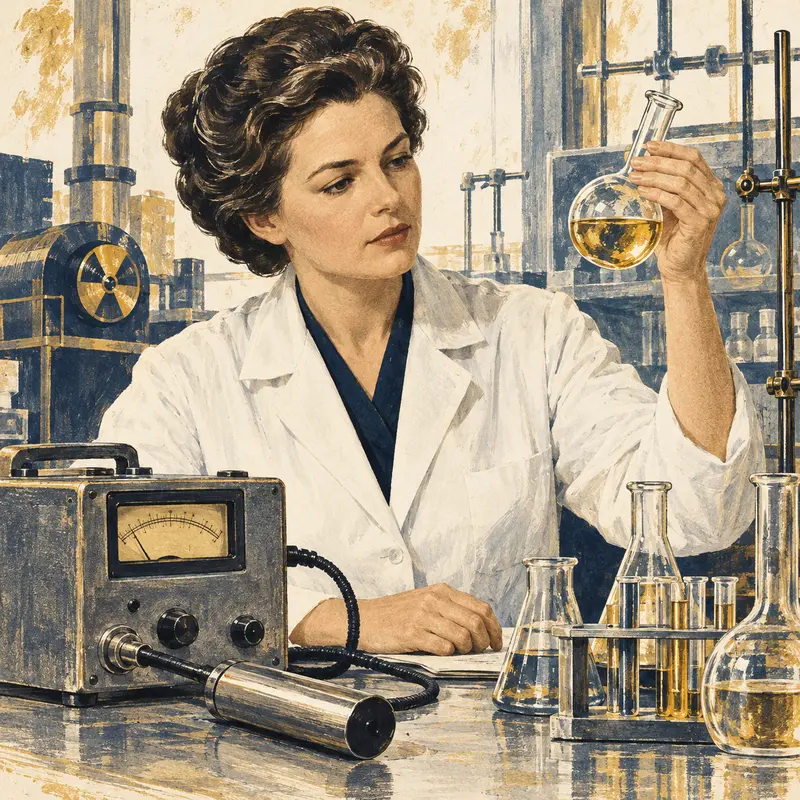
About the chemist
F. Sherwood Rowland
1927-2012 · United States · Nobel Chemistry 1995
CFC depletion of stratospheric ozone