The discovery, explained · Chemist no. 88 of 350
Sherwood Rowland: How Careful Measurement Showed That CFCs Threaten the Ozone Layer
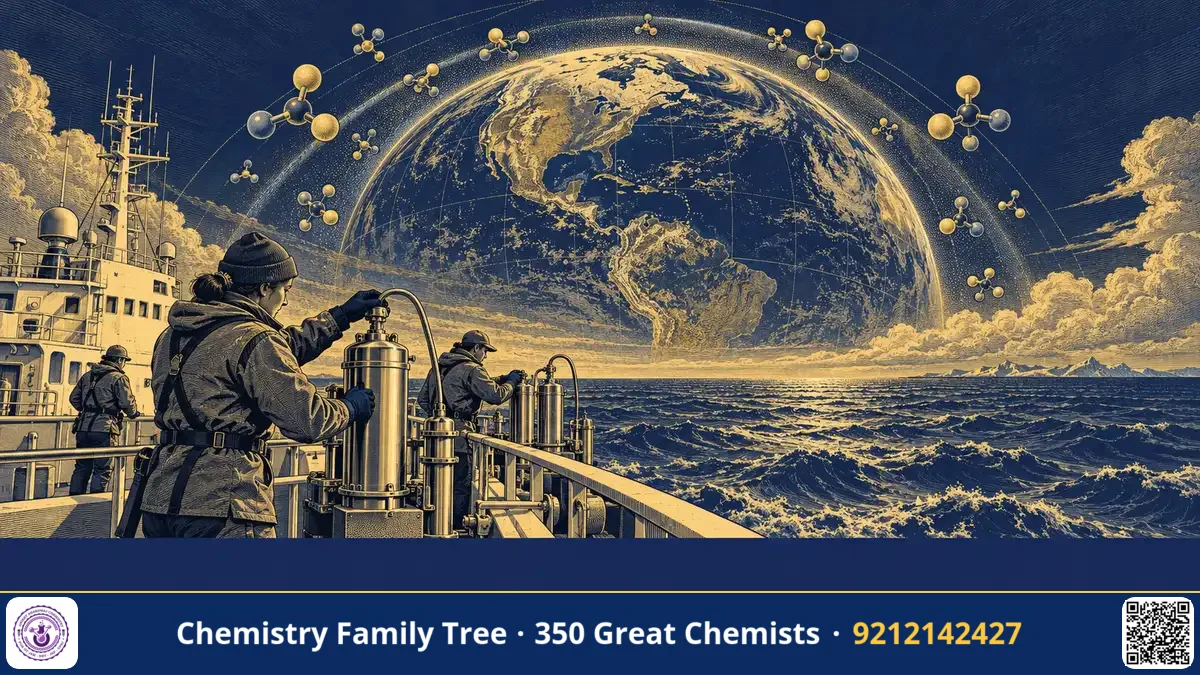
A scientific theory is only a guess until someone measures the real world. When F. Sherwood Rowland and Mario Molina proposed in 1974 that chlorofluorocarbons (CFCs) would destroy stratospheric ozone, the weak point was the proof. How much CFC was in the air? Where would it go? How long would it last? Rowland spent decades answering these questions by building a worldwide system of air sampling, using gas chromatography with a very sensitive detector. His measurements showed that the CFCs ever released were still in the atmosphere, and that their concentration was rising. He shared the 1995 Nobel Prize in Chemistry with Molina and Paul Crutzen. This blog looks at the experimental side of the CFC story, which is full of exam-friendly chemistry: hot atoms, chromatography, electron capture detection and chain reactions.
The Scientific Problem Before the Discovery
In the early 1970s CFCs were manufactured in huge amounts for refrigerators, air conditioners, aerosol sprays and foams. The most common were CFC-11 (CFCl3) and CFC-12 (CF2Cl2). They were believed to be harmless because they are unreactive, non-toxic and non-flammable.
James Lovelock, working independently, had detected CFC-11 in the air over the Atlantic and in Ireland and Britain, at levels of only tens of parts per trillion (ppt). He used a gas chromatograph with an electron capture detector. Rowland saw that the same technique could be used to answer a more serious question: is CFC-11 accumulating in the whole atmosphere, and what will happen to it? There was no known natural process to remove it near the ground. If the answer was "no sink", then all the CFC ever released would still be there.
The Discovery / Experiment — Step by Step
Step 1: Background in hot atom chemistry
Rowland's early research (1950s and 1960s) was on hot atom chemistry. A nuclear reaction can give an atom a large recoil energy, enough to break chemical bonds. For example, a tritium atom produced in a nuclear reaction can replace hydrogen in methane:
T* + CH4 → CH3T + H
These radioactive tracer experiments taught him how to detect extremely small amounts of material and how to follow atoms through reactions. This skill was ideal for atmospheric trace gases.
Step 2: Sampling the atmosphere
In 1973-1974, Rowland's group collected air samples in stainless-steel and glass containers from places around the world. Samples were taken at many latitudes, from the northern to the southern hemisphere, including over the oceans. The concentration of CFC-11 was found to be nearly the same in samples taken at different places, which shows that the gas mixes through the atmosphere over a period of a year or two. Higher values in the northern hemisphere, where most CFCs were released, showed that the sources were industrial.
Step 3: Gas chromatography with electron capture detection (GC-ECD)
- The air sample is injected into a gas chromatograph. A carrier gas (nitrogen or argon-methane) pushes it through a long column.
- Different compounds travel at different speeds depending on how strongly they stick to the column's stationary phase, so CFC-11, CFC-12, CCl4 and others come out at different times (retention times).
- The gas flow then passes through an electron capture detector. A radioactive source (nickel-63) emits beta particles that ionise the carrier gas and produce a steady current of free electrons.
- When an electronegative molecule, such as a compound with chlorine or fluorine atoms, arrives, it captures electrons:
CFCl3 + e⁻ → CFCl2 + Cl⁻. The current drops, and the drop is the signal. The detector is extremely sensitive to halogenated compounds, down to parts per trillion.
Step 4: The mass balance
Rowland compared the total amount of CFC-11 in the atmosphere, estimated from his measurements, with the total amount manufactured, known from industry statistics. They were close. In other words, nearly all CFC-11 ever released remained in the air. This agreed with the prediction of Molina and Rowland that CFCs have no important lower-atmosphere sink and last for decades. With the chlorine-catalysed ozone destruction cycle, the conclusion was serious:
CFCl3 + hν → CFCl2 + Cl
Cl + O3 → ClO + O2
ClO + O → Cl + O2        (Cl regenerated; net O3 + O → 2 O2)
The Chemistry Behind It
Why are CFCs so long-lived? Their C-F bond (about 485 kJ/mol) and C-Cl bonds (about 330 kJ/mol) are strong. They do not absorb the UV that reaches the lower atmosphere. They are not soluble in water, so rain does not remove them. They do not react with OH radicals, the "detergent" of the troposphere. This is why they survive until they reach the stratosphere, where UV of about 200-220 nm photolyses them.
| Gas | Formula | Approximate atmospheric lifetime |
|---|---|---|
| CFC-11 | CFCl3 | About 50 years |
| CFC-12 | CF2Cl2 | About 100 years |
| Carbon tetrachloride | CCl4 | About 30 years |
| HCFC-22 | CHF2Cl | About 12 years (has C-H bond; attacked by OH) |
The HCFC example shows why the replacement gases were chosen: a C-H bond lets OH radicals destroy the molecule in the lower atmosphere, so less reaches the stratosphere. Later, Rowland's group also measured methane and non-methane hydrocarbons in the air of many countries from the late 1970s onward. They showed that methane, a greenhouse gas, was increasing, and they studied how it is removed by OH: CH4 + OH → CH3 + H2O.
Applications Today
- Global monitoring networks: measurements of CFCs, HCFCs, HFCs and methane at remote stations check whether countries follow the Montreal Protocol. Scientists detected an unexpected slowdown in the decline of CFC-11 in the 2010s, which was linked to new, unreported production.
- Environmental analysis: GC-ECD is used worldwide to measure pesticide residues such as DDT and other chlorinated compounds in food, water and soil, including in Indian laboratories.
- Policy: the United States, Canada and Sweden banned most CFC aerosol uses in the late 1970s, before the ozone hole was found, based in part on this science.
- Climate science: ice-core and atmospheric records of gases like CH4 and CFCs are standard evidence for human influence on climate.
- Education: the CFC case is taught as a model of how basic chemical kinetics and photochemistry have real-world impact.
Exam Corner — 5 Likely Points
- Electron capture detector: radioactive source (63Ni) produces electrons; electronegative analytes lower the current; best for halogenated compounds.
- CFCs have no tropospheric sink: insoluble, no UV absorption, no reaction with OH.
- CFC photolysis needs UV of about 220 nm or shorter, available in the stratosphere.
- CH4 + OH → CH3 + H2O is the main sink of methane.
- Hot atom chemistry: recoil atoms from nuclear processes break chemical bonds and form new compounds, as in T + CH4.
Common Misconceptions
- "A theory with no direct evidence is useless." The CFC hypothesis was supported first by indirect evidence (long lifetime, accumulation) and later by direct observation of the ozone hole.
- "ECD detects all compounds equally." No. It is highly selective for electron-capturing (halogenated, nitro) compounds.
- "CFCs are removed by rain." They are insoluble and are not removed.
Quick Revision Box
- Rowland's group measured CFCs worldwide in the 1970s using GC-ECD.
- Nearly all CFC-11 ever produced was still in the atmosphere.
- Lifetimes: CFC-11 about 50 years; CFC-12 about 100 years.
- Replacements with C-H bonds (HCFCs, HFCs) are broken down more quickly.
- He also tracked methane increase and its removal by OH.
- Nobel Prize in Chemistry 1995 with Molina and Crutzen.
FAQ
Why is nickel-63 used in the detector?
It is a beta emitter with a long half-life (about 100 years), which gives a stable stream of electrons for the detector.
Did Lovelock discover CFCs in the atmosphere?
Yes. Lovelock first measured CFC-11 in the atmosphere using an electron capture detector. Rowland and Molina explained what it meant for ozone.
How long will CFCs remain in the air?
For many decades, because of their long lifetimes. Even after the ban, they are being removed slowly.
Why is GC-ECD used for pesticides?
Many pesticides, such as DDT and lindane, contain chlorine, so they give a strong signal in an electron capture detector.
Published by ABC Chemistry — IIT-JAM | CSIR-NET | GATE Chemistry Coaching. Visit abcchemistry.com
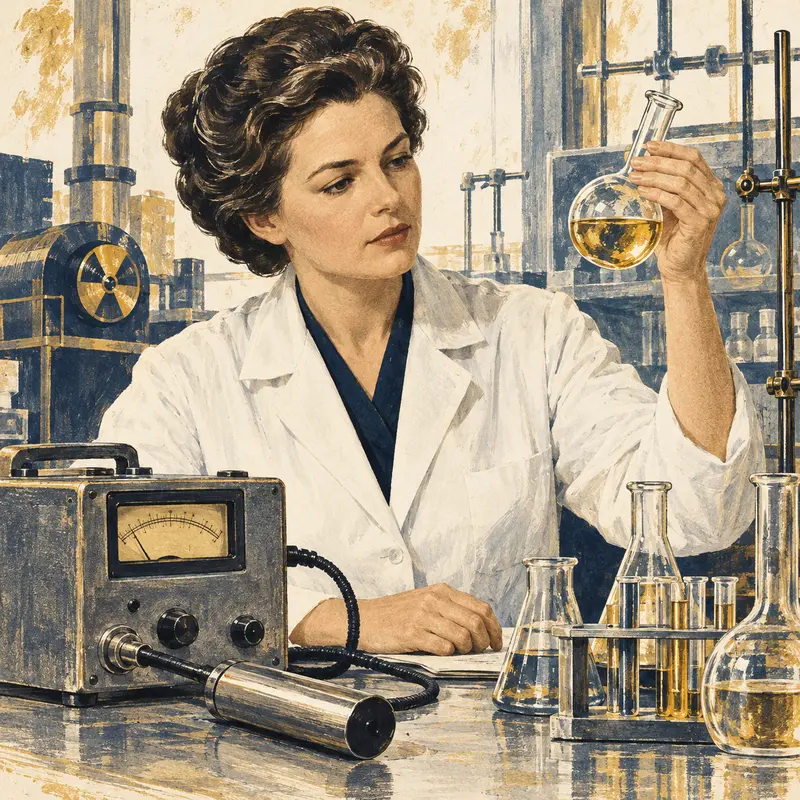
About the chemist
F. Sherwood Rowland
1927-2012 · United States · Nobel Chemistry 1995
CFC depletion of stratospheric ozone