The discovery, explained · Chemist no. 9 of 350
Michael Faraday's Laws of Electrolysis: Putting Numbers on Electrochemistry
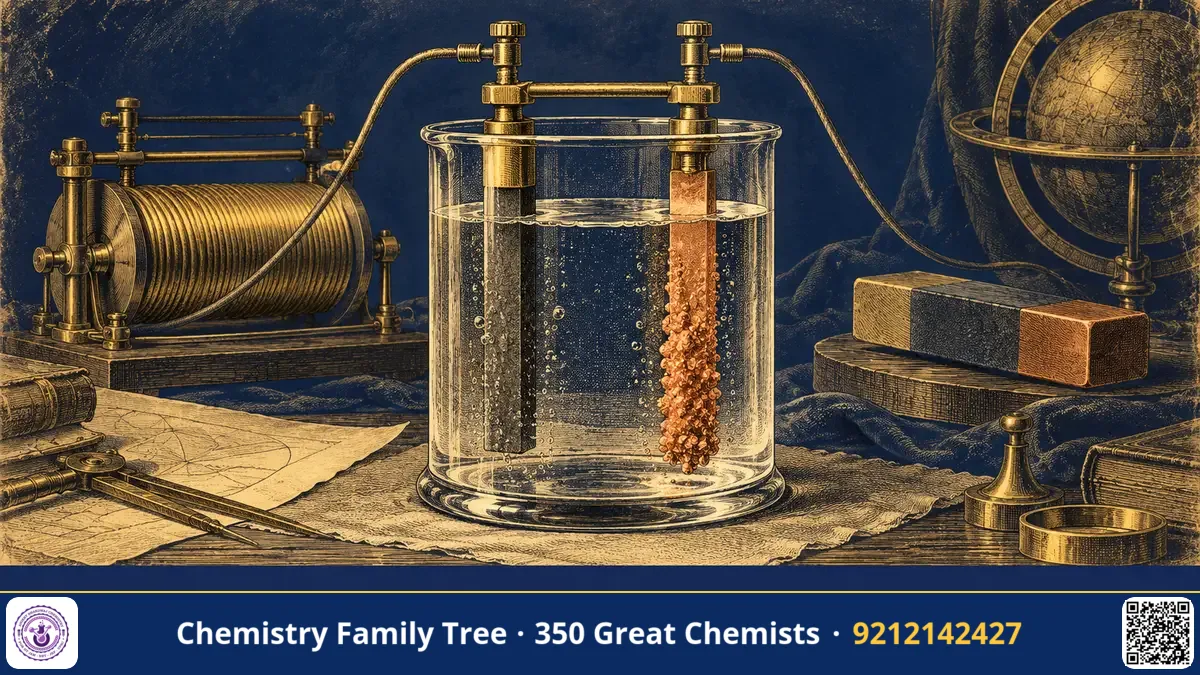
How much copper will deposit if you pass 2 amperes through copper sulphate solution for 10 minutes? How much aluminium can a factory make from a given amount of electricity? These questions are answered by two simple laws proposed by Michael Faraday in 1833-1834. Faraday was a brilliant experimenter who also discovered benzene, liquefied chlorine, invented the first electric motor and generator principles through electromagnetic induction, and introduced words such as electrode, anode, cathode, electrolyte and ion. In this post, we will focus on the chemistry: the laws of electrolysis, the Faraday constant, solved numericals and exam points.
The Scientific Problem Before the Discovery
Humphry Davy had shown in 1807-1808 that electricity can decompose compounds and produce new elements. But the relation between the quantity of electricity and the quantity of substance deposited was unknown. Was there a rule? Did the amount depend on the strength of the solution, the size of the electrodes or the source of electricity? There were also many confusing terms, and some scientists believed that the decomposition required an "attraction" from the poles. Faraday wanted to measure the process and find general laws.
The Discovery: Experiments Step by Step
- Showing that all electricity is the same. Faraday compared electricity from friction, from voltaic piles, from magnets, from animals such as the electric eel and from thermoelectric sources. He showed that they all produced the same effects, including chemical decomposition.
- Clear terms (1834). Working with William Whewell, he introduced the words electrode, anode, cathode, electrolyte, electrolysis, ion, anion and cation. Anode and cathode come from Greek words meaning "way up" and "way down".
- Measuring the current. He built a device he called a voltameter (now coulometer) in which water is decomposed and the volume of hydrogen and oxygen collected. This gave a measure of the quantity of electricity passed.
- Cells in series. He connected several electrolytic cells in series, so that the same amount of electricity passed through each one. He found that the amounts of substances deposited were related to the chemical equivalents of those substances, regardless of the size of the electrodes or concentration of the solutions.
- Publishing the laws. In his Experimental Researches in Electricity, he stated what we now call the two laws of electrolysis.
The Chemistry Behind It
Faraday's first law
The mass of a substance deposited or liberated at an electrode is directly proportional to the quantity of electricity (charge) passed through the electrolyte.
m = Z × Q = Z × I × t
Z = electrochemical equivalent = M / (n F)
m = (M × I × t) / (n × F)
Here M is the molar mass, n the number of electrons transferred per ion, I the current in amperes, t the time in seconds and F the Faraday constant.
Faraday's second law
When the same quantity of electricity is passed through different electrolytes, the masses of substances deposited are proportional to their equivalent weights (M/n).
The Faraday constant
F is the charge carried by one mole of electrons.
F = N_A × e = 6.022 × 10²³ × 1.602 × 10⁻¹⁹ ≈ 96485 C/mol (about 96500 C/mol)
| Electrode reaction | Electrons per mole (n) | Charge needed for 1 mol |
|---|---|---|
| Ag⁺ + e⁻ → Ag | 1 | 1 F |
| Cu²⁺ + 2e⁻ → Cu | 2 | 2 F |
| Al³⁺ + 3e⁻ → Al | 3 | 3 F |
| 2H⁺ + 2e⁻ → H₂ | 2 | 2 F |
Worked numerical 1
A current of 2.0 A is passed through CuSO₄ solution for 965 seconds. Find the mass of copper deposited (Cu = 63.5 g/mol).
Q = I t = 2.0 × 965 = 1930 C
Moles of electrons = 1930 / 96500 = 0.020 mol
Cu²⁺ + 2e⁻ → Cu, so moles of Cu = 0.010 mol
Mass = 0.010 × 63.5 = 0.635 g
Worked numerical 2
How long will it take to deposit 1.08 g of silver (Ag = 108) using 0.5 A?
Moles of Ag = 1.08 / 108 = 0.01 mol → charge = 0.01 × 96500 = 965 C
t = Q / I = 965 / 0.5 = 1930 s
Faraday and the discovery of benzene (1825)
Faraday also made important chemical discoveries. In 1825 he analysed an oily liquid that collected in the compressed illuminating gas (made from whale oil) used for London street lamps. He isolated a new hydrocarbon, which he called "bicarburet of hydrogen". He found that its empirical formula had equal numbers of carbon and hydrogen atoms; the compound is now called benzene (C₆H₆). Later, Kekulé proposed its ring structure in 1865. Faraday also prepared the first known chlorocarbons, such as C₂Cl₆ and C₂Cl₄, and liquefied chlorine (1823) and other gases under pressure.
Electromagnetic induction (1831)
When Faraday moved a magnet through a coil of wire, a current was induced in the coil. The induced emf is proportional to the rate of change of magnetic flux. This principle works in every generator and transformer.
Applications Today
- Electroplating. Objects are coated with silver, chromium, nickel or gold, with the thickness controlled by Faraday's law.
- Metal extraction. Aluminium is extracted by electrolysis of alumina in molten cryolite (Hall-Héroult process). The amount of aluminium per tonne depends on charge passed, as given by Faraday's laws.
- Chlor-alkali industry. Brine electrolysis yields NaOH, Cl₂ and H₂.
- Copper refining. Impure copper anode dissolves and pure copper deposits on the cathode.
- Batteries and fuel cells. The quantity of charge stored and delivered by a battery (ampere-hour) is calculated using Faraday's constant. Lithium-ion cells in electric vehicles and phones follow the same logic.
- Power generation. From India's thermal and hydro plants to everyday transformers, electromagnetic induction produces and distributes electricity.
Exam Corner
- 1 Faraday = 96485 C/mol ≈ 96500 C of charge, the charge of one mole of electrons.
- m = ZIt; Z = M/(nF). Equivalent mass = M/n.
- For equal charge in series, m₁/m₂ = E₁/E₂, where E is equivalent mass.
- To deposit 1 mol of Al, 3 F are needed; to produce 1 mol of Cl₂ from NaCl solution, 2 F are needed.
- Faraday discovered benzene (1825) and the unit of capacitance (farad) is named after him.
Common Misconceptions
- "The amount of metal deposited depends on the concentration of the solution." It depends only on the charge passed (and on the substance), provided that the electrode reaction is the same.
- "Faraday's law applies only to metals." It applies to all electrode reactions, including gas evolution like H₂ and Cl₂.
- "The farad and the faraday are the same." The farad (F) is a unit of capacitance. The faraday is a unit of charge (96485 C/mol). The Faraday constant is usually written F, so keep the context in mind.
Quick Revision Box
- First law: m ∝ Q, so m = ZIt.
- Second law: for the same Q, m ∝ equivalent weight.
- F ≈ 96485 C/mol (charge of 1 mole of electrons).
- Terms by Faraday and Whewell: electrode, anode, cathode, electrolyte, ion.
- Benzene was discovered by Faraday in 1825.
- Electromagnetic induction discovered in 1831.
FAQ
What is Faraday's first law of electrolysis?
The mass of a substance liberated at an electrode is proportional to the charge passed through the electrolyte: m = ZIt.
What is the value of the Faraday constant?
About 96485 coulombs per mole of electrons, usually rounded to 96500 C/mol in calculations.
How many faradays are needed to deposit one mole of aluminium?
Three faradays, because Al³⁺ needs three electrons to form Al.
Did Faraday discover benzene?
Yes. He isolated it in 1825 from the oily residue of illuminating gas and determined that it contained carbon and hydrogen in equal proportions.
Published by ABC Chemistry — IIT-JAM | CSIR-NET | GATE Chemistry Coaching. Visit abcchemistry.com
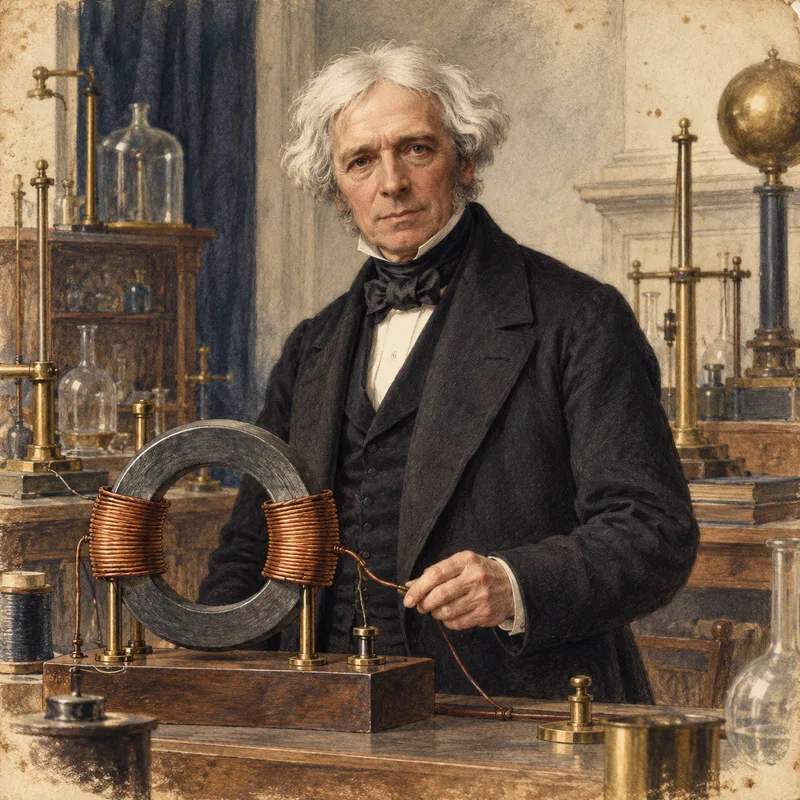
About the chemist
Michael Faraday
1791-1867 · United Kingdom
Electrolysis laws; electromagnetic induction