Biography · Chemist no. 9 of 350
Michael Faraday: The Bookbinder's Apprentice Who Became One of the Greatest Experimenters
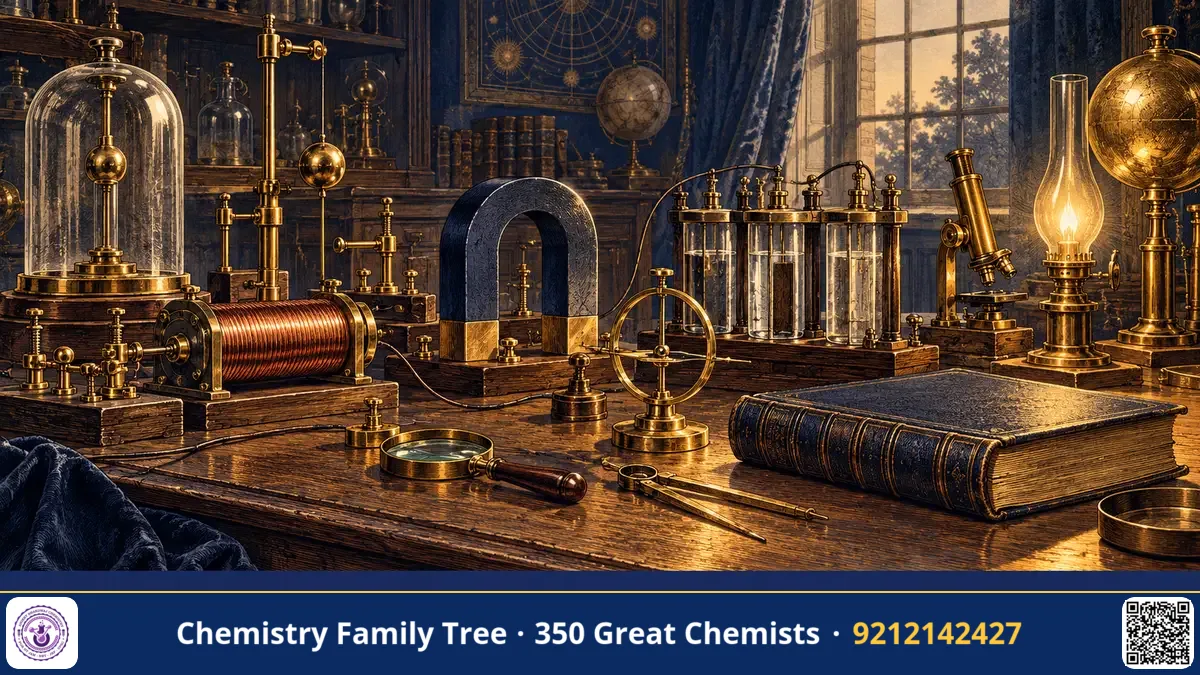
Michael Faraday (1791-1867) was an English scientist who contributed to both chemistry and physics. He discovered benzene, liquefied chlorine, formulated the laws of electrolysis, discovered electromagnetic induction and gave science the concept of the field. He had almost no formal schooling and no training in advanced mathematics, but became one of the most influential experimenters in history. His legacy in one line: a poor boy who taught himself science and showed that careful, imaginative experiment can open new worlds.
Early Life and Family
Michael Faraday was born on 22 September 1791 in Newington Butts, then a village in Surrey and now a part of south London. His father, James Faraday, was a blacksmith who often suffered from poor health, and his mother, Margaret, took care of the family. Michael was the third of four children. The family was poor, and there were times when young Michael got only one loaf of bread to last him a week. They belonged to a small Christian group called the Sandemanians, and Michael remained a committed member all his life. His faith taught him humility and honesty, and he later declined honours that did not suit his values. He received only a basic education in reading, writing and arithmetic.
Education and Mentors
- At about 13 he began work as an errand boy for a bookseller and bookbinder, George Riebau, and at 14 he became his apprentice, working for seven years. Riebau allowed him to read the books he bound.
- Two books changed his life: an article on electricity in the Encyclopaedia Britannica and Jane Marcet's Conversations on Chemistry, which was written in simple language for young readers. He repeated experiments from them with simple home-made apparatus.
- He attended evening talks by John Tatum of the City Philosophical Society, where he learnt basic science and practised speaking.
- A customer of the shop gave him tickets to attend four lectures by Humphry Davy at the Royal Institution in 1812. Faraday took careful notes, bound them in a book and sent them to Davy, asking for a job in science.
Career Timeline
| Year | Event |
|---|---|
| 1791 | Born in Newington Butts, Surrey on 22 September |
| 1805 | Apprenticed to a bookbinder |
| 1812 | Attends Davy's lectures |
| 1813 | Becomes assistant at the Royal Institution; travels in Europe with Davy until 1815 |
| 1821 | Builds the first device showing electromagnetic rotation; marries Sarah Barnard |
| 1823 | Liquefies chlorine |
| 1824 | Elected Fellow of the Royal Society |
| 1825 | Discovers benzene; becomes director of the laboratory of the Royal Institution; begins the Christmas Lectures |
| 1831 | Discovers electromagnetic induction |
| 1833 | Appointed Fullerian Professor of Chemistry |
| 1833-1834 | Formulates the laws of electrolysis |
| 1845 | Discovers the magneto-optical effect (Faraday effect) and diamagnetism |
| 1861 | Retires from the Royal Institution |
| 1867 | Dies at Hampton Court on 25 August |
Major Scientific Contributions
Laws of electrolysis. The mass of a substance liberated by electrolysis is proportional to the charge passed (m = ZIt), and for the same charge the masses are proportional to equivalent weights. The charge of one mole of electrons is called the Faraday constant, 96485 C/mol. Details and numericals are in our discovery post on Faraday.
Benzene. In 1825 he isolated benzene from the liquid obtained from compressed illuminating gas, and found that it contains carbon and hydrogen in equal numbers of atoms.
Liquefaction of gases. He liquefied chlorine and other gases by pressure and cooling, which showed that gases are vapours of substances that could be liquids, an idea important to understanding states of matter.
Electromagnetic induction. His 1831 experiments with a ring of iron wound with two coils showed that changing magnetic flux induces an electric current. This became the basis of the electric generator and transformer.
Field concept and magneto-optics. He pictured lines of force filling space, an idea that James Clerk Maxwell turned into mathematical equations. The Faraday effect, discovered in 1845, shows that a magnetic field can rotate the plane of polarised light.
Other work. He studied alloys of steel, optical glass, catalysis by platinum surfaces, and the chemistry of a burning candle in his lecture series. Faraday also created the "Faraday cage", which shields its interior from external electric fields.
Awards, Honours and Nobel Prize
- Fellow of the Royal Society (1824).
- Copley Medal of the Royal Society (1832 and 1838) and Royal Medal (1835 and 1846).
- Rumford Medal (1846).
- Honorary doctorate from Oxford University (1832) and many foreign academy memberships.
- He was offered a knighthood and the presidency of the Royal Society, and declined both.
- No Nobel Prize, since he lived before 1901. The SI unit of capacitance, the farad, and the Faraday constant carry his name.
Personality, Struggles and Lesser-Known Facts
- A happy marriage. He married Sarah Barnard in 1821, and they had no children, but they were very close throughout their lives. Sarah helped him during his later periods of poor health.
- Christmas Lectures. From 1825 he started a series of lectures for young people at the Royal Institution. His 1848 series became the book The Chemical History of a Candle, which is still read by students today. The lectures continue to this day.
- A dislike of fame and money. He could have earned a large income by working as a consultant, but chose to devote most of his time to pure research. He did, however, advise the government on lighthouses, and on how to protect the national art treasures.
- Health trouble. In the late 1830s he suffered from a breakdown, with memory problems and giddiness, and had to rest for several years. He gradually returned to research.
- Lab notebooks. Faraday kept extremely careful laboratory notes, numbered his paragraphs continuously, and left behind thousands of pages that historians study today.
- A home from the Crown. Late in his life, Queen Victoria granted him the use of a house on the grounds of Hampton Court, where he lived until his death.
Legacy and Influence on Modern Chemistry
Faraday made electrochemistry a quantitative science. His laws of electrolysis connect charge and amount of substance and led to ideas about the atomic nature of electricity. Industrial processes such as electroplating, aluminium extraction and chlor-alkali production use them every day. His discovery of benzene opened the field of aromatic chemistry, and his work on induction led to electric power generation. Maxwell's electromagnetic theory grew from Faraday's lines of force. Everyone who uses electricity, from a village home in India to a research lab, benefits from his work.
Lessons for Students
- Read widely and try things yourself. Two books and home experiments launched his career.
- Take notes carefully. His notes got him a job and his notebooks recorded his discoveries.
- Do not be afraid to start small. He began as an assistant who washed bottles.
- Explain science simply. His lectures made young people love science.
- Stay humble. He refused titles and valued truth more than fame.
Quick Facts Box
- Born: 22 September 1791, Newington Butts, Surrey, England
- Died: 25 August 1867, Hampton Court, England
- Nationality: English (British)
- Field: Chemistry, electrochemistry, electromagnetism
- Famous for: Laws of electrolysis, benzene, electromagnetic induction
- Nobel Prize: None (lived before 1901)
FAQ
How did Faraday become a scientist without a university education?
He educated himself while working as a bookbinder's apprentice, attended lectures, and impressed Humphry Davy with notes of his lectures, which led to a job as an assistant at the Royal Institution.
What are the main discoveries of Michael Faraday?
Laws of electrolysis, benzene, liquefaction of chlorine, electromagnetic induction, diamagnetism and the Faraday effect.
Why did Faraday refuse a knighthood?
Because of his religious beliefs and his preference for a simple life, he preferred to remain plain Mr Faraday.
What is the Faraday constant?
It is the charge of one mole of electrons, about 96485 coulombs per mole.
Published by ABC Chemistry — IIT-JAM | CSIR-NET | GATE Chemistry Coaching. Visit abcchemistry.com
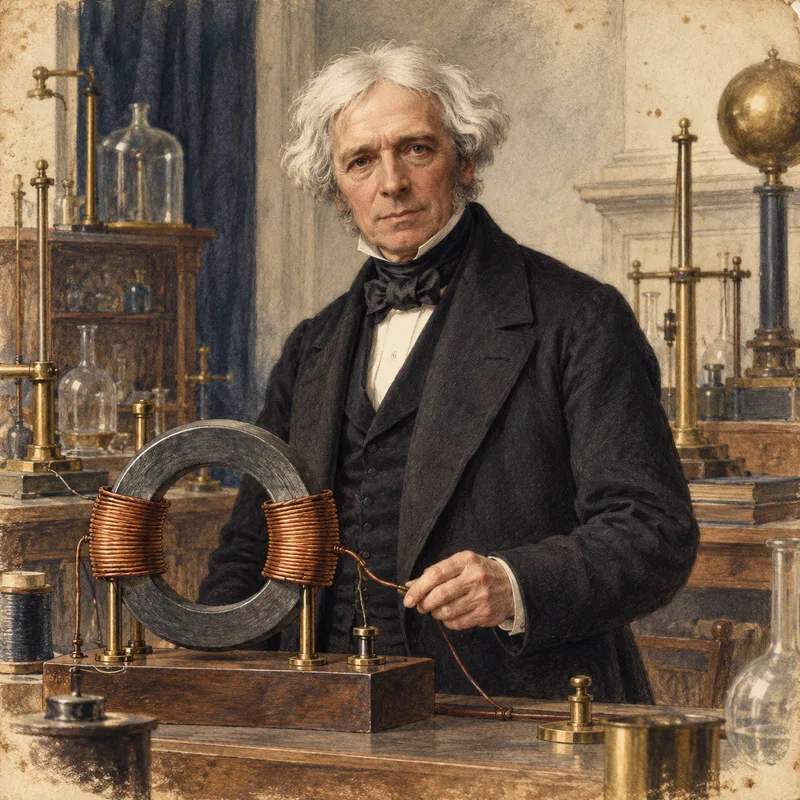
About the chemist
Michael Faraday
1791-1867 · United Kingdom
Electrolysis laws; electromagnetic induction