Biography · Chemist no. 284 of 350
Felix Hoffmann (1868–1946): The Chemist Who Gave the World Aspirin
Introduction
Felix Hoffmann was a German pharmaceutical chemist who spent most of his working life at Bayer. In 1897 he prepared acetylsalicylic acid in a pure form, the compound that the world knows as aspirin, one of the most widely used medicines ever made. His career also touched another famous but troubled compound, diacetylmorphine, later sold as heroin. In one line: Hoffmann was the industrial chemist behind the world's most familiar painkiller, and his story shows both the promise and the risks of drug development.
Early Life & Family
Felix Hoffmann was born on 21 January 1868 in Ludwigsburg, in the Kingdom of Württemberg in southwestern Germany. His family was middle class, and he was drawn to chemistry through pharmacy, a common route in Germany where pharmacists were the practical chemists of their communities.
Education & Mentors
Hoffmann trained first as a pharmacist, working in apothecaries, and then studied chemistry and pharmacy at the University of Munich. He earned his doctorate in 1893. Munich was a leading German centre of organic chemistry at that time. In 1894 he joined Bayer in Elberfeld. There he worked in the pharmaceutical laboratory led by Arthur Eichengrün, who was one of the most important figures in Bayer's drug research, and alongside the pharmacologist Heinrich Dreser, who tested compounds on animals and patients.
Career Timeline
| Year | Event |
|---|---|
| 1868 | Born in Ludwigsburg, Württemberg |
| 1893 | Doctorate in chemistry at Munich |
| 1894 | Joins Bayer in Elberfeld |
| 1897 | Prepares pure acetylsalicylic acid (August) and diacetylmorphine (heroin, October) |
| 1899 | Aspirin launched by Bayer |
| 1900s | Rises in the company, continuing in pharmaceutical development and sales |
| 1928 | Retires from Bayer |
| 1946 | Dies on 8 February in Switzerland |
Major Scientific Contributions
- Aspirin: He synthesised acetylsalicylic acid in a pure, stable form on 10 August 1897, a compound that was tested and sold as a drug for fever, pain and rheumatism. For the chemistry, see our companion discovery post on Felix Hoffmann.
- Diacetylmorphine: A few days later he acetylated morphine to produce diacetylmorphine. Bayer marketed it from 1898 as Heroin, a cough remedy and morphine substitute, believing it to be safer. Its addictive nature led to worldwide control in the early twentieth century.
- Industrial pharmaceutical research: He represents the new type of chemist employed by companies to modify natural products systematically, which is the basis of modern medicinal chemistry.
The chemical logic is simple and instructive. Both aspirin and heroin come from acetylation of a natural product to modify its properties: salicylic acid (from willow) and morphine (from opium poppy). Acetylation of the phenolic OH in salicylic acid makes it milder on the stomach; acetylation of morphine's hydroxyl groups makes the molecule more lipid soluble, so it crosses the blood–brain barrier more quickly, and is converted back to morphine in the brain, which increases its potency and addictive power.
Awards, Honours & Nobel Prize
Hoffmann did not win a Nobel Prize and received few formal scientific honours in his lifetime. His fame grew mainly after his death, as the history of aspirin became widely known. Bayer's company records and later histories credited him as the discoverer of aspirin. He is now a standard figure in the history of drug discovery.
Personality, Struggles & Lesser-Known Facts
- A personal motive. The common account says he wanted a gentler drug for his father, who had rheumatism and could not tolerate sodium salicylate. Some historians treat this story with caution, but it is widely repeated.
- The credit dispute. In 1949, three years after Hoffmann's death, his colleague Arthur Eichengrün published an article claiming that he had directed the work on aspirin and that Hoffmann had acted on his instructions. Eichengrün was Jewish and had been persecuted by the Nazi regime, which affected how his account was received. Historians have debated the evidence ever since.
- Not a famous name. Unlike scientists who won prizes, Hoffmann was a company chemist, and he remained little known to the public until the later twentieth century.
- A drug and a danger. Hoffmann's name is associated with both one of the safest widely used drugs and one of the most notorious. This contrast is often used in teaching about drug safety and the need for rigorous testing before marketing.
- Retirement in Switzerland. After retiring from Bayer, he spent his later years in Switzerland, where he died in 1946.
Legacy & Influence on Modern Chemistry
Aspirin remains in use over a century later. Researchers continue to find new roles for it, including in preventing heart attacks and strokes and in studies of cancer prevention, though these uses require medical supervision. The molecule is also a teaching classic: synthesis, recrystallisation, melting point (about 135 °C) and the ferric chloride test appear in almost every undergraduate practical course. More broadly, the aspirin story launched the modern pharmaceutical industry, where companies develop and market synthetic drugs under trade names. The heroin story, in turn, helped motivate drug regulation, testing and international control of narcotics.
Lessons for Students
- Small structural changes can produce large changes in biological behaviour; this is the central idea of structure–activity relationships.
- Safe medicine needs thorough testing; early enthusiasm for heroin shows the cost of skipping it.
- Credit in science is sometimes contested, so keep clear records and acknowledge collaborators.
- You do not need a Nobel Prize to change the world; a well-made compound can reach billions of people.
- Learn the practical techniques, because purification and characterisation make the difference between an old curiosity and a usable drug.
Quick Facts Box
- Born: 21 January 1868, Ludwigsburg, Württemberg
- Died: 8 February 1946, Switzerland
- Nationality: German
- Field: Pharmaceutical and organic chemistry
- Famous for: Pure acetylsalicylic acid (aspirin), 1897
- Nobel Prize: None
FAQ
Who discovered aspirin?
Charles Gerhardt first made an impure form in 1853. Felix Hoffmann prepared the pure compound at Bayer in 1897, though Arthur Eichengrün later claimed a leading role in the work.
Did Hoffmann also make heroin?
Yes. In 1897, a few days after aspirin, he prepared diacetylmorphine, which Bayer sold as Heroin before its dangers were understood.
Where did Felix Hoffmann work?
He worked at Bayer's pharmaceutical laboratory in Elberfeld from 1894, and stayed with the company until his retirement.
Did he win a Nobel Prize?
No. John Vane, who explained how aspirin works, won the 1982 Nobel Prize in Physiology or Medicine, but Hoffmann himself received no such prize.
Published by ABC Chemistry — IIT-JAM | CSIR-NET | GATE Chemistry Coaching. Visit abcchemistry.com
About the chemist
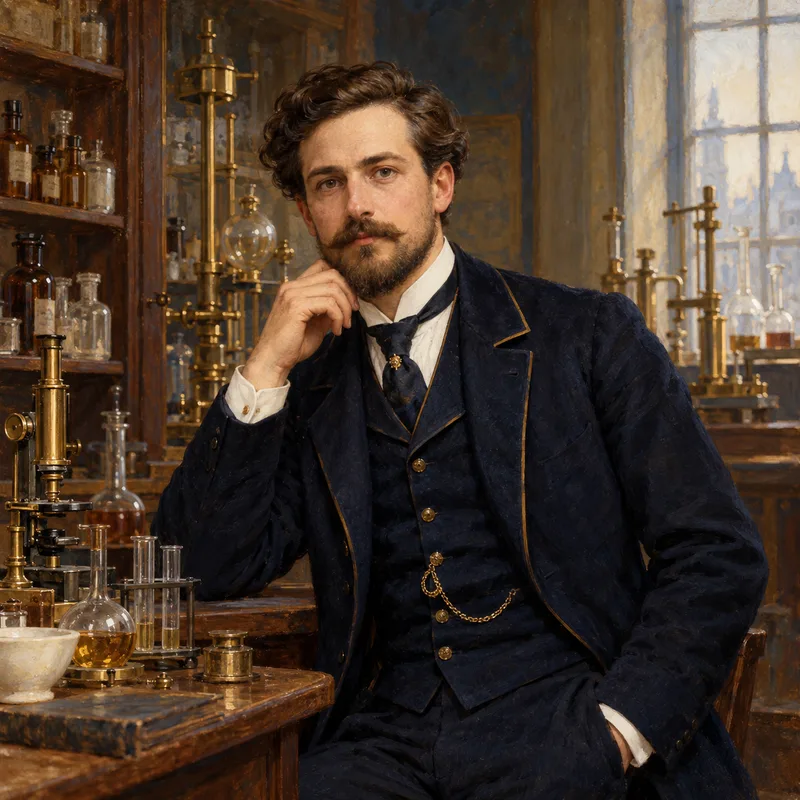
Felix Hoffmann
1868-1946 · Germany
Synthesised aspirin at Bayer