The discovery, explained · Chemist no. 284 of 350
Felix Hoffmann and the Making of Aspirin
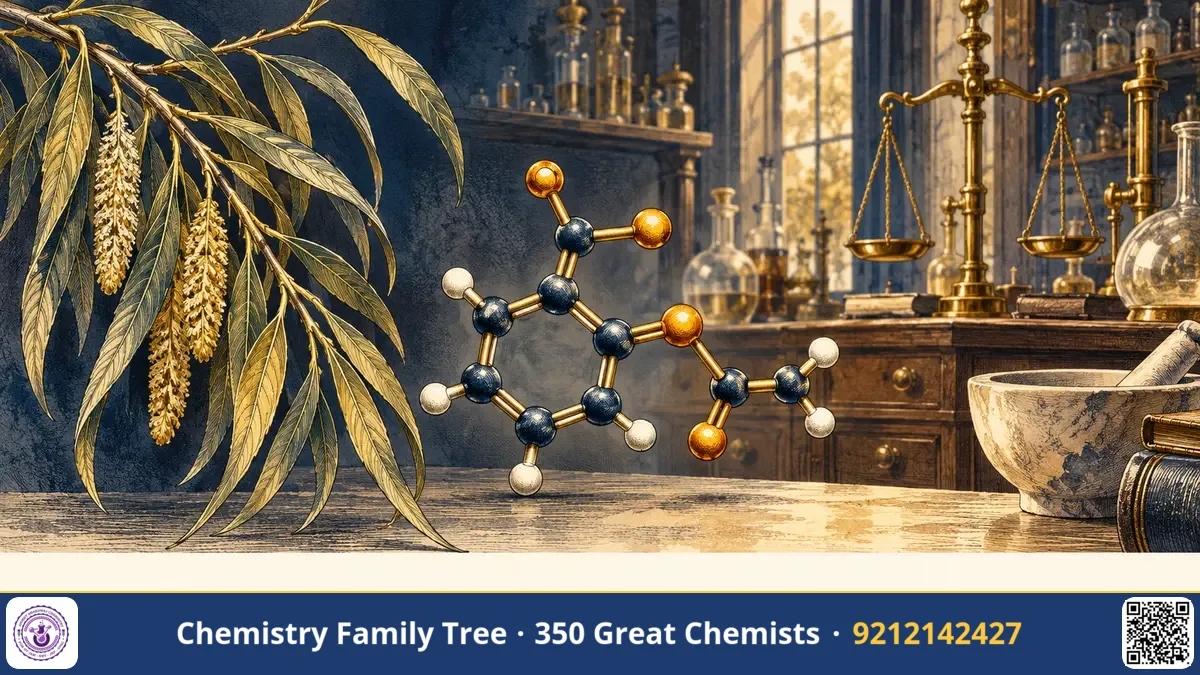
Few chemical compounds are as familiar as aspirin. It sits in medicine cabinets in homes from Patna to Chennai, and billions of tablets are consumed worldwide each year. Behind it is a young chemist at the German company Bayer, Felix Hoffmann, who in August 1897 prepared acetylsalicylic acid in a pure and stable form suitable for medicine. The compound had been made before, but Hoffmann's work, and the testing that followed, turned it into the first great synthetic drug in everyday use. This post explains the problem he solved, the reaction, the mechanism of action, and the questions that appear in exams.
The Scientific Problem Before the Discovery
For thousands of years, people used willow bark to relieve pain and fever. In 1828 the German pharmacist Johann Buchner isolated its active compound, salicin, and later Raffaele Piria in Italy converted it into salicylic acid. By the 1870s, sodium salicylate and salicylic acid were used to treat fever and rheumatism. But they had a serious problem. Salicylic acid tastes bitter, and it irritates the mouth, throat and stomach lining badly; many patients could not tolerate the doses needed for rheumatic fever.
Chemists therefore wanted a derivative that would keep the pain-relieving action while reducing the harsh side effects. The phenolic –OH group in salicylic acid was the obvious suspect, since it is acidic and reactive. Capping it might make the drug gentler. In fact, the French chemist Charles Gerhardt had made acetylsalicylic acid as early as 1853, but his material was impure and unstable, and it was not developed as a drug.
The Discovery / Experiment
Hoffmann worked in the pharmaceutical laboratory of Bayer in Elberfeld under Arthur Eichengrün, the head of the pharmaceutical group. According to the accepted account, Hoffmann's father suffered from rheumatism and could not tolerate sodium salicylate, which gave Felix a personal reason to look for something better. On 10 August 1897, Hoffmann acetylated salicylic acid by heating it with acetic anhydride, and obtained a purified product:
C₆H₄(OH)COOH + (CH₃CO)₂O  --(heat, trace acid)-->  C₆H₄(OCOCH₃)COOH + CH₃COOH
salicylic acid + acetic anhydride  →  acetylsalicylic acid (aspirin) + acetic acid
The pharmacologist Heinrich Dreser tested the compound, and clinical trials showed it relieved pain and fever with fewer irritations than salicylic acid. Bayer introduced it in 1899 under the trade name Aspirin, whose "A" came from acetyl and "spir" from Spiraea, the plant genus from which salicylates were obtained.
Historical note: credit for the discovery was later disputed. Arthur Eichengrün claimed in 1949 that he directed the work and that Hoffmann carried out his instructions, while Bayer long credited Hoffmann and Dreser. Historians still debate the exact roles, so it is safest to say that Hoffmann made the pure compound in Eichengrün's group.
The Chemistry Behind It
Mechanism of synthesis. This is a nucleophilic acyl substitution. The phenolic oxygen of salicylic acid attacks one carbonyl carbon of acetic anhydride, forming a tetrahedral intermediate. The intermediate collapses, expelling acetate (a good leaving group), and a proton transfer gives aspirin and acetic acid. A few drops of concentrated H₂SO₄ or phosphoric acid catalyse the reaction by protonating the anhydride carbonyl and making it more electrophilic.
Purification. The crude product is recrystallised from ethanol–water. A simple test for purity is the ferric chloride test: salicylic acid has a free phenolic –OH and gives a violet colour with FeCl₃, while pure aspirin gives none. This is a standard practical in B.Sc. laboratories.
Mode of action. It took until 1971 for John Vane to show that aspirin inhibits the enzyme cyclooxygenase (COX), for which he later shared the 1982 Nobel Prize in Physiology or Medicine. Aspirin acetylates a serine residue (Ser-530 in COX-1) in the enzyme's channel, irreversibly blocking the formation of prostaglandins from arachidonic acid:
Arachidonic acid --COX--> PGG₂ → PGH₂ → prostaglandins, thromboxane A₂
Aspirin transfers its acetyl group to Ser-OH of COX → inactive enzyme
Because prostaglandins cause pain, fever and inflammation, blocking them gives relief. Because thromboxane A₂ makes platelets clump, low-dose aspirin reduces the risk of blood clots. Stomach irritation persists in some people because prostaglandins also protect the gastric lining.
Applications Today
- Analgesic and antipyretic: used for mild pain, headaches and fever (but avoided in children with viral infections due to Reye's syndrome).
- Anti-inflammatory: higher doses are used in arthritis.
- Cardiovascular prevention: low-dose aspirin is prescribed after heart attacks and strokes to reduce clotting; use should follow a doctor's advice.
- Indian pharmaceutical industry: aspirin and its derivatives are manufactured at large scale in India, and its synthesis is a standard experiment in college chemistry.
- Drug design model: aspirin is the classic example of a prodrug-like modification of a natural product to improve tolerance, and the starting point for NSAIDs such as ibuprofen and naproxen.
Exam Corner
- Aspirin is 2-acetoxybenzoic acid (acetylsalicylic acid), made by acetylation of salicylic acid with acetic anhydride.
- Ferric chloride test: salicylic acid gives violet colour; pure aspirin does not.
- Aspirin irreversibly inhibits COX by acetylating a serine residue.
- Low-dose aspirin is antiplatelet because it blocks thromboxane A₂.
- Aspirin on hydrolysis gives salicylic acid and acetic acid; it smells of vinegar when stored damp.
Common Misconceptions
- "Aspirin is natural willow bark extract." Willow bark contains salicin, but aspirin is the semi-synthetic acetylated derivative of salicylic acid.
- "Aspirin was first ever made by Hoffmann." Gerhardt made an impure form in 1853; Hoffmann's contribution was a pure, usable preparation that became a drug.
- "Aspirin is safe for everyone." It can cause stomach bleeding, and it should not be given to children with viral fever.
Quick Revision Box
- Aspirin = acetylsalicylic acid, C₉H₈O₄, molar mass about 180 g/mol.
- Made by salicylic acid + acetic anhydride, with acid catalyst.
- Made pure by Hoffmann at Bayer, 1897; marketed 1899.
- Mechanism: acetylates COX serine; stops prostaglandins.
- FeCl₃ test checks for leftover salicylic acid.
- John Vane explained the mechanism in 1971.
FAQ
Why is acetic anhydride preferred to acetic acid?
Acetic anhydride is a much stronger acylating agent, and its reaction is not reversible in the same way, so the yield is higher and the reaction is faster.
Why does aspirin smell like vinegar when old?
Moisture hydrolyses aspirin to salicylic acid and acetic acid, and the acetic acid has the vinegar smell.
What does the name aspirin mean?
The "a" stands for acetyl and "spirin" refers to Spiraea (meadowsweet), a plant that is a source of salicylic compounds.
How does aspirin reduce fever?
By blocking prostaglandin synthesis in the brain's heat-regulating centre, which lowers the body's temperature set point.
Published by ABC Chemistry — IIT-JAM | CSIR-NET | GATE Chemistry Coaching. Visit abcchemistry.com
About the chemist
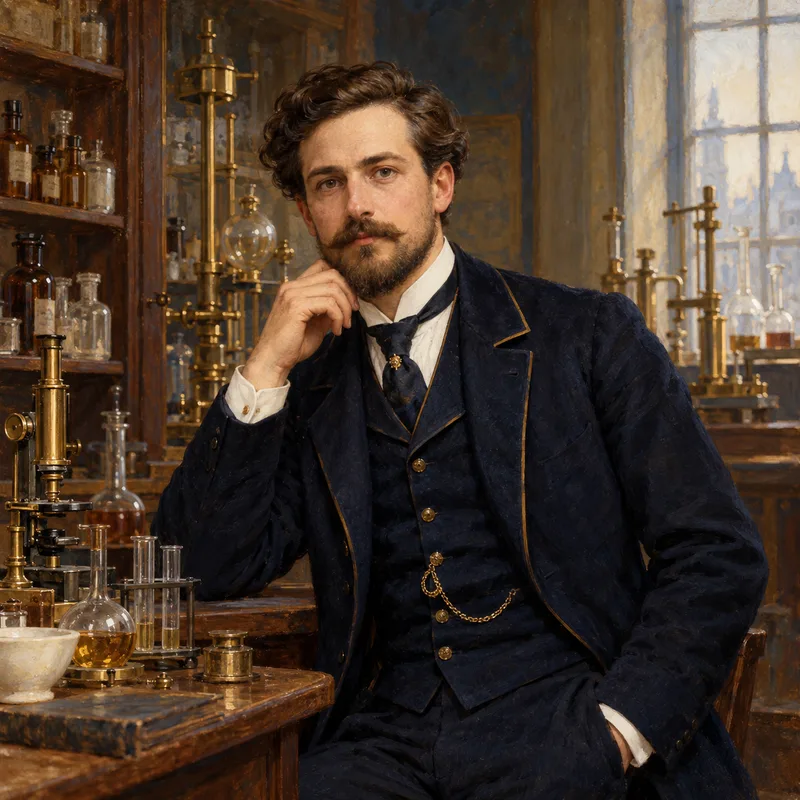
Felix Hoffmann
1868-1946 · Germany
Synthesised aspirin at Bayer