Biography · Chemist no. 98 of 350
Frances H. Arnold: The Engineer Who Taught Enzymes to Evolve
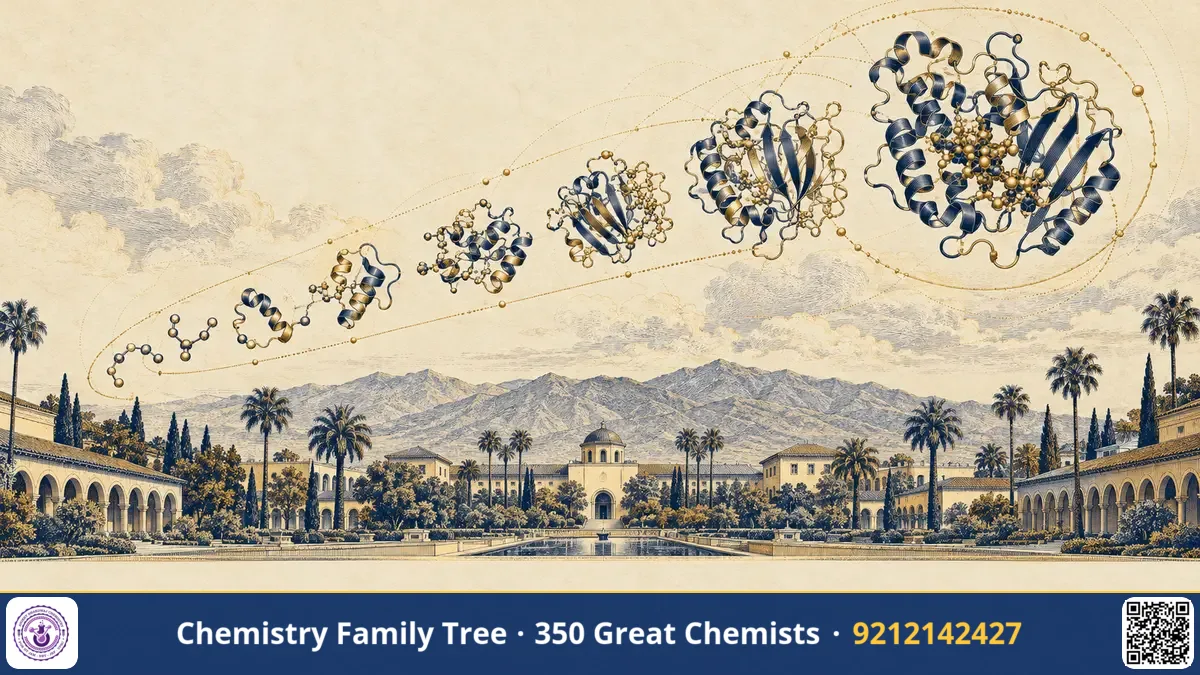
Frances Hamilton Arnold (born 1956) is an American chemical engineer and chemist at the California Institute of Technology (Caltech). She pioneered directed evolution, a laboratory method that uses repeated cycles of mutation and selection to create better enzymes. In 2018 she received half of the Nobel Prize in Chemistry, and she was the fifth woman to win it. Her legacy in one line: she showed that a chemist does not need to understand a protein completely in order to improve it, because evolution can do the design work if the experimenter chooses the right test.
Early Life and Family
Arnold was born on 25 July 1956 in Pittsburgh, Pennsylvania. Her father was a nuclear physicist, so science was part of the conversation at home, and she grew up in a family where engineering and physics were familiar subjects. As a teenager she was independent and strong-willed. She has said in interviews that she left home early and supported herself with jobs such as waitressing and driving a taxi. These experiences gave her a practical and unconventional outlook, which later showed in her research approach: try bold ideas, learn from failure and do not be afraid to leave the beaten track.
Education and Mentors
Arnold studied mechanical and aerospace engineering at Princeton University and earned her bachelor's degree in 1979. After graduation, she worked on solar energy, including time in Brazil and South Korea and a period at the Solar Energy Research Institute in Colorado. Concern for energy and the environment led her to biochemistry and chemical engineering. She did her PhD at the University of California, Berkeley, completing it in 1985 in chemical engineering with Harvey Blanch. She then continued in postdoctoral research at Berkeley before moving to Caltech in 1986. Her training in engineering, which values design, optimisation and testing, explains why her biology looked different from that of traditional biochemists.
Career Timeline
| Year | Event |
|---|---|
| 1956 | Born in Pittsburgh, USA |
| 1979 | BS in mechanical and aerospace engineering, Princeton |
| Early 1980s | Worked on solar energy in the USA and abroad |
| 1985 | PhD in chemical engineering, UC Berkeley |
| 1986 | Joined Caltech as assistant professor |
| 1993 | Published directed evolution of subtilisin for activity in organic solvent |
| 2000s | Evolved cytochrome P450 enzymes for new substrates |
| 2013-2016 | Engineered enzymes for new-to-nature carbene transfer reactions |
| 2016 | Millennium Technology Prize |
| 2018 | Nobel Prize in Chemistry (half share) |
Major Scientific Contributions
1. Directed evolution. The core idea is a repeating loop:
random mutation → screening → selection of the best variant → repeat
Arnold's 1993 work with the protease subtilisin showed that after a few rounds the enzyme could work in a solvent that normally destroyed its activity. The method was taken up in laboratories all over the world. See our discovery post on directed evolution for details.
2. Enzymes for hydrocarbons. Her group evolved cytochrome P450 enzymes to oxidise small alkanes such as propane and ethane, reactions that are difficult for conventional chemistry. The overall reaction is C–H hydroxylation: R–H + O₂ + 2 e⁻ + 2 H⁺ → R–OH + H₂O.
3. New-to-nature chemistry. Starting around 2012-2013 her lab converted heme proteins into catalysts for carbene and nitrene transfer. Examples include cyclopropanation of alkenes and C–H amination. In 2016 her team reported enzymes that form carbon-silicon bonds, a bond not known to be made by living organisms.
4. Sustainable chemistry. Arnold has long argued that biocatalysis can reduce the use of toxic metals and solvents, and she has applied directed evolution to biofuel production pathways.
Awards, Honours and Nobel Prize
The Nobel Prize in Chemistry 2018 was divided: one half to Frances H. Arnold "for the directed evolution of enzymes", and the other half jointly to George P. Smith and Sir Gregory P. Winter "for the phage display of peptides and antibodies". Earlier she received the US National Medal of Technology and Innovation and the Millennium Technology Prize (2016), for which she was the first woman to be named a laureate. She is a member of the US National Academy of Sciences, National Academy of Engineering and National Academy of Medicine, and she holds the Linus Pauling Professorship at Caltech. For other honours, use an official biography.
Personality, Struggles and Lesser-Known Facts
- An engineer among chemists: Her degrees are in engineering, not chemistry. She often says that this outsider's view allowed her to propose a method that experts in protein chemistry found surprising.
- Independent youth: She left home as a teenager and supported herself with ordinary jobs. This shaped her self-reliant character.
- Early scepticism: When she proposed that random mutation and screening could beat rational design, many scientists doubted her. It took years of results to persuade the community.
- Entrepreneur: She helped found start-up companies, including Gevo (biofuels and chemicals) and Provivi (agricultural chemistry), showing that university science can reach the market.
- Public role: She has spoken about the importance of diversity in science and has served on national advisory bodies in the United States, including as a co-chair of the President's Council of Advisors on Science and Technology.
Legacy and Influence on Modern Chemistry
Directed evolution is now a standard technique in universities and companies. Almost every biotech firm that makes enzymes for detergents, food or drugs uses it. It changed the way we think about catalyst design: instead of designing a perfect structure from theory, we can let diversity and selection explore a vast space of possibilities. It also reconnected chemistry, engineering and biology, which is exactly the type of interdisciplinary work encouraged in India's newer curricula. Arnold's story is important for young women in science, because she reached the top of a field that has historically had few women Nobel laureates.
Lessons for Students
- Look at problems from another discipline. Engineering skills opened a new path in biochemistry.
- Do not wait for full understanding. A good experiment can succeed even when theory is incomplete.
- Design the screen carefully. What you measure is what you get.
- Be ready for doubt. New ideas often face resistance.
Quick Facts Box
- Born: 25 July 1956, Pittsburgh, Pennsylvania, USA
- Died: Living
- Nationality: American
- Field: Chemical engineering, biochemistry, protein engineering
- Famous for: Directed evolution of enzymes
- Nobel: Chemistry 2018 (half share; other half to Smith and Winter)
FAQ
Is Frances Arnold a chemist or an engineer?
Her degrees are in engineering, and she holds a professorship in chemical engineering, bioengineering and biochemistry at Caltech. Her work is at the interface of chemistry, biology and engineering.
Which institute does Arnold work at?
The California Institute of Technology (Caltech), where she has been since 1986.
What did Arnold win the Nobel Prize for?
For the directed evolution of enzymes, which she shared with phage display (Smith and Winter) in the 2018 Nobel Prize.
Was she the first woman to win the Nobel Prize in Chemistry?
No. She was the fifth woman, after Marie Curie, Irène Joliot-Curie, Dorothy Hodgkin and Ada Yonath.
Published by ABC Chemistry — IIT-JAM | CSIR-NET | GATE Chemistry Coaching. Visit abcchemistry.com
About the chemist
Frances Arnold
1956- · United States · Nobel Chemistry 2018
Directed evolution of enzymes