The discovery, explained · Chemist no. 98 of 350
Frances Arnold and the Art of Evolving Enzymes in the Test Tube
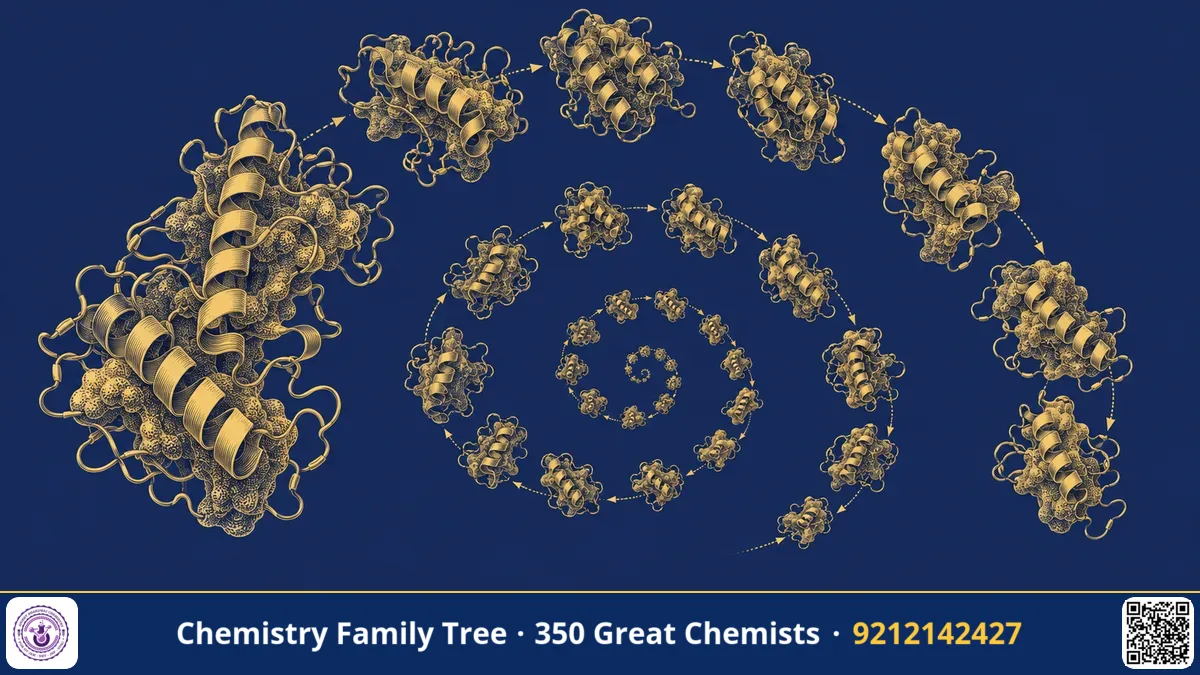
Nature took billions of years to make enzymes. Frances H. Arnold asked a bold question: can chemists copy the process of evolution in a laboratory and get better enzymes in weeks? Her answer, directed evolution, is a method in which genes are mutated at random, the resulting proteins are screened for a useful property, the best ones are selected, and the cycle is repeated. In the early 1990s her group at Caltech showed that this simple loop could make enzymes that work in solvents, at high temperature or on completely new substrates. For this achievement Arnold received half of the 2018 Nobel Prize in Chemistry, becoming the fifth woman to win it. The other half was shared by George P. Smith and Sir Gregory Winter for phage display.
The Scientific Problem Before the Discovery
Enzymes are excellent catalysts. They work in water at room temperature, they are highly selective and they create very little waste. But natural enzymes are made for the needs of a living cell, not for an industrial reactor. In a factory, one may need an enzyme that tolerates organic solvent, high temperature or acidic conditions, or one that acts on an unnatural substrate.
The traditional approach, called rational design, tried to predict from the three-dimensional structure which amino acid to change. It rarely worked. A protein has hundreds of amino acids and the effect of a single mutation depends on many interactions that are hard to predict. In the 1980s, scientists could make site-directed mutants, but they still needed to know which site to change. Arnold, who was trained as a chemical engineer, found the problem from a different angle: if you cannot predict, then try many variants and let a test select the winner, exactly as nature does.
The Discovery: Step by Step
- Choose a starting enzyme. Arnold's group chose subtilisin E, a protease (enzyme that cuts peptide bonds), because it is used in detergents.
- Introduce random mutations. The gene was copied by error-prone PCR, a polymerase chain reaction run under conditions that cause errors, so each copy carried a few random amino acid changes.
- Express the library. Bacteria were made to produce thousands of different variants, one per colony.
- Screen for the property. The group tested the activity of each variant in a high concentration of the organic solvent dimethylformamide (DMF), where the normal enzyme loses activity.
- Select the best variant and repeat. The best mutant became the parent of the next round. After a few rounds, the enzyme was dramatically more active in DMF than the original, published in 1993.
- Recombine. Later, DNA shuffling (developed by Willem Stemmer) was added to the toolbox: genes from the best mutants are cut and recombined, mixing good mutations, like sexual reproduction.
The cycle can be summarised as:
Parent gene → random mutations (error-prone PCR) → library of variants
→ screen / select (high activity) → best variant → new parent → repeat
The Chemistry Behind It
Enzyme catalysis is described by the Michaelis-Menten equation:
v = Vmax[S] / (Km + [S]) and kcat = Vmax / [E]total
The catalytic efficiency is kcat/Km. Directed evolution aims to raise this value, to increase stability (higher melting temperature, Tm), or to change substrate or product selectivity (enantioselectivity). Each round of evolution is an uphill climb on a "fitness landscape", in which every point is a protein sequence and the height is the activity. Mutations that raise activity are kept. A key idea from Arnold's work is that the best mutations are often far from the active site, and that many small steps can add up to a large change in function.
The success of the method depends on a good screen: "you get what you screen for". If your assay measures the wrong thing, you evolve the wrong property.
Moving beyond natural reactions
Later, Arnold's lab took cytochrome P450 enzymes, which normally insert oxygen into C–H bonds, and evolved them to catalyse new reactions that biology does not use. In the 2010s they obtained enzymes that perform cyclopropanation of alkenes with diazo compounds through a carbene transfer:
Ph–CH=CH₂ + N₂=CH–CO₂Et --[engineered P450]--> cyclopropane + N₂
Further work produced enzymes that form carbon-silicon bonds, a bond that does not exist in nature, using engineered heme proteins. These examples show that evolution can be directed towards a chemistry that life has never used.
Applications Today
- Detergents: Evolved proteases and lipases work in cold water and with surfactants, saving energy in washing.
- Pharmaceuticals: Evolved enzymes are used in drug manufacture. A well-known case is the engineered transaminase for the diabetes drug sitagliptin, developed by a company working with a pharmaceutical partner, which replaced a metal-catalysed step.
- Biofuels and chemicals: Arnold's group worked on enzymes and pathways for making fuels such as isobutanol from sugar, and she co-founded a company in this area.
- Green chemistry: Biocatalysis reduces the use of toxic metals and organic solvents, and lowers waste. This fits the aims of green chemistry education in India.
- Research tools: Directed evolution has been applied to antibodies, fluorescent proteins and genome-editing proteins.
Exam Corner
- Directed evolution cycle: diversity generation (error-prone PCR, DNA shuffling), screening or selection, amplification, repeat.
- Nobel Prize in Chemistry 2018: Frances Arnold (directed evolution of enzymes); George Smith and Gregory Winter (phage display of peptides and antibodies).
- Catalytic efficiency is kcat/Km. A good enzyme has high kcat and low Km.
- Error-prone PCR works because Taq polymerase lacks proofreading, and the error rate is raised by Mn²⁺ and unequal dNTP concentrations.
- Directed evolution does not need structural knowledge, unlike rational design or site-directed mutagenesis.
Common Misconceptions
- "It is just genetic engineering." It is different: the aim is not to insert a gene, but to search a huge sequence space through repeated mutation and selection.
- "Directed evolution is random." The mutations are random, but the selection is deliberate and directed by the experimenter.
- "Enzymes cannot do unnatural chemistry." Arnold's lab showed they can, after evolution.
Quick Revision Box
- Directed evolution = mutate, screen, select, repeat.
- First major demonstration: subtilisin in DMF, early 1990s.
- Methods: error-prone PCR, DNA shuffling (Stemmer).
- Efficiency measure: kcat/Km.
- Extended to new-to-nature reactions: cyclopropanation, C–Si bond formation.
- Nobel Prize in Chemistry 2018 (half), with Smith and Winter (other half).
FAQ
What is directed evolution?
It is a laboratory method that imitates natural selection: genes are mutated, the best-performing proteins are selected, and the process is repeated to improve a desired property.
Why did Arnold use random mutations instead of rational design?
Because predicting the effect of an amino acid change is very hard. Random mutation plus a good screen finds beneficial changes without needing that prediction.
What is error-prone PCR?
It is a PCR carried out under conditions that increase the mistakes of the DNA polymerase, giving a library of gene variants.
Is directed evolution used in industry?
Yes. It is used in detergent enzymes, pharmaceutical manufacturing, food processing and the production of biofuels and specialty chemicals.
Published by ABC Chemistry — IIT-JAM | CSIR-NET | GATE Chemistry Coaching. Visit abcchemistry.com
About the chemist
Frances Arnold
1956- · United States · Nobel Chemistry 2018
Directed evolution of enzymes