Biography · Chemist no. 29 of 350
Francis William Aston: The Man Who Weighed the Atoms
Introduction
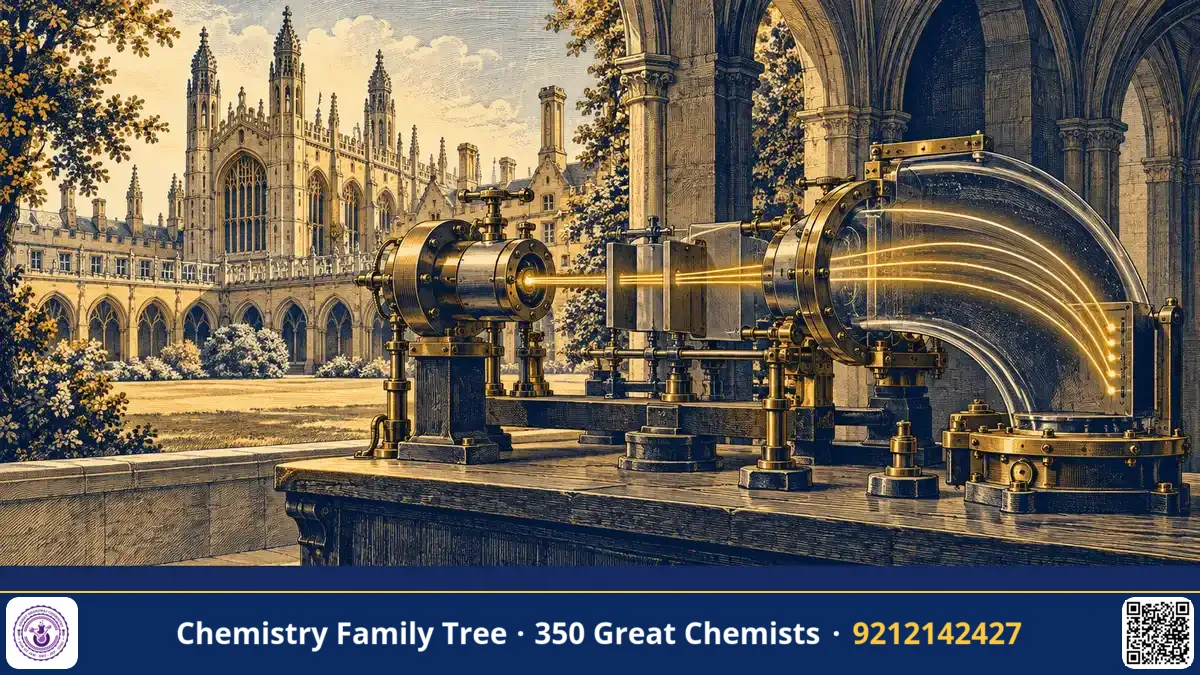
Francis William Aston (1877-1945) was an English chemist and physicist who spent his scientific career at the Cavendish Laboratory in Cambridge. He built the first mass spectrograph and used it to show that most elements are mixtures of isotopes. For this work he won the Nobel Prize in Chemistry in 1922. He was a skilled experimenter with great patience, and an instrument-maker whose designs set the standard for decades. His legacy in one line: he gave chemistry the first reliable way to weigh individual atoms.
Early Life and Family
Aston was born on 1 September 1877 in Harborne, near Birmingham, England. His father was a metal merchant and farmer. As a boy he loved making things. He built simple apparatus at home, including electrical devices and a small workshop of his own, and this practical skill stayed with him all his life. He attended Harborne Vicarage School and then Malvern College, where he showed ability in science.
Education and Mentors
Aston studied chemistry at Mason College in Birmingham, which later became the University of Birmingham. There he was taught by Percy Frankland and by the physicist John Henry Poynting. After college he worked for a few years as a chemist in a brewery in Wolverhampton, while continuing to experiment in a home laboratory. In 1903 he returned to Birmingham as a researcher and, in 1909, moved to the Cavendish Laboratory in Cambridge as assistant to J. J. Thomson. This changed his life. Thomson's work on positive rays introduced Aston to the problem of the masses of atoms.
Career Timeline
| Year | Event |
|---|---|
| 1877 | Born in Harborne, Birmingham (1 September) |
| 1890s | Studies chemistry at Mason College, Birmingham |
| Early 1900s | Works for a time as a brewery chemist |
| 1910 | Joins J. J. Thomson at the Cavendish Laboratory, Cambridge |
| 1912-13 | With Thomson, finds two isotopes of neon in positive-ray studies |
| 1914-18 | Works at the Royal Aircraft Factory, Farnborough, during the First World War |
| 1919 | Builds the first mass spectrograph in Cambridge |
| 1920 | States the whole-number rule |
| 1921 | Elected Fellow of the Royal Society |
| 1922 | Wins the Nobel Prize in Chemistry |
| 1920s-30s | Builds improved spectrographs with greater accuracy |
| 1945 | Dies in Cambridge (20 November) |
Major Scientific Contributions
- Isotopes of neon: with Thomson, he provided the first evidence for stable isotopes, neon-20 and neon-22.
- Mass spectrograph: the focusing design allowed precise mass determination and became the model of all later mass spectrometers.
- Isotopes in many elements: he identified isotopes in dozens of non-radioactive elements, including chlorine, bromine, krypton, xenon, mercury and tin.
- Whole-number rule and packing fraction: he showed that atomic masses of isotopes are close to whole numbers and used small deviations to discuss nuclear stability.
- Link to nuclear energy: his accurate mass measurements supported the idea of releasing energy from nuclei, and he spoke publicly about this possibility.
For the detailed chemistry and exam points, read our companion post on the mass spectrograph.
Awards, Honours and Nobel Prize
- Nobel Prize in Chemistry, 1922: for his discovery, by means of his mass spectrograph, of isotopes in a large number of non-radioactive elements, and for his enunciation of the whole-number rule.
- Fellow of the Royal Society (1921), and recipient of the Royal Society's Hughes Medal (1938).
- Fellow of Trinity College, Cambridge, for many years.
Personality, Struggles and Lesser-Known Facts
- Hands-on genius. Aston built much of his equipment himself, including glassblowing and vacuum work. Many colleagues said his skill with apparatus was almost artistic.
- A man of many hobbies. He was an enthusiastic sportsman and traveller, enjoying tennis, skiing, swimming and cycling. He also played the cello and took a serious interest in photography.
- Never married. He lived mostly in college rooms at Trinity and devoted his life to his work.
- Wartime work. During the First World War he worked on aircraft problems at Farnborough rather than on atoms, so his research on isotopes was delayed until 1919.
- Attention to public debate. He warned that the energy released from atoms could be used for good or harm, and he hoped that nations would use it wisely.
Legacy and Influence on Modern Chemistry
Aston's mass spectrograph opened the field of isotope analysis. Later scientists, including Arthur Dempster and Alfred Nier, developed instruments that used electrical detection, which became the mass spectrometer. Today, mass spectrometry underpins organic structure determination, proteomics, drug testing, environmental analysis, geochemistry and forensic science. His packing fraction idea was an early form of the binding energy curve that you study in nuclear chemistry. His accurate masses also helped confirm Einstein's equation E = mc² in the nuclear world.
Lessons for Students
- Learn to build and handle apparatus. Many great discoveries depend on skilled hands.
- Accuracy is a discovery in itself. Better measurement revealed hidden patterns.
- Stay curious outside the lab. Aston's interests in music, travel and photography fed his careful eye.
- Keep going after delays. The war interrupted his research, but he returned and finished the job.
- A good tool can outlive its inventor. Instruments shape science for generations.
Quick Facts Box
- Born: 1 September 1877, Harborne, Birmingham, England
- Died: 20 November 1945, Cambridge, England
- Nationality: British
- Field: Physical chemistry and mass spectrometry
- Famous for: Mass spectrograph, isotopes of non-radioactive elements, whole-number rule
- Nobel Prize: Chemistry, 1922
FAQ
Why did Francis Aston win the Nobel Prize?
For discovering isotopes in many non-radioactive elements using his mass spectrograph, and for formulating the whole-number rule.
What was Aston's connection with J. J. Thomson?
He was Thomson's assistant at the Cavendish Laboratory. Together they found the first stable isotopes, in neon, and Aston then developed the mass spectrograph independently.
Did Aston work on nuclear energy?
He did not work on weapons, but his precise mass data showed that large amounts of energy are stored in nuclei, and he discussed this publicly.
What is a packing fraction?
It is the difference between the isotopic mass and the mass number, divided by the mass number, usually multiplied by 10,000. It indicates how tightly the nucleus is bound.
Published by ABC Chemistry — IIT-JAM | CSIR-NET | GATE Chemistry Coaching. Visit abcchemistry.com
About the chemist
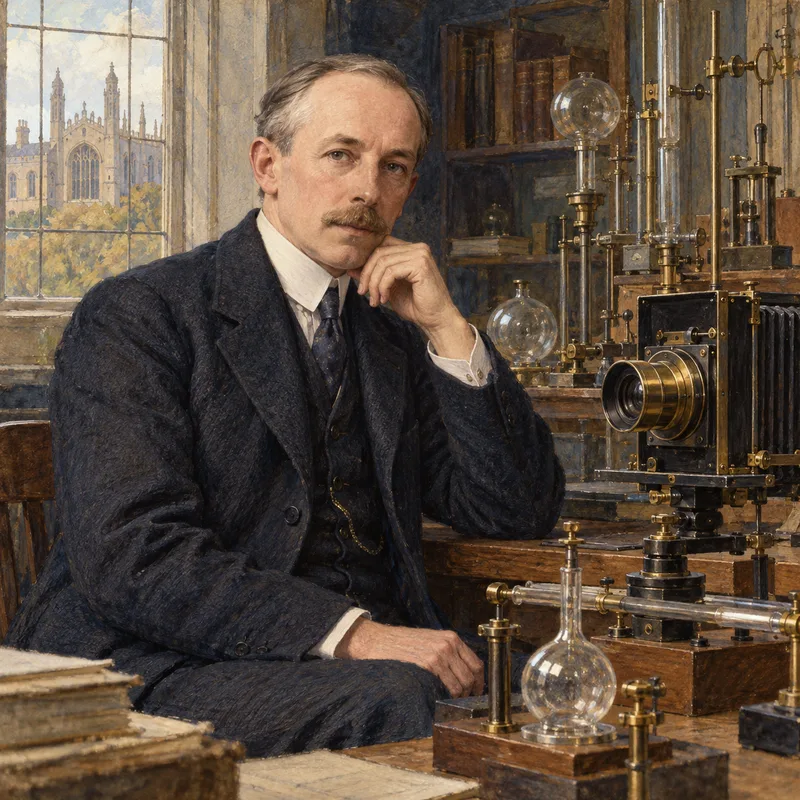
Francis William Aston
1877-1945 · United Kingdom · Nobel Chemistry 1922
Mass spectrograph; isotopes of elements