The discovery, explained · Chemist no. 29 of 350
Francis Aston and the Mass Spectrograph: Weighing Atoms One Isotope at a Time
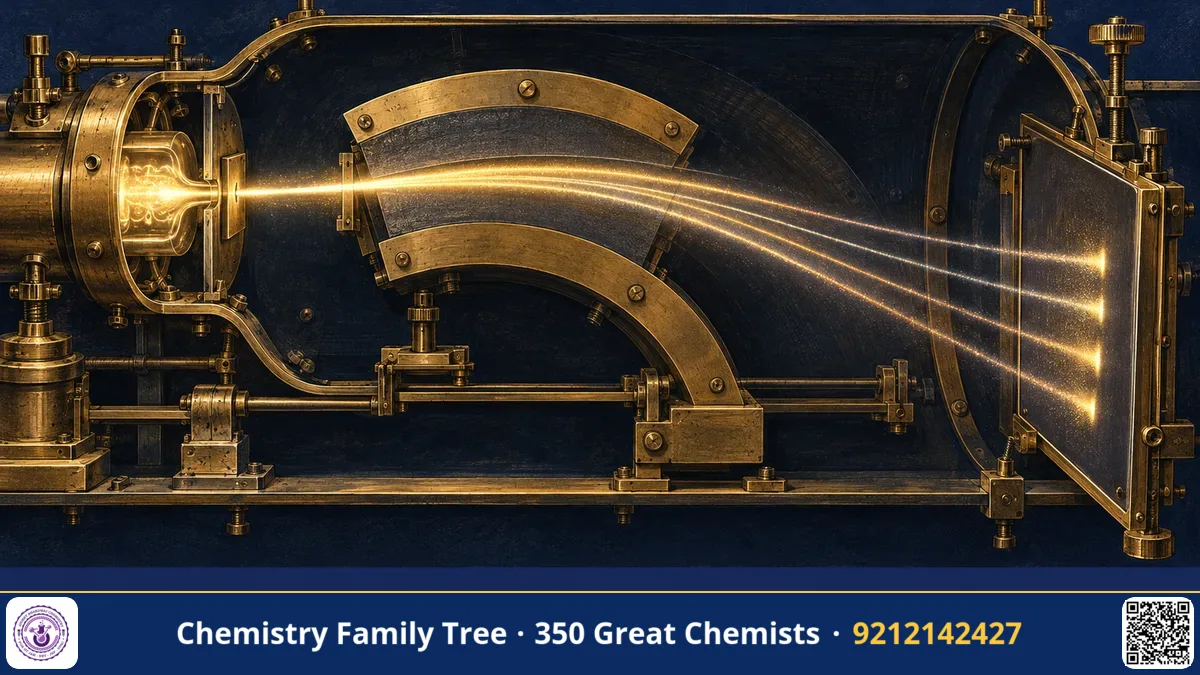
How do you weigh an atom? Francis William Aston found a beautiful answer. In 1919 he built an instrument at the Cavendish Laboratory in Cambridge that sorts charged atoms by their mass and records them as dark lines on a photographic plate. This instrument, the mass spectrograph, showed that most elements are mixtures of isotopes, and led to the whole-number rule for isotopic masses. Aston received the 1922 Nobel Prize in Chemistry for the discovery, by means of his mass spectrograph, of isotopes in a large number of non-radioactive elements and for his enunciation of the whole-number rule. Every modern mass spectrometer in a research lab, hospital or airport security desk descends from his idea.
The Scientific Problem Before the Discovery
By 1913 Frederick Soddy had shown that radioactive elements can have isotopes, atoms with the same chemical properties but different masses. But what about ordinary, stable elements? Many of them have atomic weights that are far from whole numbers. Chlorine, for example, has an atomic weight of about 35.45. If hydrogen has a mass of about 1, why should chlorine have a mass of 35.45 and not 35 or 36? Prout had suggested in 1815 that all atoms are made from hydrogen, but the fractional weights seemed to contradict that.
Two possibilities were open. Either chlorine atoms are all identical with a strange fractional mass, or chlorine is a mixture of atoms of whole-number masses, giving an average. To decide, scientists needed an instrument that could measure individual atomic masses, not bulk averages. Chemical methods could not separate isotopes because they behave identically in reactions.
The Discovery: Step by Step
Step 1: Positive rays and neon (1912-1913)
J. J. Thomson, working at the Cavendish Laboratory, had studied positive rays, beams of positively charged gas ions produced in a discharge tube. By passing them through electric and magnetic fields he could deflect them, and a beam of ions with the same charge-to-mass ratio landed as a single parabola on a photographic plate. In 1912-13 Thomson and his assistant Aston studied neon. Instead of one parabola, they saw two: one corresponding to mass 20 and a fainter one corresponding to mass 22. This was the first evidence for isotopes of a stable element, now known as neon-20 and neon-22. Aston tried to separate them by repeated diffusion through clay pipes, but only small differences could be obtained.
Step 2: A better instrument (1919)
After the First World War, in which he worked at the Royal Aircraft Factory at Farnborough, Aston returned to Cambridge. He designed a new instrument that did much more than the parabola method. The key idea was focusing: ions of the same mass but slightly different speeds would be brought to a sharp line, so that each mass produced a clear, narrow line on the plate.
- A gas is ionised in a discharge tube, producing positive ions.
- The ions pass through narrow slits, forming a thin beam.
- The beam passes through an electric field, which spreads the ions according to their energies.
- It then enters a magnetic field that bends the ions in the opposite sense and focuses ions of the same mass onto one point.
- The ions strike a photographic plate. The position of each line gives m/z, and its darkness gives the relative abundance.
Step 3: Isotopes everywhere
Using this instrument, Aston showed that chlorine consists of isotopes of mass 35 and 37 and that many other elements, such as argon, bromine, krypton, xenon, mercury and tin, are mixtures of isotopes. Over many years he and his instruments identified a large number of the naturally occurring isotopes. Tin was found to have a notably large number of stable isotopes.
Step 4: The whole-number rule
Aston found that the mass of each isotope, measured relative to oxygen-16 = 16, was very close to a whole number. This was the whole-number rule. The fractional atomic weights of elements arise only because the elements are mixtures. For chlorine:
Average atomic mass = (75.8 × 35 + 24.2 × 37) / 100 ≈ 35.5
Aston also found small deviations from exact whole numbers. He expressed them by the packing fraction:
Packing fraction = (isotopic mass - mass number) / mass number × 10⁴
These small deviations are explained by the mass defect and the nuclear binding energy. When nucleons combine, a little mass is converted to energy according to E = mc². Aston's accurate mass measurements thus supported Einstein's relation and gave an early view of the energy that could be released by nuclear processes.
The Chemistry Behind It
The principle of mass spectrometry
A charged particle of mass m and charge q moving at speed v in a magnetic field B follows a circular path of radius r. The magnetic force supplies the centripetal force:
qvB = mv²/r so r = mv/(qB)
Ions with a greater mass-to-charge ratio are bent less. An ion accelerated through a potential difference V has kinetic energy qV = ½mv², so
m/q = B²r² / (2V)
Measuring r therefore gives the mass of the ion.
Relative atomic mass
The relative atomic mass of an element is the weighted average of the masses of its isotopes. Today the carbon-12 scale is used as the standard, whereas Aston and his generation used oxygen-16 = 16.
Mass defect and binding energy
The mass of a nucleus is slightly less than the sum of its separate nucleons. The difference is the mass defect, and the energy equivalent is the binding energy. The packing fraction curve showed that iron-region nuclei are the most tightly bound.
Applications Today
- Chemistry labs: mass spectrometry gives molecular masses and fragmentation patterns, essential for identifying organic compounds. It is combined with GC and LC in routine analysis.
- Medicine and biology: mass spectrometry identifies proteins, drugs, hormones and metabolites. It is used in newborn screening and in testing for banned substances in sport.
- Geology and archaeology: isotope ratios measure the ages of rocks and fossils and trace the origin of materials.
- Isotope enrichment: mass-based separation methods developed from the same ideas were used to enrich uranium-235.
- India context: Indian research institutes and forensic and drug-testing laboratories use mass spectrometers, and Indian space missions have carried mass spectrometers to study planetary atmospheres.
Exam Corner
- Aston built the mass spectrograph (1919) and won the 1922 Nobel Prize in Chemistry. He first found neon-20 and neon-22 with J. J. Thomson.
- In a mass spectrometer, deflection depends on m/z; lighter ions are deflected more for the same charge and fields.
- Average atomic mass = sum of (isotopic mass × fractional abundance). Be ready to calculate Cl, Br or Mg.
- Whole-number rule: isotopic masses are very nearly whole numbers; deviations give mass defect and binding energy.
- In organic mass spectra, the molecular ion peak M⁺ gives the molecular mass, and the base peak is the most intense peak.
Common Misconceptions
- "The whole-number rule is exact." It is approximate. Small deviations exist because of mass defect.
- "Isotopes are separated by chemical reactions." They are separated by physical properties related to mass.
- "Atomic weight is always a whole number." The atomic weight of an element is an average over its isotopes.
Quick Revision Box
- 1912-13: Thomson and Aston see neon-20 and neon-22.
- 1919: Aston's mass spectrograph, using electric and magnetic fields to focus ions.
- Radius of path r = mv/(qB); heavier ions bend less.
- Whole-number rule: isotopic masses are nearly integers.
- Packing fraction measures deviation from whole numbers.
- Nobel Prize in Chemistry 1922.
FAQ
What is the difference between a mass spectrograph and a mass spectrometer?
A mass spectrograph records ions on a photographic plate. A mass spectrometer detects them electronically. Both use the same principle.
Why does chlorine have an atomic mass of 35.5?
Natural chlorine is a mixture of about 75.8 percent chlorine-35 and 24.2 percent chlorine-37, and 35.5 is the weighted average.
Who helped Aston?
He began as assistant to J. J. Thomson at the Cavendish Laboratory, and he worked at Trinity College, Cambridge, in later years.
Is the mass spectrograph used today?
The photographic version is mostly historical, but modern mass spectrometers follow the same physical principle and are among the most important instruments in chemistry.
Published by ABC Chemistry — IIT-JAM | CSIR-NET | GATE Chemistry Coaching. Visit abcchemistry.com
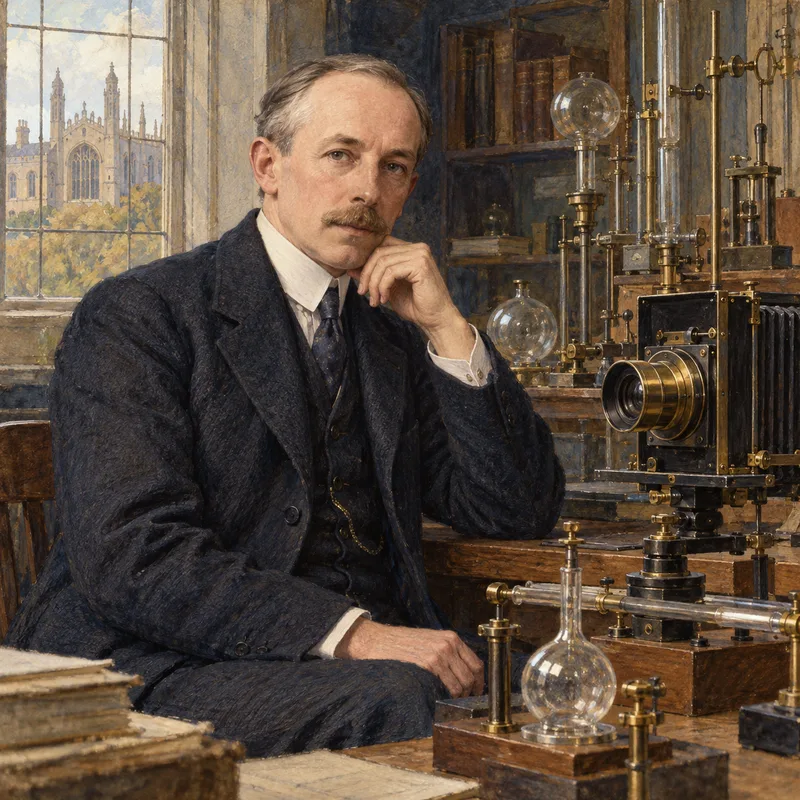
About the chemist
Francis William Aston
1877-1945 · United Kingdom · Nobel Chemistry 1922
Mass spectrograph; isotopes of elements