Biography · Chemist no. 322 of 350
Francis Crick: Complete Life and Legacy
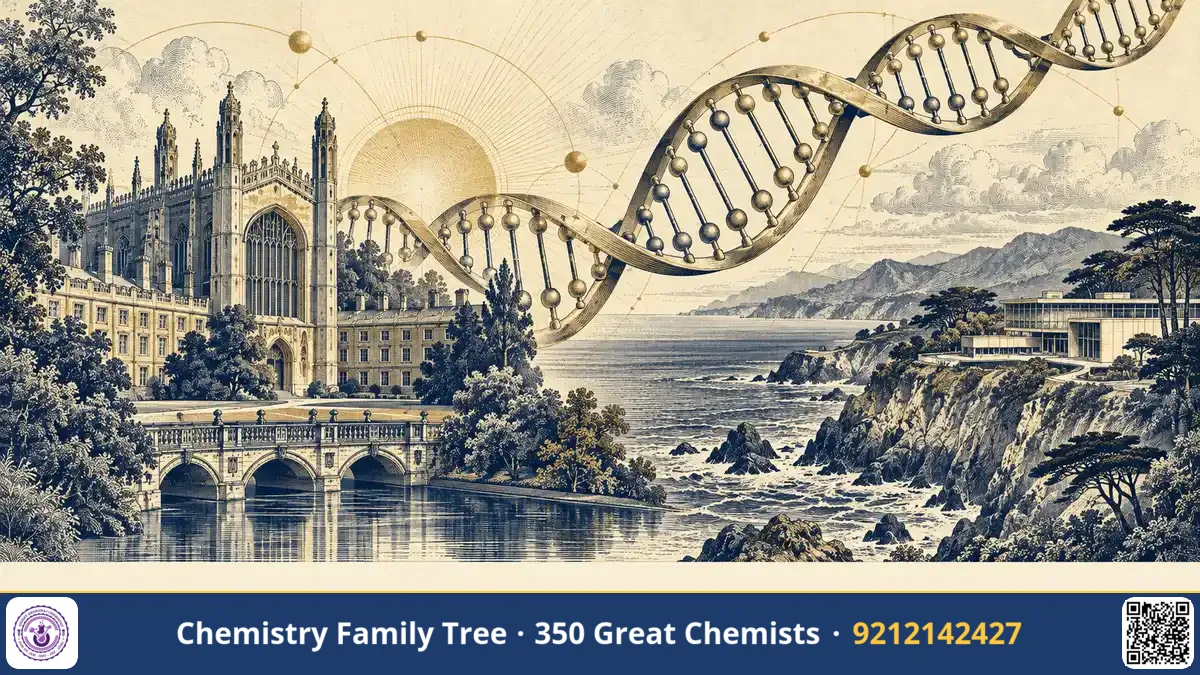
Francis Harry Compton Crick (1916-2004) was a British scientist who began as a physicist, switched to biology in his thirties and co-discovered the structure of DNA. He proposed the central dogma and the adaptor hypothesis, and helped to decode the genetic code. He shared the 1962 Nobel Prize in Physiology or Medicine with James Watson and Maurice Wilkins. In his final decades he turned to one of the hardest problems of all: how the brain produces consciousness. His life shows that curiosity is more important than a ready-made speciality.
Early Life and Family
Francis Crick was born on 8 June 1916 in Weston Favell, near Northampton, England. His father, Harry Crick, ran a family boot and shoe business, and his mother was Annie Elizabeth Wilkins. He was the elder of two sons. As a child he was extremely curious, asking questions about everything, and he loved reading science books. His mother was patient with his questions, though he later said that he was sometimes told he was asking too many. He attended Northampton Grammar School and then Mill Hill School in London, where he studied mathematics, physics and chemistry. He did not originally plan to be a biologist; the question "what is life?" slowly pulled him towards biology.
Education and Mentors
He studied physics at University College London and graduated with a second-class degree in 1937. He began a Ph.D. on the viscosity of water at high temperature under Edward Neville da Costa Andrade, but his work was ended when the laboratory was destroyed by a German bomb in 1940. During the Second World War he worked for the British Admiralty on the design of magnetic and acoustic mines. After the war he read Erwin Schrödinger's What Is Life? and Linus Pauling's articles, and decided to move to biology. In 1947 he started to work at the Strangeways Laboratory in Cambridge and then moved in 1949 to the Medical Research Council unit at the Cavendish Laboratory under Max Perutz and Sir Lawrence Bragg, to study protein structure using X-ray diffraction. He completed his Ph.D. at Cambridge in 1954 on X-ray diffraction of proteins, with Perutz as a supervisor. There he met James Watson in 1951.
Career Timeline
| Year | Event |
|---|---|
| 1916 | Born near Northampton, England |
| 1937 | B.Sc. in physics, University College London |
| 1940-1947 | Scientific work for the Admiralty (mine design) |
| 1947 | Changed to biology; Strangeways Laboratory, Cambridge |
| 1949 | Joined Cavendish Laboratory, Cambridge |
| 1953 | With Watson, proposed the double-helix structure of DNA |
| 1954 | Ph.D., Cambridge |
| 1955-1958 | Adaptor hypothesis; sequence hypothesis; central dogma |
| 1961 | Triplet nature of the genetic code (with Brenner) |
| 1962 | Nobel Prize in Physiology or Medicine |
| 1966 | Wobble hypothesis |
| 1976 | Moved to the Salk Institute for Biological Studies, La Jolla, California |
| 1980s-2004 | Research on the neural basis of visual awareness and consciousness, with Christof Koch |
| 2004 | Died on 28 July in San Diego |
Major Scientific Contributions
- DNA double helix (1953): With Watson, using data from Franklin and Wilkins. Crick's skills in X-ray diffraction theory, notably helical diffraction (he worked this out with William Cochran and Vladimir Vand), were vital.
- Central dogma and sequence hypothesis: The logical framework of molecular biology.
- Adaptor hypothesis: The prediction of tRNA.
- Triplet code and reading frame: Proved with Brenner using phage T4.
- Wobble hypothesis: Third-base flexibility in codon-anticodon pairing.
- Neuroscience: From the late 1970s, a systematic scientific attack on consciousness, including ideas on the visual system, the claustrum and the role of attention.
The details of the code and the dogma are given in our discovery blog on Crick.
Awards, Honours and Nobel Prize
The 1962 Nobel Prize in Physiology or Medicine was shared by Crick, Watson and Wilkins for their discoveries concerning the molecular structure of nucleic acids. Crick was elected Fellow of the Royal Society (1959), and received the Royal Medal (1972) and the Copley Medal (1975). He was awarded the Order of Merit in 1991. He is known to have declined a knighthood, but he accepted the Order of Merit. He was also a foreign associate of the US National Academy of Sciences.
Personality, Struggles and Lesser-Known Facts
- A late starter: He was 31 when he first changed to biology, and 37 when he proposed the double helix. He had no Ph.D. when the double helix was solved.
- Talkative and brilliant: Colleagues recalled that his loud laughter and constant discussion filled the Cavendish corridors. Sir Lawrence Bragg, the head of the laboratory, is said to have been irritated at times by the noise and by the pair's focus on DNA instead of their assigned work.
- Founder of the RNA Tie Club: In 1954-55 he took part in an informal club started by the physicist George Gamow to think about the genetic code. Every member wore a tie with an RNA design and a pin with the abbreviation of an amino acid.
- Family: He married Ruth Doreen Dodd (1940) and had a son, Michael; after their divorce he married the artist Odile Speed in 1949, and they had two daughters, Gabrielle and Jacqueline. Odile designed the well-known sketch of the double helix.
- Beyond biology: In the 1960s he speculated on the origin of life, and in 1973 with Leslie Orgel he proposed "directed panspermia", the idea that life might have been seeded on Earth by intelligent beings from elsewhere. It was a speculative thought experiment, not an accepted theory.
- Letter to his son: He wrote on the day of the discovery to his son Michael describing the structure; the handwritten letter was sold at auction in 2013 for a record sum.
Legacy and Influence on Modern Chemistry
Crick's genius was to ask clear questions and to see what had to be true. His central dogma is still the starting point of every molecular biology course. His attitude, that biology can be understood in terms of chemistry and physics, became the foundation of modern biochemistry and molecular medicine. In his last decades at the Salk Institute he encouraged scientists to look at the brain with the same rigour. Indian students will recognise his name in almost every topic of molecular biology, from replication and transcription to translation and the genetic code.
Lessons for Students
- You can change your field. A physicist became a world leader in biology.
- Think clearly, test boldly. Crick's predictions of tRNA were made before it was discovered.
- Talk to people. Daily argument and conversation with Watson, Brenner and others led to his best ideas.
- Take on the big questions at any age. He started consciousness research in his sixties.
Quick Facts Box
- Born: 8 June 1916, near Northampton, England
- Died: 28 July 2004, San Diego, California, USA
- Nationality: British
- Field: Molecular biology, biophysics, neuroscience
- Famous for: DNA double helix, central dogma, adaptor hypothesis, genetic code
- Nobel: 1962, Physiology or Medicine (with Watson and Wilkins)
FAQ
Was Crick a chemist?
No, he trained as a physicist. He worked in X-ray crystallography, molecular biology and later neuroscience. His work is, however, central to biochemistry and chemistry syllabuses.
What did Crick do after the double helix?
He proposed the central dogma and the adaptor hypothesis, and proved the triplet nature of the code with Sydney Brenner.
Why did Crick move to the Salk Institute?
In 1976 he moved to La Jolla to work on neuroscience, particularly visual awareness and consciousness, in a place that encouraged interdisciplinary research.
Who drew the first picture of the double helix?
Odile Crick, his wife, an artist, drew the diagram published with the 1953 paper.
Published by ABC Chemistry — IIT-JAM | CSIR-NET | GATE Chemistry Coaching. Visit abcchemistry.com
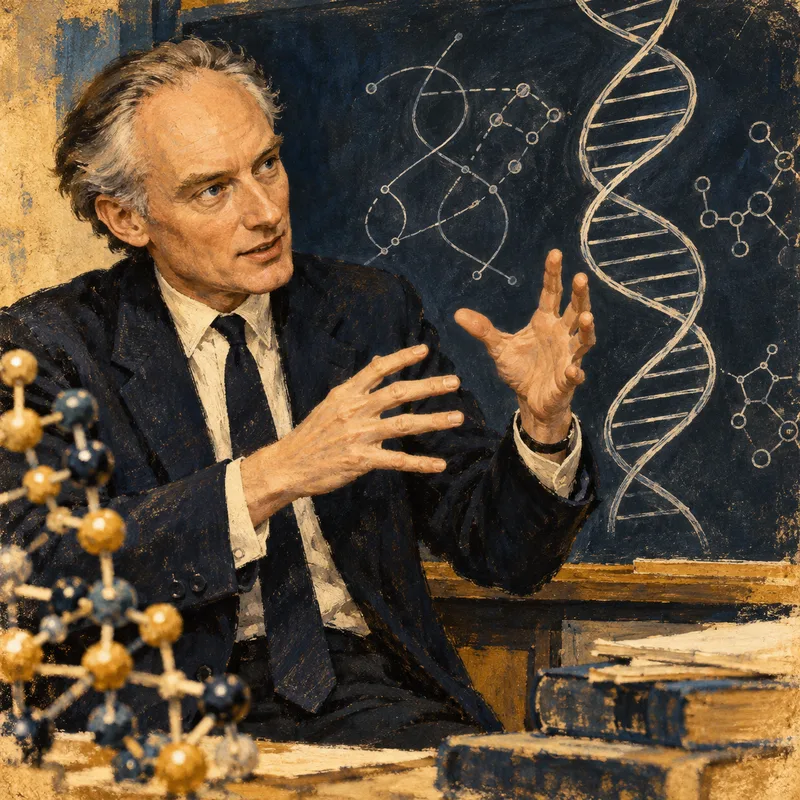
About the chemist
Francis Crick
1916-2004 · United Kingdom · Nobel Physiology/Medicine 1962
Co-discovered DNA double helix; central dogma