The discovery, explained · Chemist no. 322 of 350
Francis Crick: The Central Dogma and the Genetic Code
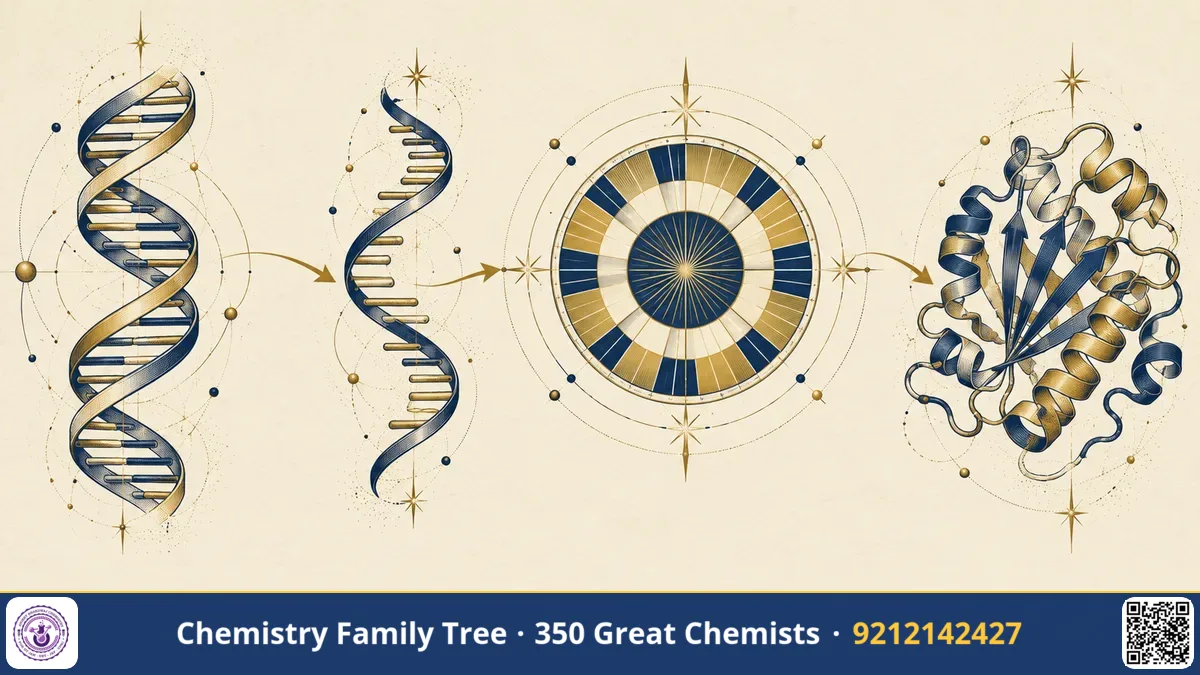
The double helix of 1953 was only the beginning for Francis Harry Compton Crick (1916-2004). Over the next fifteen years he did more than anyone to turn DNA structure into a theory of how living cells work. In 1957-58 he proposed the central dogma of molecular biology: information flows from DNA to RNA to protein, and not back from protein. He predicted that small adaptor molecules carry amino acids to the ribosome, which turned out to be transfer RNA. In 1961, with Sydney Brenner and others, he showed that the genetic code is read in non-overlapping triplets. In 1966 he suggested the wobble hypothesis. Crick shared the 1962 Nobel Prize in Physiology or Medicine with James Watson and Maurice Wilkins for the structure of DNA.
The Scientific Problem Before the Discovery
Once the double helix was known, new puzzles arose. DNA sits in the nucleus, but proteins are made in the cytoplasm on ribosomes. How is the information carried across? DNA has only four letters, yet proteins have twenty amino acids. How can a four-letter alphabet specify twenty different units? What is the nature of the code? Is it overlapping or not? Is it read from a fixed starting point? And how does an amino acid, which has no chemical affinity for a nucleotide sequence, find its position on the template?
Crick, a physicist by training who had switched to biology, approached these questions as logical puzzles that could be solved by reasoning and by simple genetic experiments.
The Discovery / Experiment
Step 1: The sequence hypothesis and the central dogma
In a 1957 lecture, "On Protein Synthesis", and a 1958 paper, Crick set out two ideas. The sequence hypothesis says that the order of bases in a gene determines the order of amino acids in a protein, and that the protein folds up by itself from its sequence. The central dogma says that once information has passed into protein it cannot get out again. In its usual textbook form:
DNA  →  DNA      (replication)
DNA  →  RNA      (transcription)
RNA  →  Protein  (translation)
Special cases:  RNA → RNA (RNA viruses), RNA → DNA (reverse transcription)
Never:  Protein → DNA, RNA or protein
Many students think the central dogma was disproved by reverse transcriptase (discovered by Temin and Baltimore in 1970), but that is a misunderstanding. Crick had explicitly included RNA to DNA as a possible transfer; what he ruled out was transfer from protein back to nucleic acid.
Step 2: The adaptor hypothesis
Crick argued that amino acids cannot recognise codons directly. In 1955 he proposed (in a note to the "RNA Tie Club") that each amino acid is attached to a small adaptor molecule which carries a nucleotide-based recognition site. Soon after, Mahlon Hoagland and Paul Zamecnik isolated small soluble RNA molecules (now called tRNA) carrying amino acids, confirming the idea. Today we know that aminoacyl-tRNA synthetases attach the correct amino acid to its tRNA using ATP, and the anticodon of tRNA pairs with the mRNA codon on the ribosome.
Step 3: The triplet code and reading frame
In 1961, Crick, Leslie Barnett, Sydney Brenner and Richard Watts-Tobin used the chemical mutagen proflavine (an acridine dye) on bacteriophage T4 to add or delete single bases. They found that adding or deleting one base destroys the gene's function (a frameshift), as does adding or deleting two bases. But adding three bases (or deleting three) restored function in many cases. This showed that:
- The code is read in groups of three bases (codons).
- The reading is continuous, from a fixed starting point, with no punctuation between codons.
- The code does not overlap.
Three bases give 4 × 4 × 4 = 64 combinations, more than enough for 20 amino acids. This suggested that the code is degenerate, meaning that more than one codon can code for one amino acid.
Step 4: Cracking the code and the wobble hypothesis
Nirenberg and Matthaei (1961), Ochoa, and Khorana (1960s) then determined which codon corresponds to which amino acid. Of the 64 codons, 61 code for amino acids, and 3 (UAA, UAG, UGA) are stop codons. AUG codes for methionine and acts as the start codon. A puzzle was that cells have fewer than 61 types of tRNA. In 1966 Crick suggested the wobble hypothesis: the first two positions of a codon pair strictly with the anticodon, but the third position of the codon (and the first of the anticodon) can pair less strictly. For example, G in the anticodon's first position can pair with C or U, and inosine (I) can pair with U, C or A. This explains the degeneracy of the code.
The Chemistry Behind It
- Codon-anticodon pairing uses Watson-Crick hydrogen bonds: A–U (two) and G–C (three), antiparallel.
- Aminoacylation: amino acid + ATP → aminoacyl-AMP + PPi; aminoacyl-AMP + tRNA → aminoacyl-tRNA + AMP. Two high-energy bonds are used per amino acid.
- Peptide bond: formed on the ribosome by the 23S/28S rRNA, which acts as a ribozyme (peptidyl transferase).
- Degeneracy: Leucine, serine and arginine have six codons each; methionine and tryptophan have only one each.
- Properties of the code: triplet, non-overlapping, comma-less, degenerate, nearly universal, and with start and stop signals.
Applications Today
- Genetic engineering: Codon optimisation is used to express human proteins such as insulin in bacteria and yeast.
- Genetic disease: Frameshift mutations explain diseases such as some forms of Tay-Sachs disease and cystic fibrosis.
- Antibiotics: Streptomycin, tetracycline and erythromycin work by interfering with bacterial translation, an idea based on adaptor and ribosome knowledge.
- mRNA vaccines: Using the codon system and tRNA, mRNA vaccines instruct our cells to build a viral protein.
- Synthetic biology: Researchers are now expanding the code with unnatural amino acids by engineering new tRNA-synthetase pairs.
Exam Corner
- Central dogma (Crick, 1958): DNA to RNA to protein; information cannot flow from protein to nucleic acid.
- Genetic code is triplet, non-overlapping, degenerate and nearly universal; 61 sense codons, 3 stop codons; AUG is the start codon.
- Wobble occurs at the 3rd position of the codon (5' end of the anticodon). Inosine pairs with U, C, A.
- Frameshift: adding or deleting one or two bases destroys the gene; three bases restore the frame (Crick, Brenner, 1961).
- Crick received the 1962 Nobel Prize in Physiology or Medicine.
Common Misconceptions
- "Reverse transcriptase disproved the central dogma." No, because RNA to DNA transfer was already allowed. Only protein to nucleic acid is forbidden.
- "The genetic code is perfectly universal." Almost, but mitochondria and some organisms use slightly different assignments.
- "Crick won a Chemistry Nobel." It was Physiology or Medicine. He trained in physics.
Quick Revision Box
- Central dogma: replication, transcription, translation.
- Adaptor molecule = tRNA, carrying the anticodon and the amino acid.
- Triplet code shown by frameshift mutations in phage T4 (1961).
- 64 codons: 61 sense, 3 stop (UAA, UAG, UGA).
- Wobble hypothesis (1966) explains degeneracy.
- Nobel Prize 1962, Physiology or Medicine.
FAQ
What does the central dogma state?
Sequence information passes from nucleic acid to protein, but once in protein it cannot return to nucleic acid or to another protein.
How did Crick prove that the code is a triplet?
By showing that adding or removing one or two bases from a viral gene destroys its function, while adding or removing three restores it.
What is the wobble hypothesis?
It states that the third base of a codon can form non-standard pairs with the first base of the anticodon, so a single tRNA can read more than one codon.
Is the central dogma important for entrance exams?
Yes. Questions on codons, wobble, tRNA charging, reverse transcription and frameshift mutations are common in NET, GATE and JAM.
Published by ABC Chemistry — IIT-JAM | CSIR-NET | GATE Chemistry Coaching. Visit abcchemistry.com
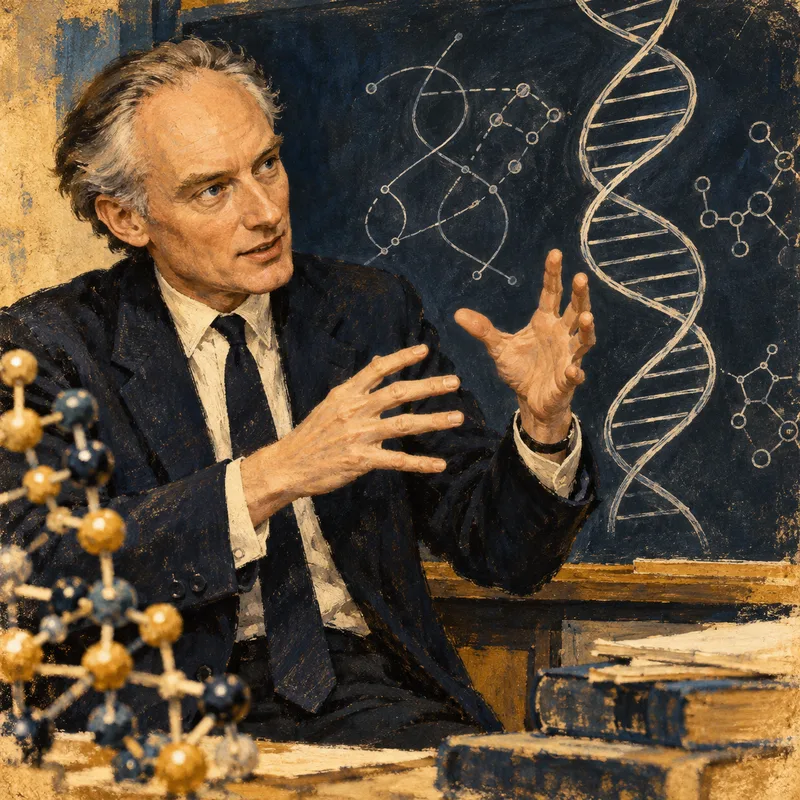
About the chemist
Francis Crick
1916-2004 · United Kingdom · Nobel Physiology/Medicine 1962
Co-discovered DNA double helix; central dogma