Biography · Chemist no. 263 of 350
François-Marie Raoult (1830-1901): The Patient Measurer of Freezing Points
Introduction
François-Marie Raoult was a French chemist and professor at the University of Grenoble. Through thousands of careful measurements of freezing points and vapour pressures, he established the laws that bear his name and gave chemists the tools to find the molar masses of dissolved substances. His legacy in one line: he showed that the effect of a solute on a solvent depends on how many particles are dissolved, not on what they are.
Early Life and Family
Raoult was born on 10 May 1830 in Fournes-en-Weppes, a village in northern France near Lille. His family was modest, and he grew up without wealth. He had to work to support himself, and for many years he took jobs as a teacher or as a clerk. His life is a good example of a scientist who came from a poor background and reached an important place by determination and hard work.
Education and Mentors
As a young man Raoult worked as a tutor and school teacher in different towns, studying at the same time. He moved to Paris for some time, where he continued his studies. He earned his science degree and in the 1860s taught in a lycée in Sens. He took his doctorate in 1863 with a thesis on the electromotive force of electric cells, which he measured with care, and in which he related the electrical energy of cells to the heat of chemical reactions. This early work shows his interest in precise measurement, which stayed with him through his career. He had no single famous mentor and was to a large extent self-taught.
Career Timeline
| Year | Event |
|---|---|
| 1830 | Born in Fournes-en-Weppes, 10 May |
| 1850s | Worked as teacher and clerk while continuing his studies |
| 1863 | Doctorate on electromotive force of cells |
| 1860s | Taught at the lycée in Sens |
| 1867 | Moved to the University of Grenoble |
| 1870s | Became professor of chemistry at Grenoble |
| 1882 | Announced the law of freezing point depression for solutions |
| 1886-87 | Published the law of vapour pressure lowering |
| 1901 | Died in Grenoble, 1 April |
Major Scientific Contributions
- Cryoscopy (1882): Equal numbers of moles of different non-electrolytes dissolved in the same amount of solvent lower its freezing point by the same amount. The method became a standard technique to find molar masses. See our discovery blog for the equations.
- Raoult's law (1886-87): The relative lowering of the vapour pressure of a solvent is equal to the mole fraction of the non-volatile solute.
- Ebullioscopy: Related measurements of the boiling point elevation of solutions, which gave a second route to molar masses.
- Molar mass determination: He showed that his methods could give the molecular weights of dissolved organic compounds with good accuracy, long before spectroscopic techniques existed.
- Anomalies with salts: His results showed that electrolytes give bigger effects than expected. These anomalies were later explained by Arrhenius and van't Hoff through the theory of electrolytic dissociation and the van't Hoff factor i.
Awards, Honours and Nobel Prize
Raoult received recognition in France during his later years. His work was very much appreciated by the physical chemists van't Hoff, Arrhenius and Ostwald, who used his data as an experimental base for their theories. When van't Hoff received the first Nobel Prize in Chemistry in 1901 for his work on solutions and osmotic pressure, Raoult's experimental findings were part of the foundation of that work. Raoult himself did not receive a Nobel Prize; he died in April 1901, before the first prizes were awarded in December of that year.
Personality, Struggles and Lesser-Known Facts
- He was a quiet man, completely devoted to experiment. He repeated measurements many times, and his accuracy was his strength.
- He began as a teacher and reached a university post only in his late thirties, an unusual path for a scientist of that period.
- Despite working far from Paris, in Grenoble, he made major discoveries. This was a time when most prestigious research was done in the capital.
- The word "cryoscopy", from Greek roots meaning "to observe the cold", is linked with his freezing-point method.
Legacy and Influence on Modern Chemistry
Raoult's law is a pillar of solution chemistry. It defines the idea of an ideal solution, and deviations from it are used to study intermolecular forces. The concept of activity coefficients, developed by G. N. Lewis, is a measure of how far real solutions differ from Raoult's law. His data helped explain osmosis, the working of membranes and the behaviour of electrolytes. Practical uses include antifreeze, de-icing, saline drips and the design of distillation columns. In Indian syllabi, Raoult's law features in Class 12 (Solutions), and in physical chemistry papers of JAM, NET and GATE, which commonly ask about deviations, azeotropes and molar mass determination.
Lessons for Students
- Start where you are. Raoult became a professor after years as a teacher and clerk.
- Precision matters. His laws came from careful, repeated measurement.
- Look for exceptions. The anomaly with salts led to a new theory of ions.
- Work does not need a big city. Great science was done in Grenoble.
- Your data can support other people's theories. Van't Hoff and Arrhenius built on his results.
Quick Facts Box
- Born: 10 May 1830, Fournes-en-Weppes, France
- Died: 1 April 1901, Grenoble
- Nationality: French
- Field: Physical chemistry
- Famous for: Raoult's law; cryoscopy
- Nobel Prize: None (died before the first prizes)
FAQ
Where did Raoult work?
At the University of Grenoble in France, where he became professor of chemistry.
What is cryoscopy?
The determination of molar mass from the lowering of freezing point of a solvent by a dissolved solute.
How did Raoult's work help Arrhenius?
His data showed that salts lower freezing points more than expected, which supported the idea that they dissociate into ions.
Did Raoult win a Nobel Prize?
No. He died in April 1901, before the first Nobel Prizes were awarded.
Published by ABC Chemistry — IIT-JAM | CSIR-NET | GATE Chemistry Coaching. Visit abcchemistry.com
About the chemist
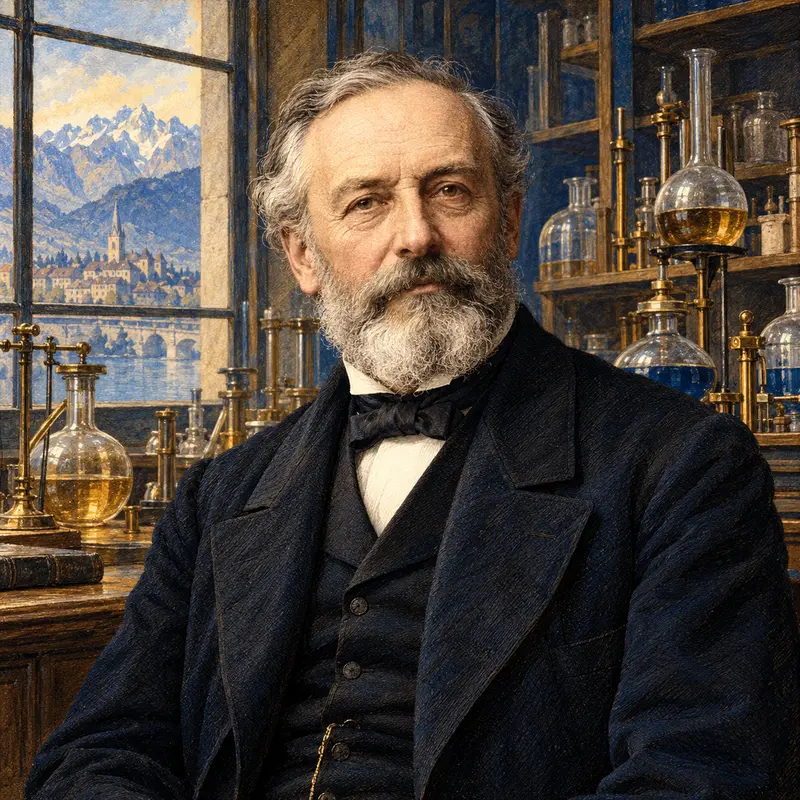
François-Marie Raoult
1830-1901 · France
Raoult's law; freezing point depression