The discovery, explained · Chemist no. 263 of 350
Raoult's Law: How a Dissolved Solute Changes a Solvent
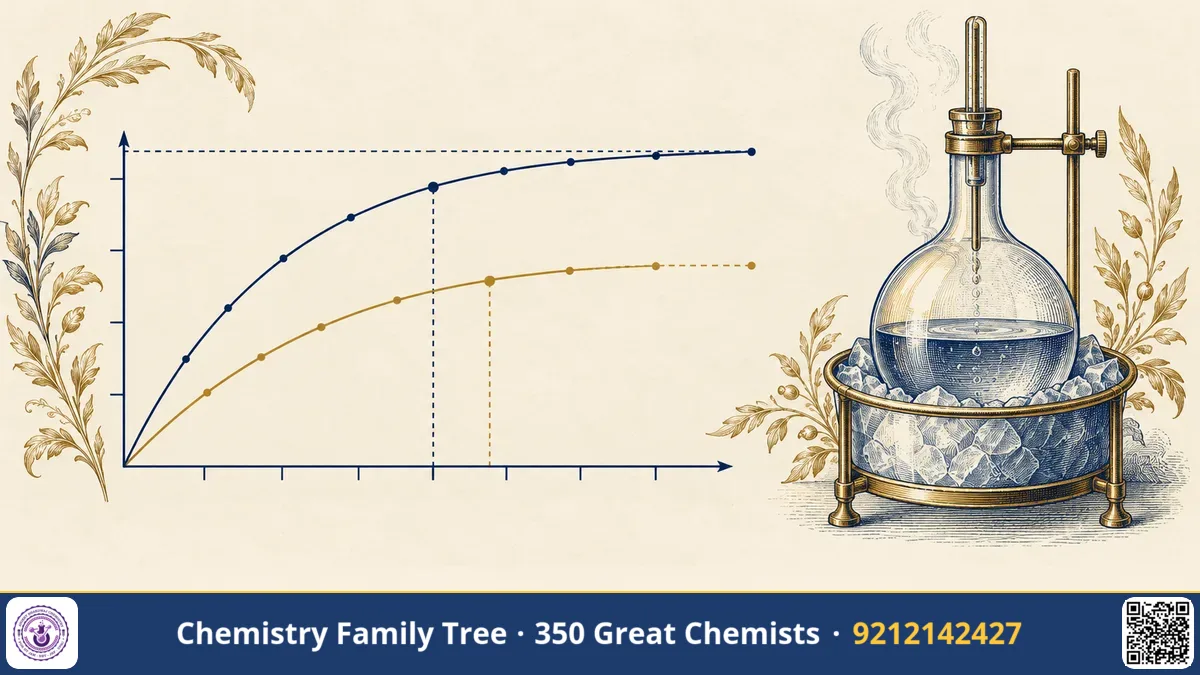
Why do we add salt to ice when making kulfi or ice cream? Why does antifreeze keep a car radiator from freezing in winter in Kashmir? Why does sea water boil at a slightly higher temperature than pure water? All these questions have one answer: the presence of dissolved particles lowers the escaping tendency of the solvent. The quantitative law was found by the French chemist François-Marie Raoult in the 1880s. Raoult's law and his work on freezing points opened the way to measuring molar masses of dissolved substances and supported the theory of electrolytic dissociation. This blog explains the law and its consequences.
The Scientific Problem Before the Discovery
Chemists of the 19th century could find molar masses of gases by vapour density, but for non-volatile substances in solution there was no simple method. In 1788 Charles Blagden had noticed that the lowering of freezing point of water is proportional to the amount of solute dissolved. Others, such as Rüdorff and Coppet, had made similar observations for salts. But there was no general rule that applied to many solvents and solutes. Another problem was that salts such as NaCl showed lowering which was about double the expected value. This anomaly was not explained.
The Discovery: Raoult's Experiments
Raoult worked in Grenoble. In the early 1880s he measured the freezing points of solutions of many organic compounds in water, benzene, acetic acid and other solvents. He found that, for non-electrolytes, equal numbers of moles of solute in the same weight of a given solvent lowered the freezing point by the same amount, whatever the solute. In 1882 he announced this rule. Then in 1886-1887 he studied the lowering of vapour pressure of solvents by non-volatile solutes, mainly in ether, and expressed the law:
(P° − P) / P° = X(solute)          (relative lowering of vapour pressure)
P(solution) = X(solvent) · P°(solvent)
Here P° is the vapour pressure of the pure solvent, P that of the solution and X the mole fraction. In words, the vapour pressure of a solvent in an ideal solution is proportional to its mole fraction.
For a mixture of two volatile liquids A and B, each follows the law:
P(total) = X_A · P°_A + X_B · P°_B
The Chemistry Behind It
When a non-volatile solute is dissolved, solute particles occupy part of the surface and reduce the number of solvent molecules that can escape. In terms of thermodynamics, the chemical potential of the solvent decreases. Four properties depend only on the number of solute particles and not on their identity. They are called colligative properties:
- Relative lowering of vapour pressure: ΔP/P° = X(solute) = n₂/(n₁ + n₂).
- Elevation of boiling point: ΔTb = Kb · m. For water Kb = 0.52 K kg/mol.
- Depression of freezing point: ΔTf = Kf · m. For water Kf = 1.86 K kg/mol.
- Osmotic pressure: π = CRT (van't Hoff).
Finding molar mass from freezing point depression:
M₂ = (K_f × w₂ × 1000) / (ΔT_f × w₁)   (w in grams)
Example: 1.8 g glucose in 100 g water → m = (1.8/180)/0.100 = 0.1 mol/kg
ΔT_f = 1.86 × 0.1 = 0.186 K
Van't Hoff factor (i): For electrolytes, the number of particles is greater than the number of formula units, so colligative effects are larger. Thus ΔT_f = i · K_f · m. For NaCl, i is close to 2; for CaCl₂, close to 3; for acetic acid dimerising in benzene, i is below 1. Raoult's data on salts led van't Hoff and Arrhenius to the theory of electrolytic dissociation in the 1880s.
Deviations: Real solutions can deviate from Raoult's law.
- Positive deviation: A–B attraction is weaker than A–A and B–B (e.g., ethanol + water, acetone + CS₂). ΔH_mix > 0, ΔV_mix > 0, and the vapour pressure is higher than expected. These form minimum-boiling azeotropes.
- Negative deviation: A–B attraction is stronger (e.g., chloroform + acetone, HNO₃ + water). ΔH_mix < 0, ΔV_mix < 0, and these form maximum-boiling azeotropes.
- Ideal solutions: Obey Raoult's law, with ΔH_mix = 0 and ΔV_mix = 0 (e.g., benzene + toluene, n-hexane + n-heptane).
Applications Today
- Antifreeze: Ethylene glycol in car radiators lowers the freezing point and raises the boiling point of coolant.
- De-icing roads: Salt on roads in Himalayan regions lowers the melting point of ice.
- Molar mass determination: Cryoscopy and ebullioscopy are used to find the molar masses of unknown compounds and polymers (osmotic pressure is best for polymers).
- Medicine: Intravenous fluids are made isotonic (0.9 percent saline) to avoid damage to red blood cells.
- Distillation and petroleum: The idea of vapour pressure of components in mixtures guides fractional distillation in refineries and in making alcohol.
- Desalination: Reverse osmosis uses pressure greater than the osmotic pressure, which is widely used for drinking-water in Indian cities.
Exam Corner
- Raoult's law: P₁ = X₁P₁°. Relative lowering of vapour pressure = mole fraction of solute.
- Colligative properties depend on the number of solute particles, not on their nature.
- ΔT_f = i K_f m; ΔT_b = i K_b m; π = i CRT.
- Positive deviation gives minimum-boiling azeotrope (ethanol-water); negative deviation gives maximum-boiling (HNO₃-water).
- Van't Hoff factor i > 1 for dissociation, i < 1 for association.
Common Misconceptions
- "Raoult's law applies to all solutions." It applies to ideal solutions; real solutions deviate, but dilute solutions follow it for the solvent.
- "Colligative properties depend on the type of solute." They depend only on particle number.
- "Boiling point lowers when a solute is added." It rises for a non-volatile solute.
Quick Revision Box
- Raoult (1880s): freezing point depression and vapour pressure lowering.
- P = X(solvent) · P°.
- Four colligative properties: ΔP, ΔT_b, ΔT_f, π.
- K_f (water) = 1.86; K_b (water) = 0.52 K kg/mol.
- Van't Hoff factor i corrects for dissociation or association.
- Ideal: ΔH_mix = 0 and ΔV_mix = 0.
FAQ
What does Raoult's law state?
The partial vapour pressure of a component in an ideal solution equals its mole fraction times its vapour pressure when pure.
What are colligative properties?
Properties of solutions which depend on the number of solute particles and not on their nature.
Why is the freezing point lowered by a solute?
The solute lowers the vapour pressure of the solvent, so the solution's vapour pressure curve meets that of the solid solvent at a lower temperature.
Why does NaCl give twice the effect of glucose at the same molality?
Because NaCl dissociates into Na⁺ and Cl⁻, giving about two particles per formula unit (i close to 2).
Published by ABC Chemistry — IIT-JAM | CSIR-NET | GATE Chemistry Coaching. Visit abcchemistry.com

About the chemist
François-Marie Raoult
1830-1901 · France
Raoult's law; freezing point depression