Biography · Chemist no. 207 of 350
Sir Fraser Stoddart: The Scottish Chemist Who Built Machines from Molecules
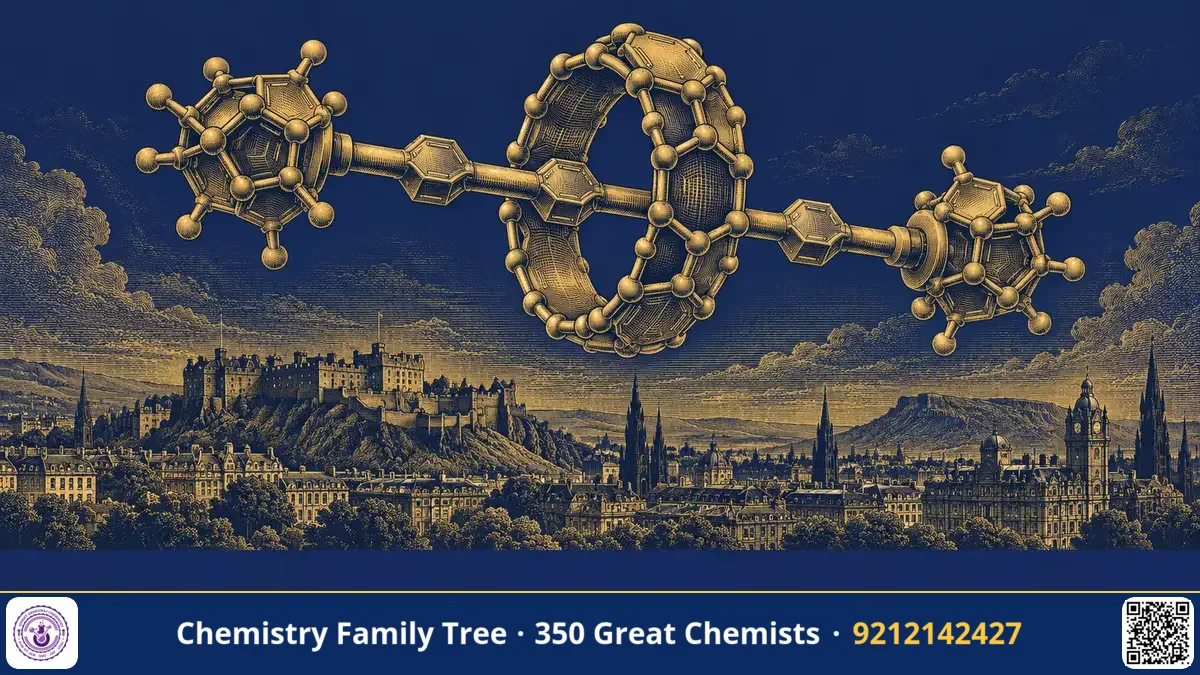
Sir James Fraser Stoddart (24 May 1942 – 30 December 2024) was a Scottish-born chemist who spent much of his career in the United States. A pioneer of supramolecular chemistry, he was awarded the 2016 Nobel Prize in Chemistry together with Jean-Pierre Sauvage and Ben Feringa. His legacy in one line: he showed that weak, non-covalent forces can be harnessed to assemble interlocked molecules and, from them, molecular machines.
Early Life and Family
Stoddart was born in Edinburgh, Scotland, and grew up on a farm in the Edinburgh area. He has described his childhood as being connected to farming life, and he developed a strong curiosity about nature. He attended local schools, and his path into chemistry began with a good school teacher and an early interest in how things are made. He later credited his Scottish education for his work habits.
Education and Mentors
He studied chemistry at the University of Edinburgh and completed his PhD there in 1966 under Edmund Hirst, a leading carbohydrate chemist. Carbohydrate chemistry, with its rings and stereochemistry, trained him to think about three-dimensional molecular shapes. He then did postdoctoral work at Queen's University in Canada and at the University of Sheffield in England, where he began exploring crown ethers, the cyclic polyethers discovered by Charles Pedersen, which bind cations in their cavities.
Career Timeline
| Year | Event |
|---|---|
| 1942 | Born in Edinburgh, Scotland |
| 1966 | PhD at the University of Edinburgh |
| Late 1960s-1970s | Postdoctoral work in Canada; then lecturer at the University of Sheffield |
| 1978-1981 | Works at the ICI research laboratory in Runcorn, UK |
| 1980s | Chair at the University of Birmingham; develops the "blue box" and rotaxane chemistry |
| 1991 | Reports a molecular shuttle |
| 1997 | Moves to UCLA |
| 2008 | Moves to Northwestern University |
| 2016 | Shares the Nobel Prize in Chemistry; knighted the same year |
| 2024 | Dies at age 82 |
Major Scientific Contributions
- Template-directed synthesis of rotaxanes and catenanes using donor-acceptor interactions.
- The "blue box": a tetracationic cyclophane that became a workhorse host.
- Molecular switches and shuttles: rings that move between stations under chemical, electrical or light control.
- Molecular Borromean rings: three interlocked rings in which removing any one frees the other two, made through templated assembly.
- Molecular elevators and artificial muscles: mechanically interlocked systems with controlled motion.
- Porous frameworks: in later years, metal-organic frameworks based on natural sugars such as cyclodextrins.
The chemical ideas are explained in our companion post on the rotaxane discovery.
Awards, Honours and Nobel Prize
The Nobel Prize in Chemistry 2016 was awarded to Jean-Pierre Sauvage, J. Fraser Stoddart and Bernard L. Feringa "for the design and synthesis of molecular machines". Stoddart was a Fellow of the Royal Society and was knighted in the 2007 New Year Honours for services to chemistry and molecular nanotechnology. He received many international awards over his career and was a member of leading academies.
Personality, Struggles and Lesser-Known Facts
- Industrial chemist for a time: He worked for ICI in the late 1970s, an experience that shaped his practical outlook.
- A prolific mentor: He trained hundreds of students and postdocs, and many are now professors around the world.
- Embracing a bold vision: He pushed the idea of "mechanostereochemistry", the study of stereochemistry arising from mechanical bonds.
- Long path to recognition: His rotaxane work was initially seen by some as a curiosity, and the practical use came much later.
- A moving international career: He worked in Scotland, England, the United States and visited laboratories in Asia, including as a distinguished professor abroad.
Legacy and Influence on Modern Chemistry
Stoddart changed how chemists think about bonding: not only atoms linked by shared electrons, but also molecules linked by shape and topology. The field of mechanically interlocked molecules now includes polymers, gels, sensors and drug delivery systems. His group's work on cyclodextrin frameworks showed that supramolecular chemistry can address environmental questions such as gas capture. His death in December 2024 was marked by tributes from chemists worldwide.
Stoddart's influence also reached beyond his own discoveries through the way he taught chemists to think. He liked to say that chemistry has a language of its own, and that the bond between molecules deserves as much attention as the bond within molecules. In lectures he used simple pictures such as rings, threads and stoppers, which made difficult ideas easy to remember for students. His groups were large and international, and many of his former students now lead research in Asia, Europe and North America, including in India, where supramolecular chemistry is taught as a core topic in postgraduate courses. His long career, from carbohydrate chemistry in Edinburgh to molecular machines in Illinois, is a reminder that a researcher can change direction several times and still build a coherent life's work. Each stage gave him tools for the next: sugars taught him about shape, crown ethers taught him about binding, and the blue box taught him about assembly.
Lessons for Students
- Weak forces can be powerful. Many small interactions together can direct a whole synthesis.
- Build a toolbox. Stoddart's blue box was a reusable component.
- Be bold with questions. He asked whether a molecule could be a machine.
- Train others. Great scientists multiply their impact through students.
- Keep learning. He moved from carbohydrates to crown ethers to rotaxanes to frameworks.
Quick Facts Box
- Born: 24 May 1942, Edinburgh, Scotland
- Died: 30 December 2024
- Nationality: British (Scottish), later also American
- Field: Supramolecular chemistry, nanotechnology
- Famous for: Rotaxanes, catenanes, molecular switches and shuttles
- Nobel: Chemistry 2016, shared with Jean-Pierre Sauvage and Ben Feringa
FAQ
Where did Stoddart work in the United States?
At the University of California, Los Angeles, and later at Northwestern University.
What is the blue box?
Cyclobis(paraquat-p-phenylene), a rigid, positively charged ring that binds electron-rich aromatic guests.
Was he knighted?
Yes, he was knighted in 2007 for services to chemistry and molecular nanotechnology.
Why is he important for exam preparation?
He represents the supramolecular and host-guest chemistry section, and his Nobel year is a common GK point in chemistry tests.
Published by ABC Chemistry — IIT-JAM | CSIR-NET | GATE Chemistry Coaching. Visit abcchemistry.com
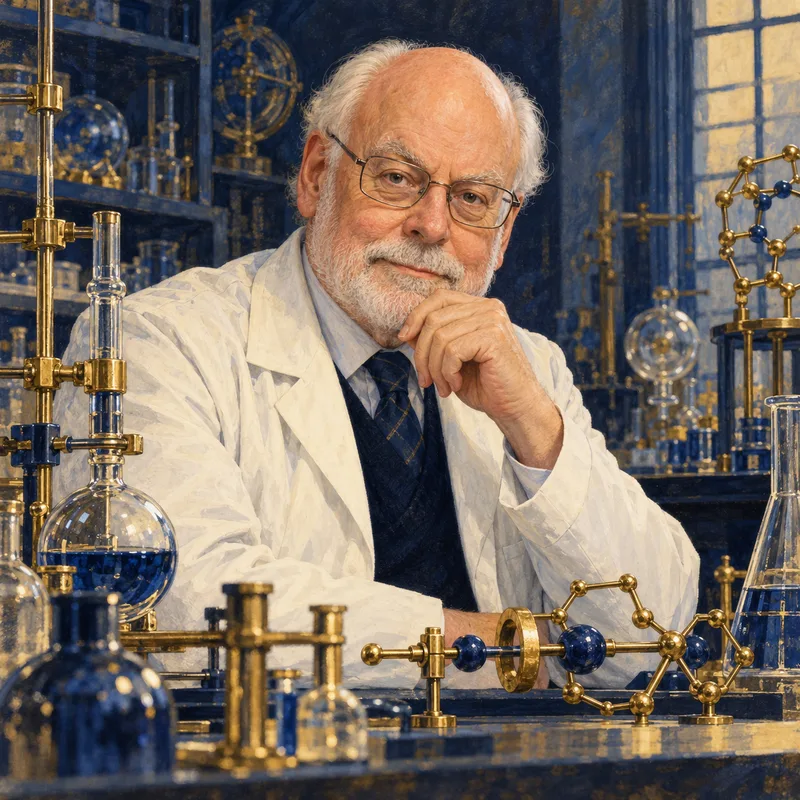
About the chemist
Fraser Stoddart
1942-2024 · United Kingdom · Nobel Chemistry 2016
Rotaxanes and molecular machines