The discovery, explained · Chemist no. 207 of 350
Fraser Stoddart and the Rotaxane: Building Molecules That Shuttle and Switch
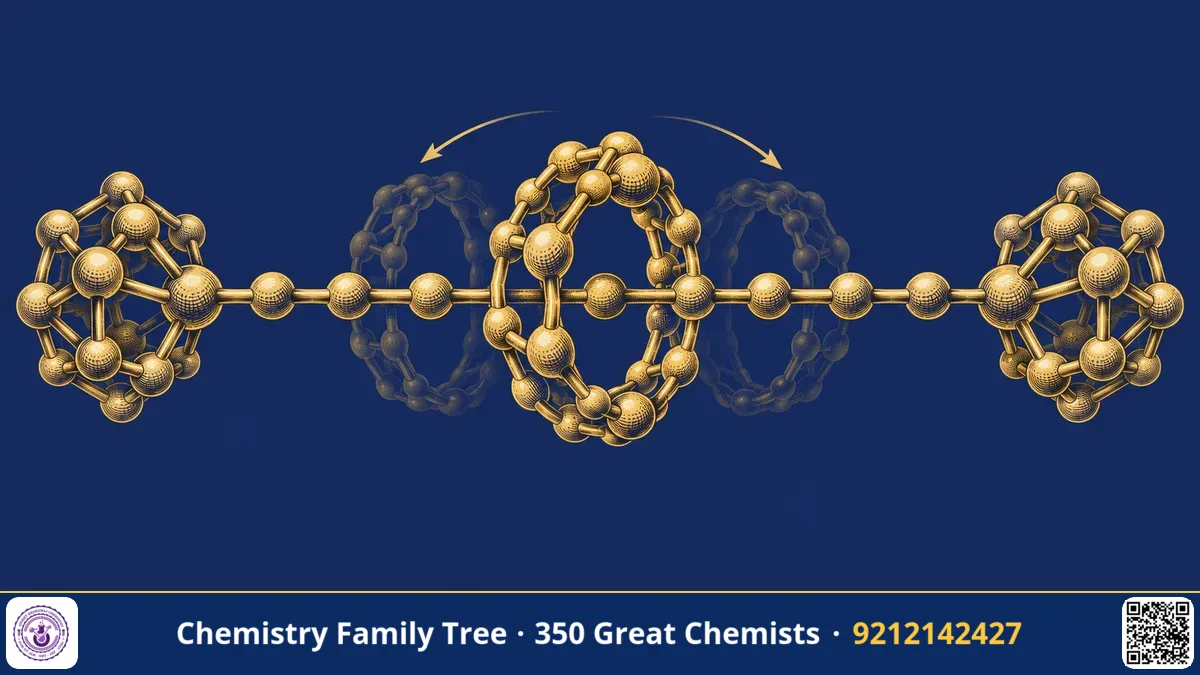
Imagine a tiny ring threaded on a molecular rod, free to slide from one end to the other, and unable to fall off because bulky groups block both ends. This is a rotaxane, and when the ring can be driven to move on command, it becomes a molecular machine. Sir James Fraser Stoddart, a Scottish-born chemist, created much of the chemistry that made such systems practical. In 1991 his group reported a molecular shuttle, and in 2016 he shared the Nobel Prize in Chemistry with Jean-Pierre Sauvage and Ben Feringa.
The Scientific Problem Before the Discovery
Before the 1980s, organic synthesis was largely about making covalent bonds. Chemists could build very complex natural products, but they treated weak, non-covalent forces (hydrogen bonds, pi-stacking, electrostatic attractions) as nuisances. Sauvage had shown in 1983 that a metal template could make catenanes. But metals are not always convenient, and many chemists wanted a way to build interlocked molecules using purely organic, non-covalent recognition. Moreover, simply making interlocked structures was not enough: to make a machine, one needed a way to control the relative motion of the parts.
The Discovery: Step by Step
Step 1: Choose complementary partners
Stoddart's group used the idea of donor-acceptor (charge-transfer) interactions. They designed an electron-poor ring, cyclobis(paraquat-p-phenylene), often called the "blue box". It contains two bipyridinium (viologen) units, which are cationic and electron-deficient. As a partner they used electron-rich aromatic units, such as hydroquinone derivatives or 1,5-dioxynaphthalene.
Step 2: Let the pieces assemble
When an electron-rich thread is mixed with the tetracationic ring, the thread slides inside the cavity because of pi-pi stacking, charge-transfer attraction and C-H···O hydrogen bonds. The result is a pseudorotaxane, a complex that can assemble and disassemble.
Step 3: Lock the threading
The ring itself was often formed in the presence of the thread in a templated reaction (the final ring-closing step is an SN2 reaction between a dibromide and bipyridinium units). Bulky stopper groups are attached at both thread ends so the ring can no longer slip off. The result is a [2]rotaxane.
Step 4: Make it move
In 1991, Stoddart and co-workers described a rotaxane with two identical electron-rich "stations" (hydroquinone units) on the thread. The ring shuttled between them by thermal motion, at a rate observable by NMR spectroscopy. This was a molecular shuttle. By making the two stations different, or by changing their properties with an acid-base or electrochemical signal, the ring could be driven to prefer one station. That is a molecular switch. The group also made catenanes using the same non-covalent strategy and later assembled the elegant "Borromean rings" and molecular elevators and muscles.
Thread (electron-rich) + Ring (electron-poor, blue box) → pseudorotaxane → add stoppers → [2]rotaxane
Switch: oxidise/reduce or protonate → ring moves from station 1 to station 2
The Chemistry Behind It
- Charge-transfer complexation: an electron-rich donor (HOMO high) interacts with an electron-poor acceptor (LUMO low), often giving a coloured complex because of a new absorption band.
- Self-assembly: molecules spontaneously arrange into ordered structures by reversible non-covalent interactions. This is thermodynamic control.
- Template-directed synthesis: existing interactions pre-organise reactants so the covalent step forms the desired product.
- Bistability: a molecule can exist in two distinct stable states and be switched between them. Here, the position of the ring is the state.
- Dynamic NMR: the shuttling is measured from the coalescence of NMR signals when the ring exchanges quickly between stations.
Applications Today
- Molecular electronics: Stoddart's collaborators explored rotaxane switches as memory elements in crossbar circuits. These remain experimental.
- Controlled release: Nanovalves made from switchable rotaxanes on silica particles can open to release drug cargo in response to pH or redox changes, a topic of active research.
- Porous materials: Later in his career he worked on metal-organic frameworks, including edible frameworks built from cyclodextrin and potassium ions, and on carbon-capture materials.
- Smart polymers and sensors: Interlocked units can give materials that change colour or shape with a stimulus.
Exam Corner
- Rotaxane versus catenane: ring on an axle with stoppers versus two interlocked rings.
- What drives the pseudorotaxane assembly? Pi-pi stacking, donor-acceptor charge transfer and C-H···O interactions.
- What is a viologen? 4,4'-Bipyridinium (N,N'-disubstituted), an electron-poor redox-active unit.
- Nobel 2016 Chemistry laureates: Sauvage, Stoddart, Feringa.
- What technique reveals shuttling? Variable-temperature NMR (dynamic NMR).
Common Misconceptions
- "A rotaxane is a single covalent molecule with a ring bonded to the axle." No, the ring is mechanically trapped, not covalently bonded.
- "Weak interactions cannot direct synthesis." Many weak interactions acting together can be strong and highly selective.
- "Molecular machines already replace silicon chips." They are still in the research stage.
Quick Revision Box
- Stoddart used electron-rich/electron-poor pairs to assemble rotaxanes.
- The "blue box" is cyclobis(paraquat-p-phenylene), a tetracationic ring.
- Molecular shuttle reported in 1991.
- Switching by redox, pH or light moves the ring.
- Mechanical bond: no covalent bond between ring and thread.
- Nobel Prize in Chemistry 2016 (shared).
FAQ
What does "rotaxane" mean?
The name comes from Latin rota (wheel) and axis (axle), describing a wheel on an axle.
How is Stoddart's approach different from Sauvage's?
Sauvage used a metal ion template, while Stoddart used organic donor-acceptor recognition without metals.
What is a molecular switch?
A molecule that can be toggled between two stable states by an external stimulus such as light, voltage or pH.
Is this relevant to JAM and NET?
Yes. Supramolecular chemistry, non-covalent interactions, charge-transfer complexes and self-assembly are standard topics.
Published by ABC Chemistry — IIT-JAM | CSIR-NET | GATE Chemistry Coaching. Visit abcchemistry.com
About the chemist
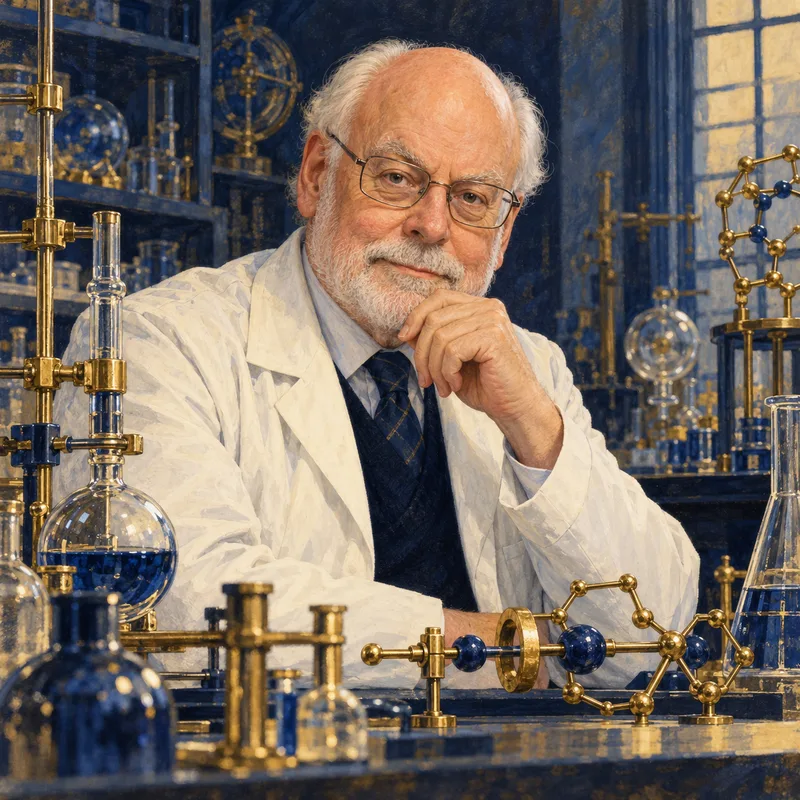
Fraser Stoddart
1942-2024 · United Kingdom · Nobel Chemistry 2016
Rotaxanes and molecular machines