The discovery, explained · Chemist no. 113 of 350
Frédéric Joliot-Curie and the Discovery of Artificial Radioactivity
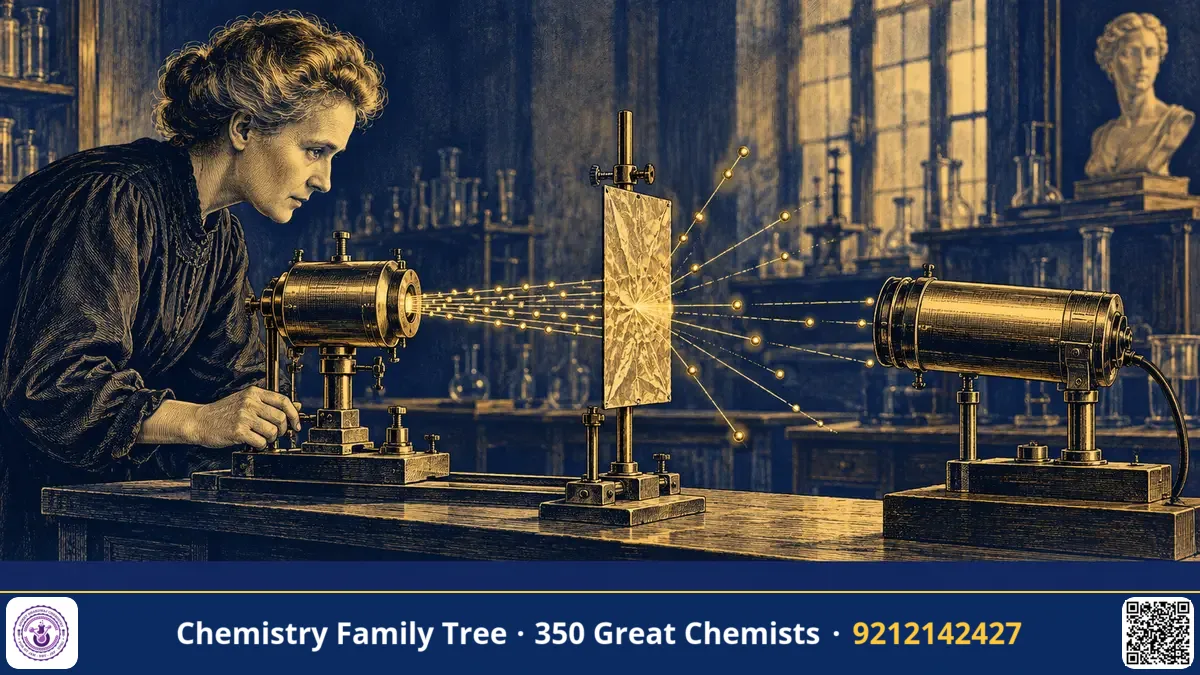
Until 1934, radioactivity was something that nature did. Uranium, thorium, radium and polonium were radioactive; ordinary elements like aluminium, phosphorus and nitrogen were not. Then, in the winter of 1933–34, Frédéric Joliot and his wife Irène Joliot-Curie, working in Paris at the Radium Institute founded by Marie Curie, bombarded aluminium foil with alpha particles and noticed something strange. After the source was taken away, the foil kept emitting radiation. They had made a new radioactive element that does not exist in nature. This was artificial radioactivity, and it opened the door to radioisotopes in medicine, industry and research. For this work, the couple received the Nobel Prize in Chemistry in 1935 "in recognition of their synthesis of new radioactive elements".
The Scientific Problem Before the Discovery
Ernest Rutherford had shown in 1919 that alpha particles can change one element into another: nitrogen bombarded with alpha particles gave oxygen and a proton. Over the next fifteen years, many light elements were shown to be transmuted in this way. Every time, the product was a stable nucleus, and the radiation seen was only that emitted during bombardment. The idea that the products might themselves be unstable and decay later had not been seen.
In 1932 the Joliot-Curies themselves had a near miss. Bombarding beryllium with alpha particles from polonium, they found a highly penetrating radiation which they thought to be gamma rays, since it knocked out protons from paraffin. James Chadwick repeated the experiment and correctly explained the radiation as a new neutral particle, the neutron. In the same period, Carl Anderson in the United States discovered the positron in cosmic rays. The Joliot-Curies had seen tracks of positive electrons in their cloud chamber work earlier but misinterpreted them. These disappointments sharpened their care in the next experiments, and they were rewarded with a discovery of the first rank.
The Discovery: Step by Step
- Source and target. A strong polonium source supplied alpha particles. It was one of the most intense polonium sources then available, prepared at the Radium Institute. A thin foil of aluminium was placed close to it.
- Detection. They used a Geiger–Müller counter to detect the radiation. As the foil was bombarded, they counted emissions of positrons (and neutrons).
- The surprise. When they removed the polonium source, the counter did not fall to zero. The aluminium foil continued to emit positrons, and the rate of emission decreased exponentially, halving in about three minutes.
- Chemical identification. This was the key contribution of Frédéric, who was a trained chemist. To prove that the radioactive atoms were a new element and not an artifact, they dissolved the irradiated aluminium in hydrochloric acid. The radioactivity came off in the gas, not in the solution, which showed that the active atoms were not aluminium; they were released as a gaseous compound, phosphine, PH3, together with hydrogen. The radioactive element was therefore an isotope of phosphorus.
- Further cases. They repeated the experiment with boron and magnesium. Boron nitride, irradiated with alpha particles and then heated with sodium hydroxide, gave off radioactive ammonia, identifying radioactive nitrogen. Magnesium gave radioactive silicon.
- Announcement. They published the discovery in January 1934 in a short note in Comptes Rendus and in Nature. Marie Curie lived to see her daughter and son-in-law's success; she died in July 1934.
The Chemistry Behind It
The nuclear equations are as follows. The alpha particle is absorbed by aluminium-27 and a neutron is ejected, giving radioactive phosphorus-30:
²⁷₁₃Al + ⁴₂He → ³⁰₁₅P + ¹₀n
Phosphorus-30 is unstable, and decays by emitting a positron (a positive electron) to give stable silicon-30:
³⁰₁₅P → ³⁰₁₄Si + ⁰₊₁e (positron) + ν (neutrino)
In β⁺ decay, a proton in the nucleus is converted into a neutron: p → n + e⁺ + ν. The atomic number decreases by one and the mass number is unchanged. The half-life of ³⁰P is about 2.5 minutes by modern measurement. Other reactions from the same work:
¹⁰₅B + ⁴₂He  →  ¹³₇N + ¹₀n       then   ¹³₇N → ¹³₆C + e⁺ + ν   (half-life about 10 minutes)
²⁴₁₂Mg + ⁴₂He → ²⁷₁₄Si + ¹₀n     then   ²⁷₁₄Si → ²⁷₁₃Al + e⁺ + ν
Key points of the underlying science:
- Nuclei with too few neutrons relative to protons are unstable and tend to decay by positron emission or electron capture. Light nuclei made with fewer neutrons than the stable isotopes fall into this category.
- The radioactive decay law is
N = N₀ e^(−λt)and the half-life ist½ = 0.693 / λ. - Radioactive atoms behave chemically exactly like the stable ones of the same element. This is why chemical separation could show that the radioactive atoms were phosphorus. It also explains why radioisotopes can be used as tracers.
- Only a very small number of atoms are produced, a few thousand at most, so ordinary chemical methods had to be adapted to work with carrier amounts of non-radioactive element.
Applications Today
- Nuclear medicine: radioisotopes such as iodine-131 (thyroid diagnosis and treatment), technetium-99m (imaging), fluorine-18 (PET scans) and phosphorus-32 are produced in reactors and accelerators. Mumbai's Bhabha Atomic Research Centre supplies many medical radioisotopes to Indian hospitals.
- PET imaging: positron emitters like ¹⁸F and ¹¹C are the descendants of the positron emitters of 1934. The positron meets an electron and produces two gamma photons, which are detected.
- Radioactive tracers: carbon-14 and phosphorus-32 are used in studies of metabolism and photosynthesis.
- Industry: thickness gauges, leak detection, sterilisation of medical equipment with cobalt-60.
- Agriculture: radiation-induced mutation breeding of crops in India; food preservation by irradiation.
- Radiometric dating: radiocarbon dating and similar methods rest on knowledge of radioactive decay.
- Synthesis of new elements: the transuranic and superheavy elements are made by nuclear bombardment, an extension of the idea of artificial transmutation.
Exam Corner
- Irène and Frédéric Joliot-Curie won the 1935 Nobel Prize in Chemistry for the synthesis of new radioactive elements (artificial radioactivity, 1934).
- Reaction: ²⁷Al(α, n)³⁰P; ³⁰P decays by β⁺ emission to ³⁰Si; half-life about 2.5 min.
- In β⁺ decay, atomic number falls by 1 and mass number is unchanged; in electron capture, same change.
- Neutron-poor nuclei decay by β⁺ or electron capture; neutron-rich nuclei by β⁻ decay.
- Decay law: N = N₀e^(−λt); t½ = 0.693/λ; mean life = 1/λ.
Common Misconceptions
- "The Joliot-Curies discovered radioactivity." Becquerel did in 1896. They discovered artificial radioactivity, produced by humans.
- "They won the Physics Nobel Prize." It was the Nobel Prize in Chemistry, because the work involved the chemical identification of new radioactive elements.
- "Positron emission increases atomic number." It decreases it by one.
Quick Revision Box
- Artificial radioactivity discovered January 1934 in Paris.
- ²⁷₁₃Al + ⁴₂He → ³⁰₁₅P + ¹₀n; ³⁰₁₅P → ³⁰₁₄Si + e⁺ + ν.
- Chemical proof: radioactive phosphorus escaped as PH3 on dissolving the foil in HCl.
- Nobel Prize in Chemistry, 1935, shared with Irène Joliot-Curie.
- Positron emission: p → n + e⁺ + ν.
- Foundation of radioisotope medicine and PET imaging.
FAQ
Why is it called artificial radioactivity?
Because the radioactive isotopes were made by humans through nuclear reactions, not found in nature.
What is a positron?
It is the antiparticle of the electron, with the same mass and a positive charge. It is emitted in β⁺ decay.
Why was chemistry needed in a physics experiment?
To prove that the radioactive atoms were of a new element, they had to be separated by chemical methods. Frédéric's chemical skill made the proof possible.
Is this chapter useful for JAM, NET and GATE?
Yes. Nuclear chemistry questions on decay modes, half-life, nuclear reactions and radioisotope applications appear frequently.
Published by ABC Chemistry — IIT-JAM | CSIR-NET | GATE Chemistry Coaching. Visit abcchemistry.com
About the chemist
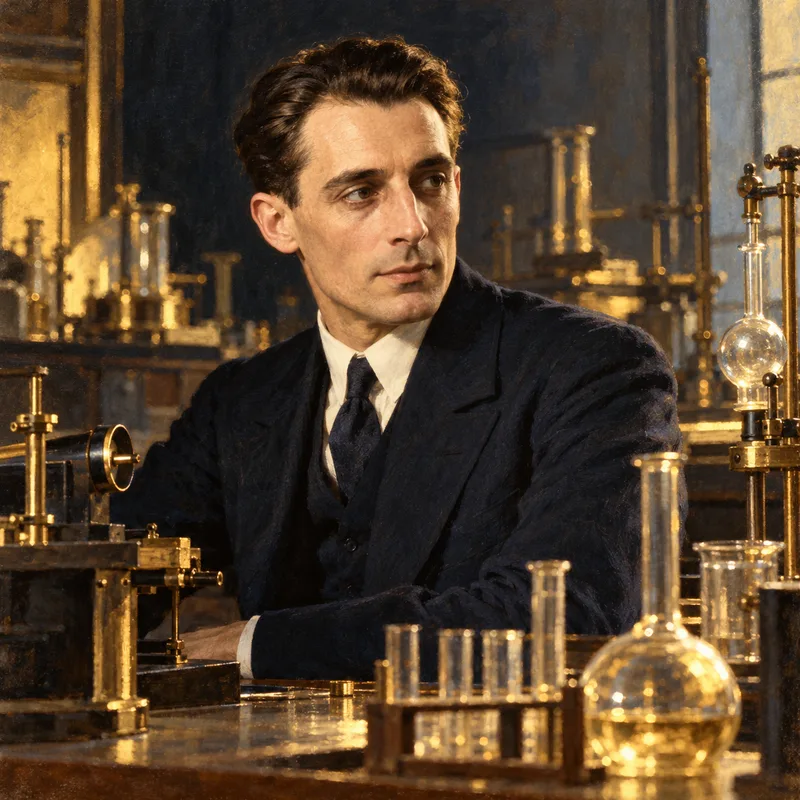
Frédéric Joliot-Curie
1900-1958 · France · Nobel Chemistry 1935
Artificial radioactivity