Biography · Chemist no. 113 of 350
Frédéric Joliot-Curie: Complete Life and Legacy
Introduction
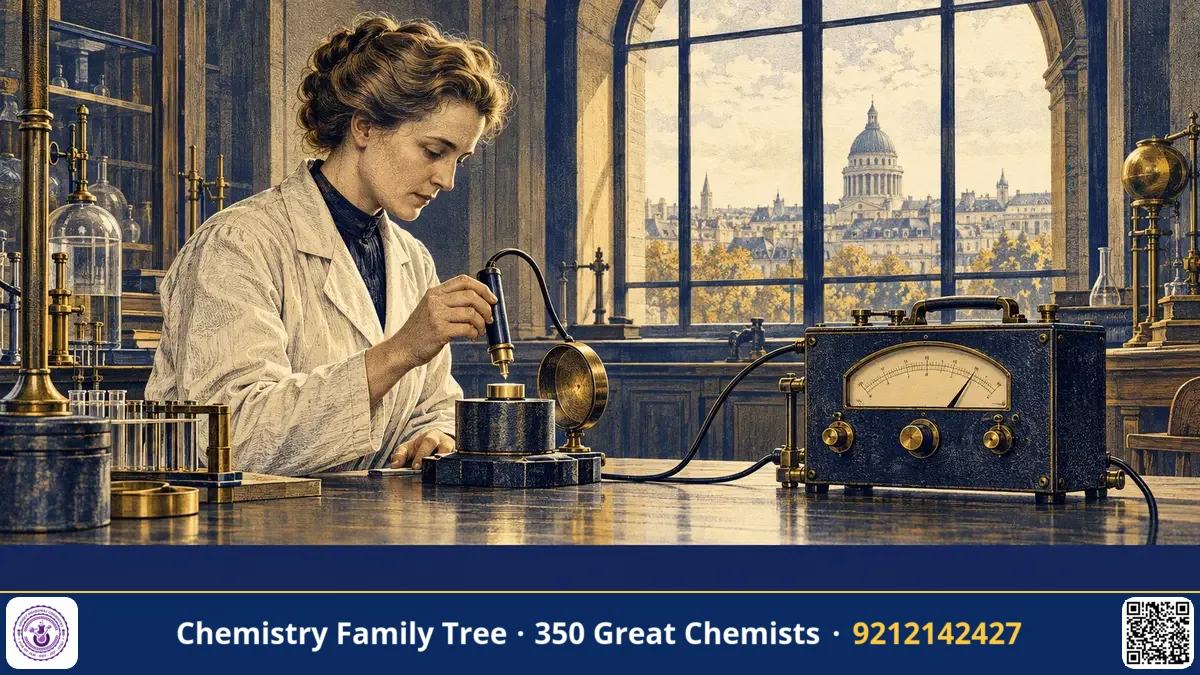
Frédéric Joliot-Curie (1900–1958) was a French nuclear physicist and chemist who, with his wife Irène Joliot-Curie, created the first artificial radioactive elements. They won the Nobel Prize in Chemistry in 1935. He later showed that nuclear fission releases neutrons, which made a chain reaction possible, and he led France's first atomic energy programme. He was also a member of the French Resistance during the Second World War and a leading voice for peace afterwards. His life joins pure science, public service and politics.
Early Life and Family
Jean Frédéric Joliot was born on 19 March 1900 in Paris, the youngest of six children. He was the youngest of six children, and the family had republican and left-wing views.
He was a keen sportsman in his youth, especially football, and was not initially a top student. His real interest in physics and chemistry developed later, at technical school.
Education and Mentors
Joliot studied at the École de Physique et de Chimie Industrielles de la Ville de Paris (ESPCI), a leading engineering school. There he met Paul Langevin, a famous physicist and teacher, who recognised his talent. On Langevin's recommendation, in 1925 Joliot became a personal assistant to Marie Curie at the Radium Institute (Institut du Radium) in Paris. He learned radiochemistry from her and received a doctorate in science in 1930, with a thesis on the electrochemistry of radioelements.
At the Institute he met Marie's daughter Irène Curie, who was working there as a researcher. They married in 1926. After their marriage, they began to use the combined name Joliot-Curie in their scientific papers. Joliot learned experimental techniques at the Institute, and became known for his skill in preparing very thin and intense polonium sources.
Career Timeline
| Year | Event |
|---|---|
| 1900 | Born in Paris on 19 March. |
| 1925 | Becomes assistant to Marie Curie at the Radium Institute. |
| 1926 | Marries Irène Curie. |
| 1930 | Doctorate in science. |
| 1932 | With Irène observes the penetrating radiation from beryllium; later explained by Chadwick as neutrons. |
| 1934 | Discovers artificial radioactivity with Irène. |
| 1935 | Awarded the Nobel Prize in Chemistry with Irène. |
| 1937 | Appointed professor at the Collège de France; builds a cyclotron there. |
| 1939 | With Halban and Kowarski shows that fission releases secondary neutrons, making a chain reaction possible. |
| 1940–1944 | Remains in occupied France; active in the Resistance. |
| 1946 | Becomes the first High Commissioner of the French Atomic Energy Commission (CEA). |
| 1948 | The first French nuclear reactor, ZOE, goes critical. |
| 1950 | Dismissed from the CEA because of his political positions. |
| 1956 | Takes the chair of nuclear physics at the Sorbonne after the death of his wife Irène. |
| 1958 | Dies in Paris on 14 August. |
Major Scientific Contributions
- Artificial radioactivity (1934): creation of radioactive phosphorus, nitrogen and silicon isotopes, with chemical proof of their identity. See our discovery post for the nuclear equations.
- Near-miss discoveries: their 1932 work on the penetrating radiation from beryllium opened the way for Chadwick's discovery of the neutron, and their cloud-chamber photographs contained positron tracks.
- Chain reaction research: in 1939 with Hans von Halban and Lew Kowarski, he demonstrated that each uranium fission releases more than one neutron on average, and he filed patents on the idea of nuclear reactors.
- Heavy water moderator: his team obtained heavy water stocks from Norway, which were brought to France in 1940, for use in experiments.
- Nuclear reactor ZOE: led the construction of the first French reactor, using heavy water and uranium oxide, which started in December 1948.
- Radiochemistry: improved methods for preparing and detecting radioactive sources and for chemical separations of tiny quantities.
Awards, Honours and Nobel Prize
The Nobel Prize in Chemistry for 1935 was awarded jointly to Frédéric Joliot and Irène Joliot-Curie "in recognition of their synthesis of new radioactive elements". They were the second married couple to win a Nobel Prize, after Marie and Pierre Curie, who won the Physics Prize in 1903. Together, the Curie family counts five Nobel laureates in three prizes: Marie (Physics 1903, Chemistry 1911), Pierre (Physics 1903), Irène and Frédéric (Chemistry 1935).
After the war, he was an international figure in the peace movement and received the Stalin Peace Prize in 1951.
Personality, Struggles and Lesser-Known Facts
- Sportsman. He was fond of sport in his youth, especially football.
- Taking his wife's name. Both Frédéric and Irène adopted the double name Joliot-Curie after their marriage. In an era when this was rare, it was a sign of respect to Marie Curie's family name and science.
- Resistance hero. During the German occupation of France, he joined the National Front resistance movement and used his laboratory to help the Resistance, at risk of arrest.
- Political commitment. He joined the French Communist Party in 1942 and was a prominent peace advocate. His political positions led to his dismissal as High Commissioner in 1950.
- Hidden costs of radiation. Like Marie Curie, Irène suffered from the long-term effects of radiation exposure, and she died of leukaemia in 1956. Frédéric himself fell ill with a liver disease and died two years after her.
- Family of scientists. Their children, Hélène Langevin-Joliot (a nuclear physicist) and Pierre Joliot (a biologist), became distinguished scientists.
Legacy and Influence on Modern Chemistry
The discovery of artificial radioactivity was a turning point in the twentieth century. It meant that scientists could make radioactive forms of almost any element, and the age of the radiotracer began. In the years after 1934, Enrico Fermi used neutrons to create many more radioisotopes, and the Berkeley cyclotron groups added to the list. Without this, there would be no PET scans, no radiotherapy sources, no isotope tracer studies in biochemistry.
Joliot's work on neutron emission in fission was crucial to the idea of the nuclear reactor, and the ZOE reactor started France on the path to its present nuclear power industry. He also set an example of the scientist as citizen, who feels responsible for how discoveries are used. His life reminds students that science and society are connected, and that radiochemistry demands respect for safety.
Lessons for Students
- Learn from near misses: the Joliot-Curies' errors in 1932 sharpened their care and led to success in 1934.
- Use chemistry to make physics results certain; chemical identification gave the proof.
- Mentorship matters. Langevin and Marie Curie shaped his life.
- Scientists have a responsibility to speak about the uses of science.
- Always respect safety; the pioneers of radioactivity paid with their health.
Quick Facts Box
- Born: 19 March 1900, Paris, France.
- Died: 14 August 1958, Paris, France.
- Nationality: French.
- Field: Nuclear chemistry and physics.
- Famous for: Artificial radioactivity; fission neutron emission; first French reactor.
- Nobel: Chemistry, 1935 (shared with Irène Joliot-Curie).
FAQ
Why is it Joliot-Curie and not just Joliot?
After marrying Irène Curie in 1926, he adopted the double name Joliot-Curie as did she, honouring the Curie family name.
Did Joliot-Curie win the Nobel Prize in Physics or Chemistry?
Chemistry, in 1935, together with his wife Irène, for their synthesis of new radioactive elements.
What was ZOE?
ZOE (a name from the French for zero power, oxide of uranium, heavy water) was the first French nuclear reactor, which started in December 1948 under his leadership.
How did Joliot-Curie miss the neutron?
In 1932, he and Irène observed a penetrating radiation from beryllium but interpreted it as gamma rays. James Chadwick correctly identified it as a stream of neutrons and received the Nobel Prize in Physics in 1935.
Published by ABC Chemistry — IIT-JAM | CSIR-NET | GATE Chemistry Coaching. Visit abcchemistry.com
About the chemist
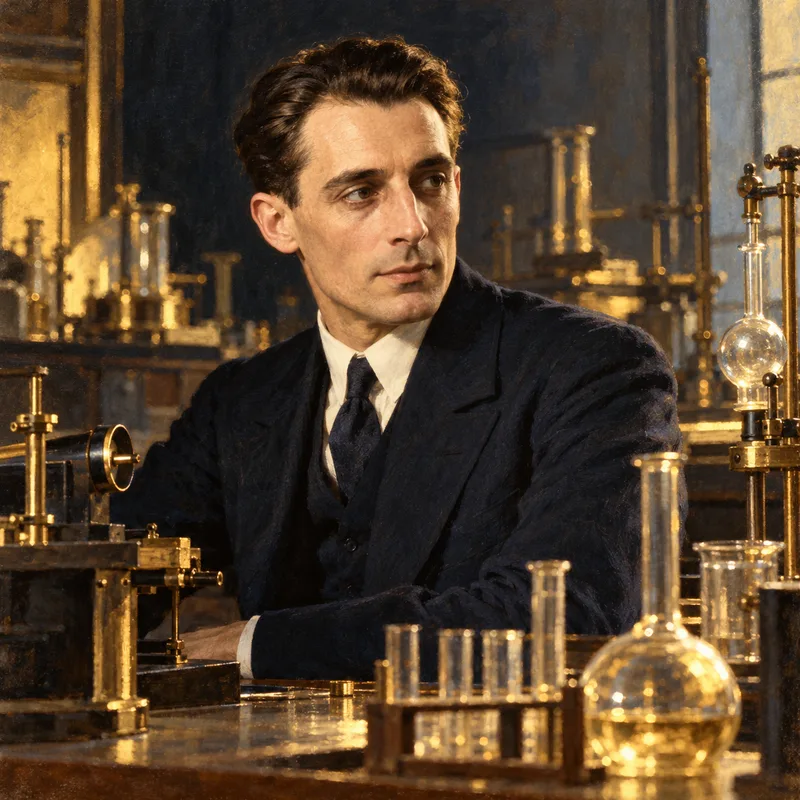
Frédéric Joliot-Curie
1900-1958 · France · Nobel Chemistry 1935
Artificial radioactivity