Biography · Chemist no. 320 of 350
Frederick Gowland Hopkins: Complete Life and Legacy
Sir Frederick Gowland Hopkins (1861-1947) was an English biochemist who founded the modern study of nutrition and built British biochemistry from nothing. He proved the existence of "accessory food factors", the vitamins, discovered tryptophan and glutathione and shared the 1929 Nobel Prize in Physiology or Medicine with Christiaan Eijkman. His life teaches that it is never too late to begin: he came to chemistry in his twenties and to research full-time only in his thirties.
Early Life and Family
Frederick Gowland Hopkins was born on 20 June 1861 in Eastbourne, on the south coast of England. His father, a bookseller, died when he was an infant, and his mother Elizabeth (née Gowland) raised him. He spent much of his childhood in London, where an uncle supported his education. At school he was a restless and not particularly distinguished pupil, but he showed an interest in microscopy and in books. His uncle encouraged his hobbies. He left school at seventeen, which meant that he started his scientific career later than most of the scientists of his time.
Education and Mentors
He first worked as a clerk in an insurance office, which he disliked. Then he trained as an analytical chemist under a consulting chemist, J. Pickering Barnes, and studied for external degrees at the University of London. He then studied at University College London and at Guy's Hospital, where he trained in medicine. He earned his B.Sc. in London in 1890 and his medical degree in 1894. At Guy's Hospital he worked as a demonstrator in physiology and became interested in the chemistry of the body. He was influenced by the Cambridge physiologist Sir Michael Foster, who invited him to Cambridge in 1898, and his career started there.
Career Timeline
| Year | Event |
|---|---|
| 1861 | Born in Eastbourne, England |
| 1880s | Worked as an analyst and chemist, studied at London |
| 1894 | Medical degree; taught at Guy's Hospital |
| 1898 | Joined Cambridge University as lecturer in chemical physiology |
| 1901 | Isolated tryptophan with Sydney Cole |
| 1905 | Elected Fellow of the Royal Society |
| 1906-1912 | Feeding experiments leading to accessory food factors |
| 1914 | Became first Professor of Biochemistry at Cambridge |
| 1921 | Discovered glutathione |
| 1924 | Became head of the new Sir William Dunn Institute of Biochemistry in Cambridge |
| 1930-1935 | President of the Royal Society |
| 1929 | Nobel Prize in Physiology or Medicine |
| 1935 | Awarded the Order of Merit |
| 1943 | Retired from the Cambridge chair |
| 1947 | Died in Cambridge on 16 May |
Major Scientific Contributions
- Essential amino acids: Isolation of tryptophan and the demonstration that it is a required dietary component.
- Accessory food factors: His rat experiments showed that small amounts of unknown substances in milk are essential for growth.
- Glutathione: Discovery of this thiol tripeptide and early studies of its role in cell oxidation.
- Muscle lactic acid: Work with Fletcher on lactic acid during muscle contraction.
- Building a school: Establishment of Cambridge as the world centre of biochemistry between the wars.
See the discovery post for the experiment in detail.
Awards, Honours and Nobel Prize
The 1929 Nobel Prize in Physiology or Medicine was shared by Christiaan Eijkman, "for his discovery of the antineuritic vitamin", and Frederick Gowland Hopkins, "for his discovery of the growth-stimulating vitamins". He was knighted in 1925, awarded the Royal Society's Copley Medal in 1926 and the Order of Merit in 1935. He served as President of the Royal Society from 1930 to 1935. The Biochemical Society honours him through the annual Hopkins Memorial Lecture,.
Personality, Struggles and Lesser-Known Facts
- Late bloomer: He did not take up full-time research until he was in his thirties, and he was close to forty when he moved to Cambridge. He often said that his early years in analytical work gave him practical skills.
- Struggles with depression: He suffered from periods of depression and fatigue, especially after a breakdown of health during the First World War period, and he had to reduce work from time to time.
- Analytical roots: In his early career he worked as a public analyst, doing chemical tests for legal and food cases, which gave him a love of precise methods.
- Butterfly pigments: His first major research, on pigments of the wings of white butterflies, showed they are uric acid derivatives.
- Mentor of Nobel laureates: His school included Hans Krebs (who came to Cambridge as a refugee in 1933), Joseph Needham, Malcolm Dixon and Albert Szent-Györgyi, and Krebs won the 1953 Nobel Prize in Physiology or Medicine.
- Support for women and refugees: He supported the entry of women to science at Cambridge and gave places to refugee scientists escaping Nazi Germany.
Legacy and Influence on Modern Chemistry
Hopkins's work changed human diets and public health. The discovery that diseases can result from missing trace nutrients led to the identification and synthesis of all known vitamins in the following three decades, and to food fortification programmes that continue in India today, such as vitamin A and iron supplementation. His view of the cell as a place of integrated chemical reactions, "dynamic biochemistry", inspired an entire generation. Many biochemistry departments in the world follow the model he created in Cambridge, where chemistry, physiology and nutrition meet. His approach, using purified diets and careful controls, is still the template for nutritional science.
Lessons for Students
- It is never too late. He started his full scientific career well into his thirties and still won a Nobel Prize.
- Doubt the accepted rule. The "four-component diet" was textbook knowledge; he tested it.
- Use controls. His two groups of rats gave clear, convincing evidence.
- Build people, not just papers. His greatest legacy is the school of scientists he trained.
Quick Facts Box
- Born: 20 June 1861, Eastbourne, England
- Died: 16 May 1947, Cambridge, England
- Nationality: British
- Field: Biochemistry and nutrition
- Famous for: Accessory food factors (vitamins), tryptophan, glutathione
- Nobel: 1929, Physiology or Medicine (shared with Christiaan Eijkman)
FAQ
Was Hopkins awarded the Chemistry Nobel?
No. His 1929 prize was in Physiology or Medicine, shared with Christiaan Eijkman.
What is Hopkins called in British science?
He is often called the "father of British biochemistry" for founding the Cambridge school of biochemistry.
Who were Hopkins's famous students?
Hans Krebs, Joseph Needham, Malcolm Dixon and others trained or worked with him in Cambridge; Szent-Györgyi worked there for a time.
Why is Hopkins important for nutrition?
He showed with controlled experiments that a diet of pure protein, fat, carbohydrate and minerals is not enough and that tiny amounts of vitamins are essential.
Published by ABC Chemistry — IIT-JAM | CSIR-NET | GATE Chemistry Coaching. Visit abcchemistry.com
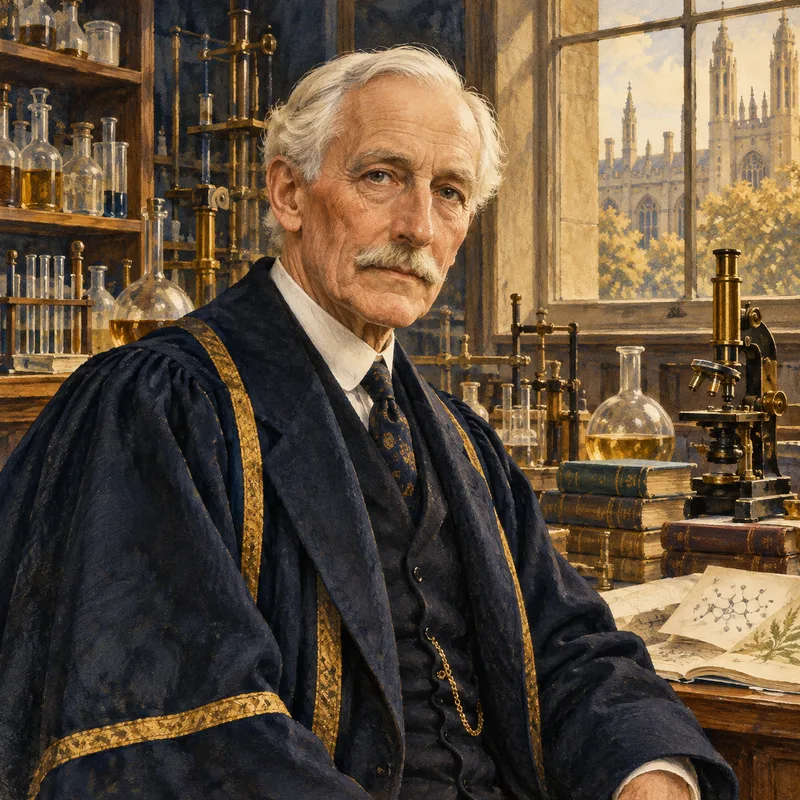
About the chemist
Frederick Gowland Hopkins
1861-1947 · United Kingdom · Nobel Physiology/Medicine 1929
Discovery of vitamins