The discovery, explained · Chemist no. 320 of 350
Frederick Gowland Hopkins and the Accessory Food Factors
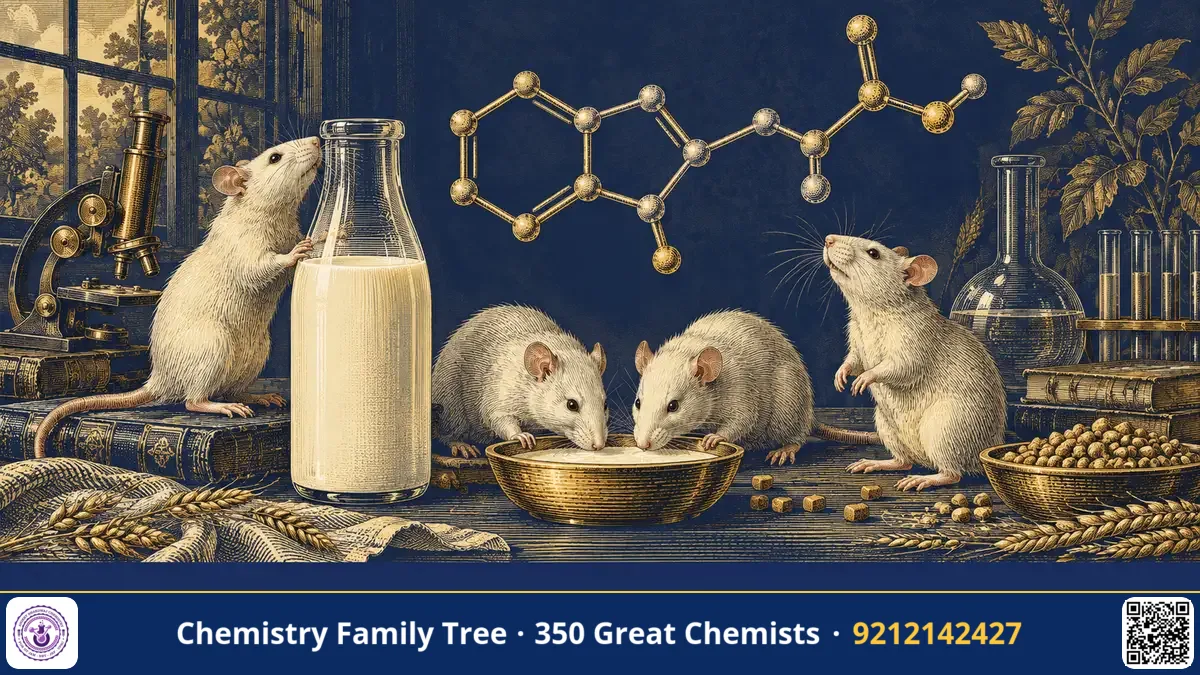
Why can you not live on pure protein, fat, carbohydrate and salts alone, even if the calories are enough? In the early 1900s, the British biochemist Sir Frederick Gowland Hopkins (1861-1947) proved with careful feeding experiments that food contains tiny amounts of essential substances, which he called accessory food factors. Today we call them vitamins. He also discovered the amino acid tryptophan as an essential dietary component and the tripeptide glutathione. For his work on growth-stimulating vitamins, Hopkins shared the 1929 Nobel Prize in Physiology or Medicine with the Dutch physician Christiaan Eijkman, who had worked on beriberi. His work founded the modern science of nutrition and established biochemistry as an independent subject in Britain.
The Scientific Problem Before the Discovery
In the nineteenth century, nutrition scientists such as Justus von Liebig believed that a diet needed only four types of ingredients: proteins, fats, carbohydrates and minerals. If animals were fed a mixture made of these purified components, they should thrive, it was thought. Yet diseases such as scurvy, beriberi and rickets existed and were linked to diet. Eijkman had shown in Java that chickens fed polished rice developed a disease like beriberi, but it was cured by rice polishings. People wondered: is this caused by poison in the polished rice or lack of something in the polishings?
Hopkins's own interest began with his study of pigments in butterfly wings (uric acid derivatives, pterins), and then with the chemistry of proteins and muscle metabolism. He became convinced that the usual idea of diet was incomplete.
The Discovery / Experiment
Step 1: Tryptophan and essential amino acids
In 1901, with Sydney Cole, Hopkins isolated the amino acid tryptophan from casein (milk protein) using a reaction with mercuric sulphate, and then used the Adamkiewicz reaction (a purple colour with glyoxylic acid and concentrated sulphuric acid) to detect it. Together with Willcock in 1906, he fed mice a diet in which zein, a maize protein lacking tryptophan, was the only protein. The mice lost weight and died sooner, but adding tryptophan prolonged life. This was the first clear evidence of an essential amino acid.
Step 2: The feeding experiments with purified diets
Between 1906 and 1912 Hopkins carried out his central experiments on young rats. He divided them into two groups:
- Group A: fed a purified diet of casein, starch, cane sugar, lard and salts. These rats stopped growing and became ill.
- Group B: fed the same purified diet plus a very small amount of fresh milk, as little as two to three millilitres per day.
Group B grew normally, and when milk was withdrawn from the second group and the rats of group A were given milk instead, growth resumed. The amount of milk was far too small to supply significant calories or protein; it had to contain a small "accessory factor". He published these results in 1912 in the Journal of Physiology.
Step 3: The concept
Hopkins argued that diseases like scurvy and rickets are "deficiency diseases" caused by the absence of such accessory factors. Along with the work of Eijkman, Funk, McCollum, Mellanby and others, his idea gave rise to the vitamin concept. Funk had proposed the term "vitamine" in 1912, thinking they were amines essential for life; later it was found that not all of them were amines, and the final "e" was dropped.
Step 4: Glutathione and cell oxidation
In 1921 Hopkins isolated a sulphur-containing compound from yeast and muscle, which he called glutathione. Its structure was later found to be a tripeptide, γ-glutamyl-cysteinyl-glycine, abbreviated GSH. It is an important reducing agent inside cells:
2 GSH  ⇌  GSSG + 2H+ + 2e-
(reduced, thiol)   (oxidised, disulphide)
Hopkins linked it to cell respiration, although the exact role of glutathione turned out to be antioxidant defence and detoxification rather than the oxygen-carrying role he first imagined.
Step 5: Lactic acid and muscle
With Walter Fletcher in 1907, Hopkins showed that lactic acid is produced in muscle in the absence of oxygen and disappears in the presence of oxygen, a landmark in muscle chemistry that preceded the later work of Hill and Meyerhof.
The Chemistry Behind It
- Tryptophan: an aromatic amino acid with an indole ring (C11H12N2O2). It is the precursor of serotonin, melatonin and niacin (vitamin B3). Humans cannot synthesise it.
- Essential amino acids: Valine, leucine, isoleucine, lysine, methionine, phenylalanine, threonine, tryptophan and histidine are essential for adults.
- Glutathione: The γ-peptide bond joins the side-chain carboxyl of glutamate to cysteine, which makes the molecule resistant to normal peptidases. The thiol (–SH) group is the active part.
- Vitamin classes: Fat-soluble (A, D, E, K) and water-soluble (B-complex, C). Many B-vitamins form coenzymes, e.g. thiamine pyrophosphate, NAD+, FAD.
Applications Today
- Dietary guidelines: Recommended dietary allowances (RDA) include vitamins and essential amino acids. In India, ICMR-NIN publishes the RDAs.
- Food fortification: Fortified rice, iodised salt, vitamin A and D in milk and oil help reduce deficiency diseases such as night blindness and rickets.
- Protein quality: The idea of a limiting essential amino acid explains why combining dal (lysine rich, methionine poor) with rice or wheat (lysine poor) in Indian meals gives a better quality protein.
- Medicine: Glutathione is a marker of oxidative stress, and its precursor N-acetylcysteine is used in paracetamol poisoning.
- Infant formula and clinical nutrition: Tube feeds and parenteral nutrition include all essential factors.
Exam Corner
- Hopkins and Eijkman shared the 1929 Nobel Prize in Physiology or Medicine.
- Tryptophan: essential amino acid with an indole ring; detected by Hopkins-Cole test (glyoxylic acid and conc. H2SO4 gives a violet ring).
- Glutathione = γ-Glu-Cys-Gly, thiol antioxidant, GSH/GSSG redox pair.
- Zein lacks tryptophan and lysine and is a poor-quality protein.
- Hopkins coined "accessory food factors"; Funk coined "vitamine".
Common Misconceptions
- "Hopkins discovered vitamin C." No. That was Szent-Györgyi (with Haworth's structure), although Hopkins hosted him in Cambridge.
- "Vitamins give energy." They do not supply calories; they act as coenzymes or regulators in tiny amounts.
- "Hopkins coined the word vitamin." The word came from Casimir Funk. Hopkins used "accessory food factors".
Quick Revision Box
- Rat experiment 1906-1912: purified diet fails; a few ml of milk restores growth.
- Concept: accessory food factors = vitamins, needed in trace amounts.
- Tryptophan isolated in 1901 (Hopkins and Cole); essential amino acid.
- Glutathione discovered 1921, a tripeptide thiol.
- Nobel 1929, Physiology or Medicine, shared with Eijkman.
- Hopkins was the first professor of biochemistry at Cambridge.
FAQ
What were accessory food factors?
They are the vitamins: organic substances needed in tiny amounts in the diet, absent from purified diets, whose lack causes deficiency diseases.
Why was tryptophan important in Hopkins's work?
It was the first clear example of an essential amino acid, because animals could not grow on a protein lacking it.
What is the Hopkins-Cole test?
It is a colour test for tryptophan, in which glyoxylic acid reacts with the indole ring in the presence of concentrated sulphuric acid to give a violet ring.
Is Hopkins's work relevant to Indian exams?
Yes. Essential amino acids, vitamin deficiency diseases, glutathione and protein quality appear in biochemistry and nutrition questions in NET, GATE biotechnology and Boards.
Published by ABC Chemistry — IIT-JAM | CSIR-NET | GATE Chemistry Coaching. Visit abcchemistry.com
About the chemist
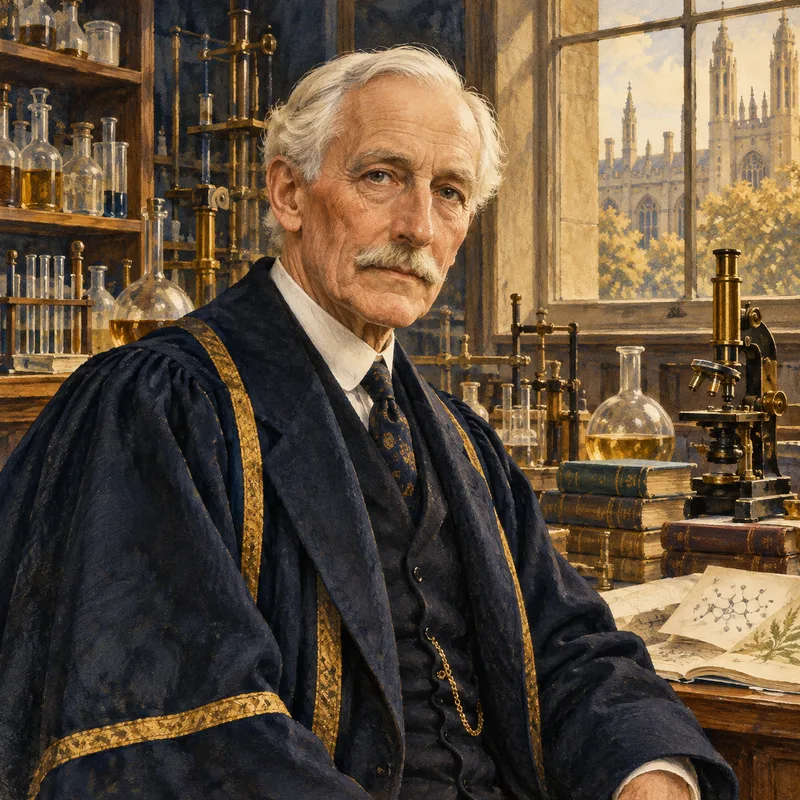
Frederick Gowland Hopkins
1861-1947 · United Kingdom · Nobel Physiology/Medicine 1929
Discovery of vitamins