Biography · Chemist no. 67 of 350
Frederick Sanger: The Quiet Genius Who Won Two Nobel Prizes in Chemistry
Frederick Sanger (1918-2013) was a British biochemist who learned to read the sequences of proteins and DNA. He is the only person to have won the Nobel Prize in Chemistry twice, in 1958 and 1980. Famous for his modesty, he preferred the laboratory bench to administration and once described himself as not being particularly clever. His legacy in one line: he made molecular information readable, and the age of genomics followed.
Early Life and Family
Frederick Sanger was born on 13 August 1918 in Rendcomb, Gloucestershire, England. His father, also named Frederick, was a medical doctor who had earlier worked as a missionary doctor in China, and his mother, Cicely, came from a family connected with the cotton business. Both parents were from Quaker backgrounds, and the family held strong pacifist values. Young Fred was interested in nature and the outdoors. The family had enough means to send him to Bryanston School in Dorset, where he was introduced to a more practical way of learning. He originally planned to follow his father into medicine, but chemistry and biology captured him instead.
Education and Mentors
Sanger studied natural sciences at St John's College, Cambridge, graduating in 1939 with a focus on biochemistry. His teachers included the biochemists who had built Cambridge's strong reputation, and he was influenced by the idea that chemistry could explain life. For his PhD he worked under Albert Neuberger on the metabolism of the amino acid lysine and the nitrogen in potatoes. As a Quaker and conscientious objector, he did not serve in the war and continued in research. He then joined A. C. Chibnall's group, which was studying insulin, and this decision shaped his career.
Career Timeline
| Year | Event |
|---|---|
| 1918 | Born in Rendcomb, Gloucestershire |
| 1939 | Graduates from St John's College, Cambridge |
| 1943 | Begins insulin work at Cambridge |
| 1945 | Develops FDNB method (Sanger's reagent) for N-terminal analysis |
| 1955 | Completes the amino acid sequence of insulin |
| 1958 | Nobel Prize in Chemistry |
| 1962 | Moves to the MRC Laboratory of Molecular Biology, Cambridge |
| 1977 | Publishes chain-termination DNA sequencing and the phiX174 genome |
| 1980 | Second Nobel Prize in Chemistry |
| 1983 | Retires from the laboratory |
| 2013 | Dies in Cambridge |
Major Scientific Contributions
Sanger's career had three major phases. First, he sequenced insulin using FDNB to label the N-terminal amino groups, then breaking the protein into fragments and reassembling the pieces. This showed that proteins have definite sequences. Second, he worked on RNA sequencing methods in the 1960s. Third, he created the dideoxy chain-termination method and sequenced the bacteriophage φX174 genome of 5,386 nucleotides, followed by the human mitochondrial DNA. His reaction chemistry is explained in our discovery post.
Awards, Honours and Nobel Prize
- Nobel Prize in Chemistry, 1958, for work on the structure of proteins, especially insulin.
- Nobel Prize in Chemistry, 1980, shared with Paul Berg and Walter Gilbert, for determining base sequences in nucleic acids. Sanger received half of the prize.
- Fellow of the Royal Society (1954).
- Order of the British Empire (CBE, 1963) and the Order of Merit (1986).
- He declined a knighthood, as he did not want to be called "Sir."
- The Wellcome Sanger Institute near Cambridge, a major genome research centre, is named in his honour.
Personality, Struggles and Lesser-Known Facts
- Bench scientist: He enjoyed experiments with his own hands and said he preferred not to take on management roles. He retired in 1983 to garden and make boats.
- Humility: He often said that luck played a large part in his success, and he disliked being treated as a celebrity.
- Quaker values: His pacifist upbringing shaped his choices during the war and his reluctance to accept honours with titles.
- Long persistence: The insulin project lasted around ten years. Many colleagues thought the work was too slow, but he believed in careful experiments.
- Family: He married Joan Howe in 1940, and they had three children.
- Interests: In his spare time he liked gardening and sailing.
Legacy and Influence on Modern Chemistry
The genome era depends on Sanger's idea. Before next-generation sequencing, nearly all large genomes were read by his method, including the first draft of the human genome. His insulin work gave strong evidence for the sequence hypothesis, which links DNA sequence to protein sequence, and it supported the central dogma of molecular biology proposed by Francis Crick. The tools of proteomics and genetic diagnosis, from newborn screening to cancer genomics, can be traced to him. In India, laboratories and companies that provide genetic tests and microbial identification still validate their results by Sanger sequencing.
Lessons for Students
- Choose a clear and important problem and stay with it.
- Develop good methods; new tools often open more doors than new theories.
- Be honest about luck and credit your collaborators.
- Success does not require a loud personality; careful work speaks for itself.
Quick Facts Box
- Born: 13 August 1918, Rendcomb, England
- Died: 19 November 2013, Cambridge, England
- Nationality: British
- Field: Biochemistry, protein and nucleic acid sequencing
- Famous for: Insulin sequence; chain-termination DNA sequencing
- Nobel: Chemistry 1958 and Chemistry 1980
FAQ
How many Nobel Prizes did Sanger win?
Two, both in Chemistry: 1958 and 1980.
Which of Sanger's discoveries is used most today?
Chain-termination DNA sequencing, usually called Sanger sequencing, is still widely used for confirming sequences.
Did he work in a university or a research council?
He worked at the University of Cambridge and later at the Medical Research Council Laboratory of Molecular Biology in Cambridge.
Why did he decline a knighthood?
He did not want a title that would set him apart from others; he valued simplicity.
Published by ABC Chemistry — IIT-JAM | CSIR-NET | GATE Chemistry Coaching. Visit abcchemistry.com
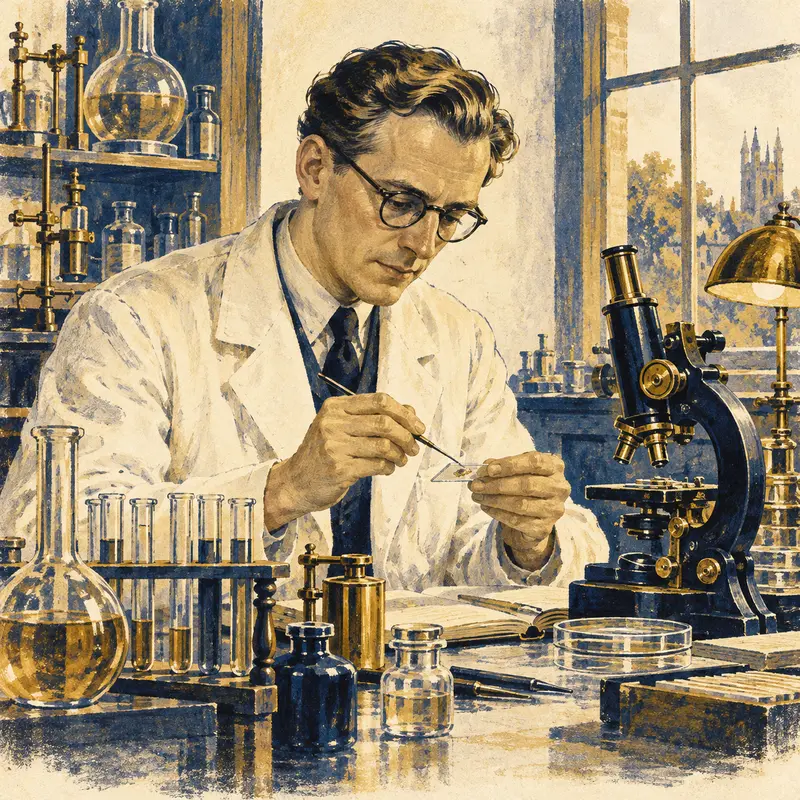
About the chemist
Frederick Sanger
1918-2013 · United Kingdom · Nobel Chemistry 1958; Chemistry 1980
Protein sequencing; DNA sequencing