The discovery, explained · Chemist no. 67 of 350
Frederick Sanger: Reading the Sequences of Proteins and DNA
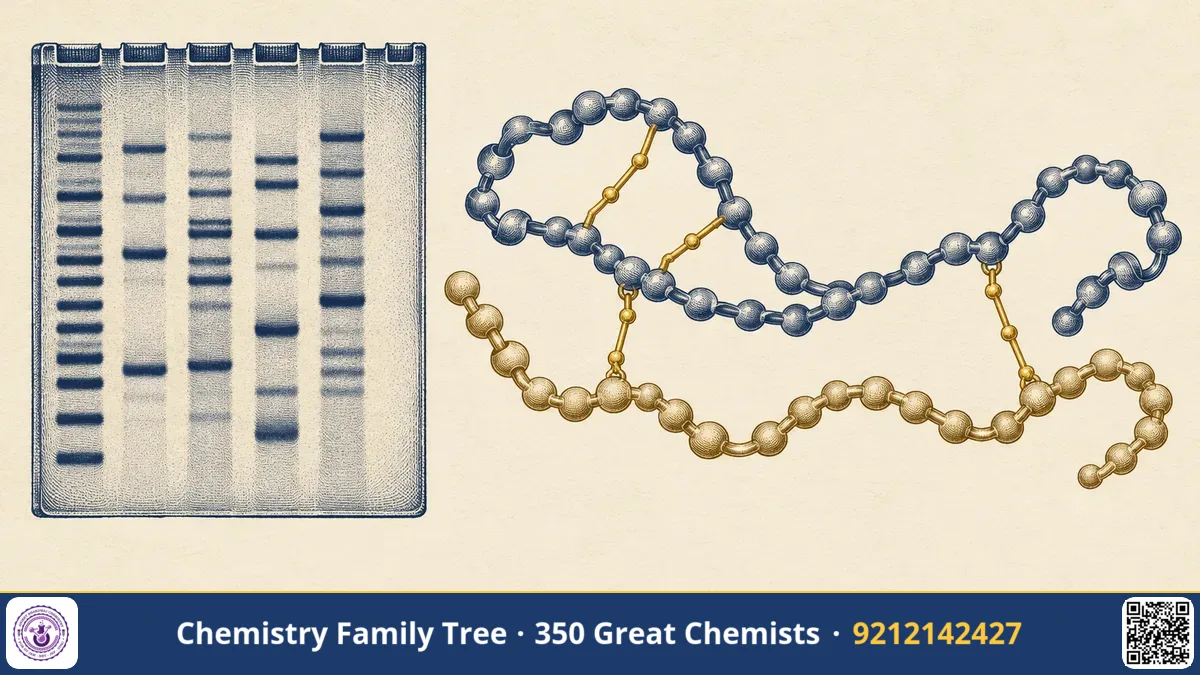
Frederick Sanger is the only scientist to have won the Nobel Prize in Chemistry twice. In 1958 he received it for showing the exact amino acid sequence of insulin, which proved that a protein is a definite molecule with a fixed order of building blocks. In 1980 he shared a second prize for inventing a fast method to read the order of bases in DNA. Both discoveries gave biology something it never had before: the ability to read molecular information letter by letter. The genome projects of today, including the Human Genome Project, rest on his chain-termination method, still called Sanger sequencing. Let us see how it worked.
The Scientific Problem Before the Discovery
Before the 1950s many scientists doubted that proteins had a fixed, defined structure. Some thought proteins were loose mixtures or colloidal aggregates with variable composition. Others suspected that amino acids were arranged in a regular repeating pattern. If proteins had no definite sequence, then the idea of a gene coding for a protein would be difficult to defend. Chemists knew that proteins were polymers of α-amino acids joined by peptide bonds, but nobody had worked out the order of residues in even one protein. Later the same problem appeared for nucleic acids: DNA was known to carry heredity, but reading long sequences was extremely slow.
The Discovery: Step-by-Step
Part 1: Sequencing insulin
Sanger chose insulin because it was available pure and in good quantity, and it was small. His method had these steps:
- Label the N-terminus. He treated the protein with 1-fluoro-2,4-dinitrobenzene (FDNB), now called Sanger's reagent. It reacts with the free amino group by nucleophilic aromatic substitution, forming a yellow dinitrophenyl (DNP) derivative.
- Hydrolyse completely with acid (6 M HCl). Peptide bonds break, but the bond between the DNP group and the N-terminal residue survives.
- Identify the yellow DNP-amino acid by chromatography.
- Repeat on partial hydrolysates. Insulin was cut into small peptides by acid and enzymes such as trypsin, and each fragment was sequenced the same way. Overlapping fragments were then assembled like a jigsaw puzzle.
The reaction can be written as:
H2N-R + F-C6H3(NO2)2 → DNP-NH-R + HF
He separated the two chains of insulin by oxidising the disulfide bonds with performic acid. Chain A has 21 amino acids and chain B has 30 amino acids. The work was completed in 1955 and showed that the two chains are linked by two disulfide bridges, with one more inside chain A.
Part 2: Sequencing DNA
In the 1970s Sanger and colleagues developed the chain-termination (dideoxy) method. In 1977 they used it to sequence the genome of bacteriophage φX174, which has 5,386 nucleotides. This was the first complete DNA genome to be sequenced. The steps are:
- Take single-stranded template DNA and a short primer.
- Add DNA polymerase, the four normal deoxynucleotides (dNTPs), and a small amount of one dideoxynucleotide (ddNTP) in each of four separate reactions.
- Whenever the polymerase inserts a ddNTP, the chain stops, because ddNTP has no 3′-OH group needed for the next phosphodiester bond.
- This produces fragments of all possible lengths ending at, for example, every G.
- The fragments are separated on a polyacrylamide gel by size and the sequence is read from the ladder of bands.
The Chemistry Behind It
Sanger's reagent works because the ring is activated for nucleophilic aromatic substitution (SNAr). Two nitro groups, positioned ortho and para to fluorine, withdraw electrons and stabilise the negative Meisenheimer intermediate. The unprotonated amine of the N-terminal residue attacks the carbon bearing fluorine, and fluoride leaves. This is a classic mechanism often asked in organic chemistry papers.
In the DNA method, the key idea is the missing 3′-hydroxyl group. DNA chain growth occurs by the 3′-OH of the last nucleotide attacking the α-phosphate of the incoming dNTP. A dideoxy sugar cannot make this bond, so the chain terminates. Modern automated sequencers replace radioactive labels with fluorescent dyes, one colour for each ddNTP, and use capillary electrophoresis.
Sanger's insulin result also supported the idea of primary structure: the amino acid sequence is the first level of protein structure, and it determines folding. Later work by Anfinsen on ribonuclease strengthened this view.
Applications Today
- Genomics: The Human Genome Project used Sanger sequencing as its main tool.
- Medicine: Genetic testing for mutations, for example in inherited diseases and cancer, often confirms results by Sanger sequencing.
- Forensics and diagnostics: DNA profiling and pathogen identification use sequencing.
- Protein chemistry: Protein sequencing now also uses Edman degradation and mass spectrometry.
- India context: Research institutes and diagnostic laboratories across India use Sanger sequencing for validating gene variants and identifying microbes.
Exam Corner
- Sanger's reagent is 1-fluoro-2,4-dinitrobenzene (FDNB); it labels the N-terminal amino acid.
- Insulin has 51 amino acids: A chain 21 and B chain 30, joined by two interchain disulfide bonds.
- Dideoxynucleotides lack the 3′-OH group, so they terminate chain elongation.
- Edman degradation uses phenyl isothiocyanate and removes residues one at a time without destroying the rest of the chain.
- Sanger won Nobel Prizes in Chemistry in 1958 (insulin) and 1980 (DNA sequencing, shared with Walter Gilbert and Paul Berg).
Common Misconceptions
- "Sanger discovered the structure of DNA." No. That was Watson, Crick, Wilkins and Franklin. Sanger developed a way to read its sequence.
- "Sanger's reagent and Edman reagent are the same." They are different. FDNB destroys the rest of the chain on hydrolysis, while phenyl isothiocyanate allows stepwise removal.
- "Insulin is one chain." The mature insulin has two chains; it is made from a longer single-chain precursor, proinsulin.
Quick Revision Box
- FDNB labels N-terminal amino groups, giving yellow DNP-amino acids.
- Insulin: A chain 21 residues, B chain 30 residues, completed 1955.
- Chain-termination uses ddNTPs without the 3′-OH group.
- First DNA genome sequenced: bacteriophage φX174 (5,386 bases), 1977.
- Two Nobel Prizes in Chemistry: 1958 and 1980.
- Primary structure = amino acid order.
FAQ
Why did Sanger choose insulin?
It was available in pure form and was relatively small, which made the problem manageable with the methods of the time.
What is the difference between dNTP and ddNTP?
dNTP has a 3′-OH group, so the chain can continue. ddNTP has only hydrogen at the 3′ position, so the chain stops after it is added.
Is Sanger sequencing still used?
Yes, for sequencing short regions and confirming results, though next-generation sequencing handles large genomes more cheaply.
Why is Sanger special among Nobel winners?
He is the only person to have received two Nobel Prizes in Chemistry.
Published by ABC Chemistry — IIT-JAM | CSIR-NET | GATE Chemistry Coaching. Visit abcchemistry.com
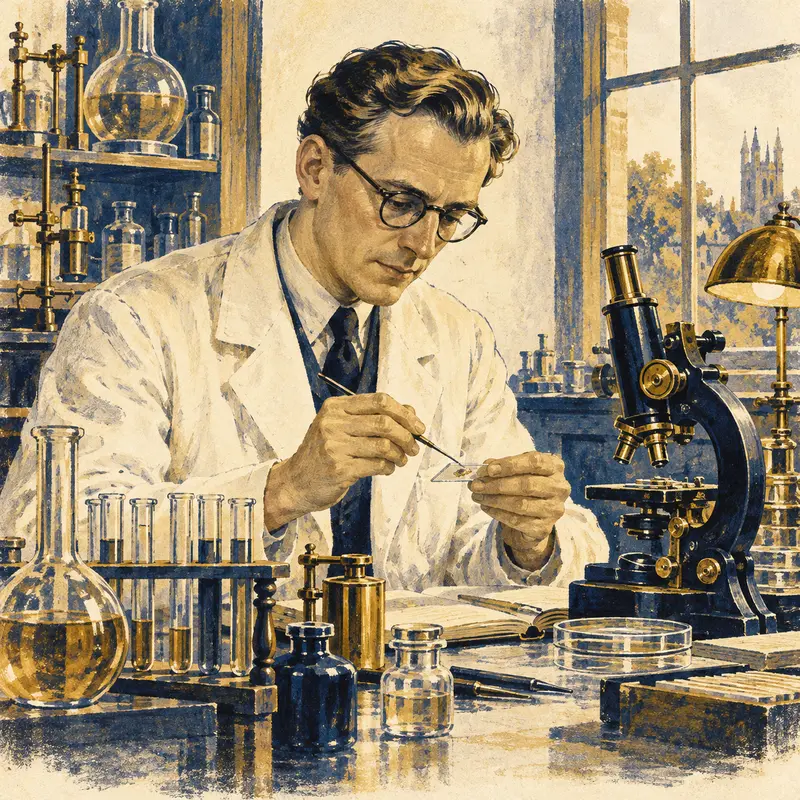
About the chemist
Frederick Sanger
1918-2013 · United Kingdom · Nobel Chemistry 1958; Chemistry 1980
Protein sequencing; DNA sequencing