Biography · Chemist no. 28 of 350
Frederick Soddy: The Chemist Who Named the Isotope
Introduction
Frederick Soddy (1877-1956) was an English chemist who helped to prove that atoms can change into other atoms, and who gave chemistry the word isotope. He worked with Ernest Rutherford and William Ramsay, taught in Glasgow, Aberdeen and Oxford, and received the Nobel Prize in Chemistry in 1921. Later in life he turned his attention to economics and money, a subject on which he held strong and unusual views. His legacy in one line: he showed that an element is not defined by its mass but by its place in the periodic table.
Early Life and Family
Frederick Soddy was born on 2 September 1877 in Eastbourne, on the south coast of England. His family was devout and comfortable but not wealthy, and he grew up on the English south coast. He showed an early interest in science and experiments at school, where he studied chemistry, and he was encouraged to continue his education beyond school.
Education and Mentors
Soddy studied at the University College of Wales in Aberystwyth, where he did well in chemistry, and in 1895 he went to Oxford, entering Merton College. He graduated with first-class honours in chemistry in 1898 and carried out some research there. His most important training, however, came when he moved abroad. In 1900 he travelled to Canada and became a demonstrator in chemistry at McGill University in Montreal. There he met Ernest Rutherford, who was working on radioactivity. Their partnership was the key moment in Soddy's career. Later, in London, he worked with Sir William Ramsay, the discoverer of the noble gases.
Career Timeline
| Year | Event |
|---|---|
| 1877 | Born in Eastbourne, England (2 September) |
| 1898 | Graduates from Oxford with first-class honours in chemistry |
| 1900 | Becomes demonstrator at McGill University, Montreal |
| 1902 | With Rutherford, proposes the theory of radioactive disintegration |
| 1903 | Works with William Ramsay at University College London; helium detected from radium |
| 1904 | Lecturer at the University of Glasgow |
| 1908 | Marries Winifred Beilby |
| 1913 | Coins the term isotope; formulates the displacement law |
| 1914 | Becomes professor at the University of Aberdeen |
| 1917 | Identifies protactinium (with John Cranston) |
| 1919 | Appointed Dr Lee's Professor of Chemistry at Oxford |
| 1921 | Awarded the Nobel Prize in Chemistry |
| 1936 | Retires from Oxford |
| 1956 | Dies in Brighton, England (22 September) |
Major Scientific Contributions
- Theory of radioactive disintegration (1902): with Rutherford, he showed that radioactivity is the spontaneous transformation of one element into another. This ended the old idea that atoms are permanent and unchangeable.
- Helium from radium (1903): with Ramsay, he showed that helium is produced during radioactive decay.
- Isotopes (1913): he explained that chemically identical atoms can have different masses and radioactive properties.
- Displacement law (1913): alpha emission shifts an element two places down the periodic table, beta emission shifts it one place up. Fajans described it independently.
- Protactinium (1917): he and Cranston identified the parent of actinium, a discovery made about the same time by Otto Hahn and Lise Meitner.
The detailed chemistry is covered in our companion post, "Frederick Soddy and the Discovery of Isotopes".
Awards, Honours and Nobel Prize
- Nobel Prize in Chemistry, 1921: awarded for his contributions to the chemistry of radioactive substances and for his investigations into the origin and nature of isotopes. The prize for 1921 was announced in 1922.
- Fellow of the Royal Society, elected in 1910.
- A lunar crater is named after him, and he is remembered with Rutherford in the history of nuclear science.
Personality, Struggles and Lesser-Known Facts
- A sharp tongue and independent mind. Colleagues described him as brilliant but argumentative. He did not hesitate to criticise authorities.
- Foresight on atomic energy. Soddy spoke and wrote about the enormous energy stored in the atom years before nuclear weapons existed, and warned of misuse. He is often quoted as an early voice on both the promise and the danger.
- Turn to economics. After the First World War he became disturbed by the economic problems of society and wrote on money and debt, including the 1926 book "Wealth, Virtual Wealth and Debt". He argued that real wealth is tied to physical energy and resources and that banks create money in a way that causes harm. His economic ideas were ignored by many contemporaries but have been revisited in recent decades.
- Quiet later research career. After the 1920s his scientific output at Oxford slowed as his interests shifted, and he built less of a research school than his earlier fame might have suggested.
- Tragedy at home. His wife Winifred died in 1936, the year he retired. They had no children.
Legacy and Influence on Modern Chemistry
The concept of the isotope is now basic to every chemistry course. Atomic weights, mass spectrometry, nuclear medicine, radiocarbon dating, nuclear power and isotope tracing in biology all depend on it. Soddy's disintegration theory with Rutherford was the first step towards nuclear chemistry, which grew into the work of Hahn, Meitner, Seaborg and many others. His displacement law gave later chemists a simple way to follow the long decay series of uranium, thorium and actinium. Soddy is also remembered as one of the first chemists to ask how scientific discoveries should be used responsibly by society.
Lessons for Students
- Chemistry skills open new physics. Soddy's careful chemical tests proved that a gas from thorium was an inert gas, which led to a revolution.
- Question accepted rules. Dalton's "unchangeable atom" was replaced by evidence, not by opinion.
- Find a good partner. Rutherford the physicist and Soddy the chemist solved together what neither could solve alone.
- Science and society are linked. Think about the use of your knowledge, as Soddy did.
- Use words precisely. One new word, "isotope", cleared decades of confusion.
Quick Facts Box
- Born: 2 September 1877, Eastbourne, England
- Died: 22 September 1956, Brighton, England
- Nationality: British
- Field: Radiochemistry and nuclear chemistry
- Famous for: Radioactive disintegration theory, the term isotope, displacement law
- Nobel Prize: Chemistry, 1921
FAQ
Why did Frederick Soddy win the Nobel Prize?
For his contributions to the knowledge of the chemistry of radioactive substances and his investigations into the origin and nature of isotopes.
What was the relationship between Soddy and Rutherford?
They worked together at McGill University between 1901 and 1903 and proposed the theory of radioactive disintegration. Rutherford later won the 1908 Nobel Prize in Chemistry.
Where did Soddy teach?
He taught at Glasgow, Aberdeen and finally at Oxford, where he held the Dr Lee's Professorship of Chemistry from 1919 to 1936.
Why is Soddy also known for economics?
After the First World War he wrote about money, banking and debt, arguing that the monetary system should be tied more closely to real physical wealth.
Published by ABC Chemistry — IIT-JAM | CSIR-NET | GATE Chemistry Coaching. Visit abcchemistry.com
About the chemist
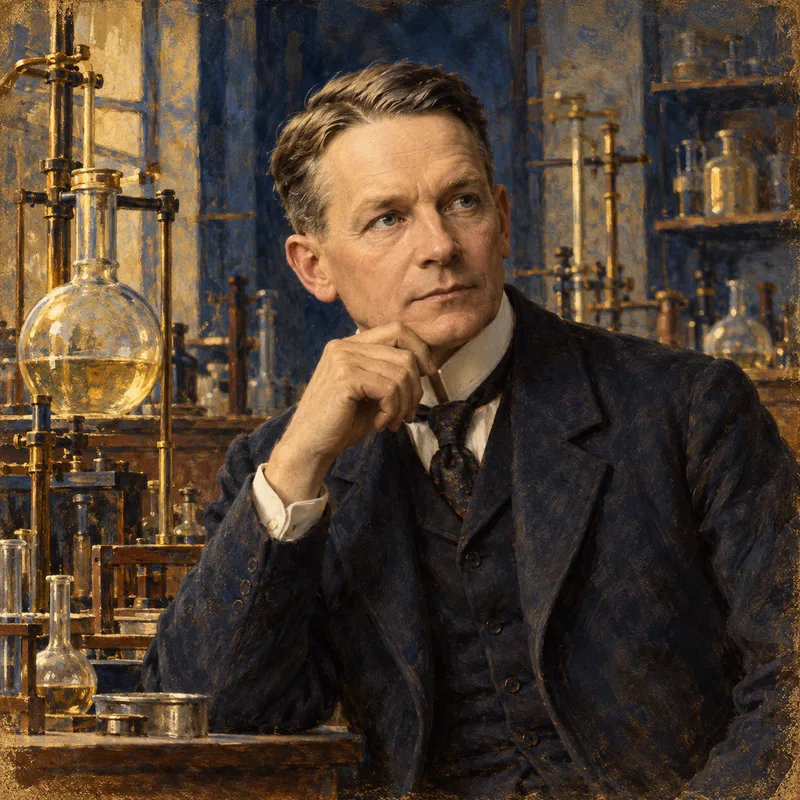
Frederick Soddy
1877-1956 · United Kingdom · Nobel Chemistry 1921
Isotopes; radioactive decay theory