The discovery, explained · Chemist no. 28 of 350
Frederick Soddy and the Discovery of Isotopes
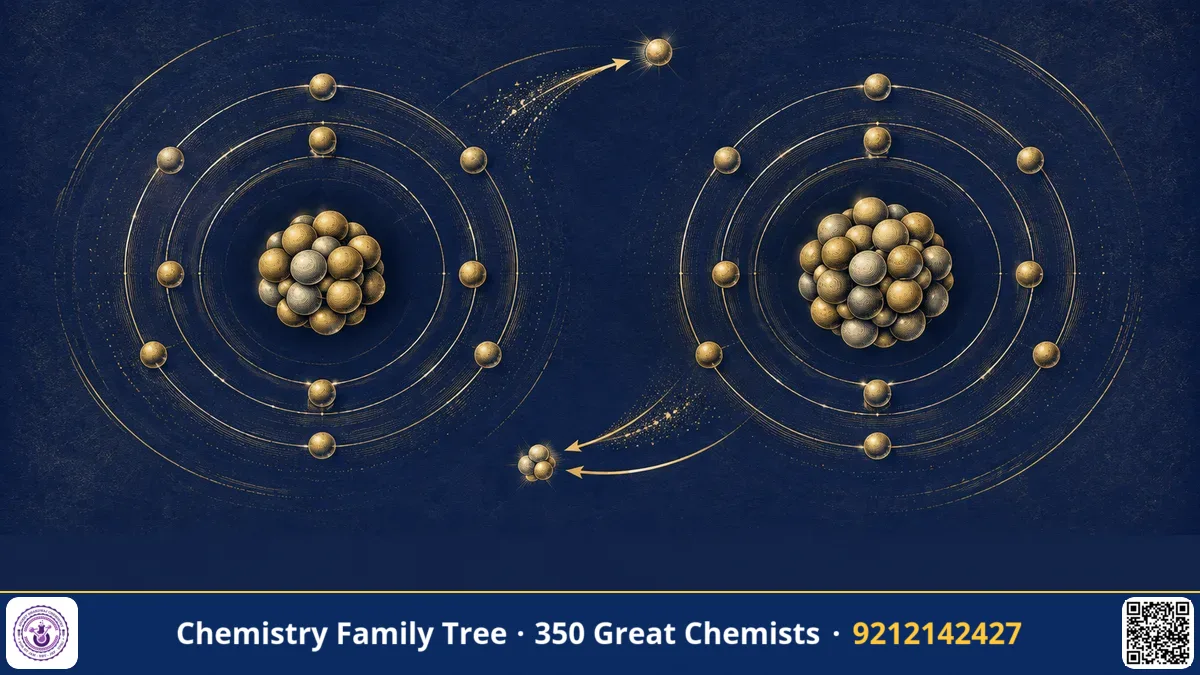
In 1913 a British chemist put forward an idea that sounded almost impossible: two atoms can belong to the same chemical element, occupy the same place in the periodic table, behave identically in a test tube, and still have different atomic masses. Frederick Soddy called such atoms isotopes, from Greek words meaning "same place". Combined with his earlier work with Ernest Rutherford showing that radioactive atoms transform into other elements, this idea rewrote the foundations of chemistry. Soddy received the 1921 Nobel Prize in Chemistry for his contributions to the chemistry of radioactive substances and for his investigations into the origin and nature of isotopes. This post explains the problem, the steps of discovery and the concepts you must know for exams.
The Scientific Problem Before the Discovery
Dalton's atomic theory, which dominated the nineteenth century, said that atoms of an element are identical in mass and cannot be changed into other elements. Then radioactivity was discovered by Becquerel in 1896, and Marie and Pierre Curie isolated new radioactive elements such as polonium and radium. Chemists were left with puzzles:
- Where does the energy of radioactive substances come from, and why does it never seem to run out quickly?
- Radioactive materials gave off new radioactive substances, such as emanations (gases). Was this just a chemical change, or something deeper?
- By 1910, chemists had separated dozens of radioactive "elements" with different half-lives, such as radium D, mesothorium, ionium and thorium, yet the periodic table had no room for so many new elements. Some of them could not be separated from each other by any chemical method.
The Discovery: Step by Step
Step 1: Montreal, 1901-1903, the disintegration theory
Soddy worked as a young demonstrator at McGill University in Canada with Ernest Rutherford. They studied thorium compounds and found that a radioactive gas was given off, and that it behaved chemically like an inert gas. Soddy's chemical skill was vital: he showed that the gas did not react with the reagents that would remove other gases. Further work showed that thorium continuously produced a new, chemically different, radioactive substance called thorium X. Rutherford and Soddy concluded in 1902 that radioactivity is spontaneous transformation of one element into another. This was called the theory of radioactive disintegration, and it overturned the idea that atoms are indestructible.
Step 2: London, 1903, helium from radium
At University College London, Soddy worked with Sir William Ramsay. Using radium bromide, they detected helium as a product of radioactive decay by spectroscopic analysis. This supported the view that alpha particles are helium nuclei, formed as radium emits them and slowly changes into other elements.
Step 3: Glasgow, 1910-1913, many "elements", one place
At the University of Glasgow, Soddy noticed that some radioelements that seemed different, with different radioactive properties, were chemically identical. Once mixed, they could not be separated by chemical methods. The decay chains of uranium, thorium and actinium produced many such substances. Soddy proposed that these substances were chemically the same element but with different atomic masses and different radioactive behaviour. In 1913, with a suggestion from a friend, Margaret Todd, he used the word isotope.
Step 4: The displacement law, 1913
Soddy, and independently Kasimir Fajans (and also Alexander Russell), described what happens to an element's position in the periodic table when it emits radiation. This is the group displacement law, also called the Soddy-Fajans law:
- Alpha emission lowers the mass number by 4 and the atomic number by 2, so the element moves two places to the left (two groups).
- Beta (electron) emission leaves the mass number unchanged and raises the atomic number by 1, so the element moves one place to the right.
²³⁸₉₂U → ²³⁴₉₀Th + ⁴₂He      (alpha emission)
²³⁴₉₀Th → ²³⁴₉₁Pa + ⁰₋₁e      (beta emission)
²³⁴₉₁Pa → ²³⁴₉₂U + ⁰₋₁e      (beta emission)
Notice that the last two steps lead to a uranium atom with mass number 234 instead of 238: two atoms of uranium with different masses, both uranium. These are isotopes.
Step 5: Lead from different sources
Soddy predicted that the end product of the uranium decay series would be lead with atomic mass slightly different from ordinary lead. Measurements on lead extracted from uranium minerals, including work by T. W. Richards, supported the idea that "lead" is a mixture of isotopes whose proportions depend on the source.
The Chemistry Behind It
Definition of isotopes
Isotopes are atoms of the same element with the same atomic number (Z, the number of protons) but different mass numbers (A) because they contain different numbers of neutrons. Soddy proposed this in terms of mass and radioactive properties; the neutron itself was discovered much later, in 1932, by James Chadwick.
Why isotopes behave the same chemically
Chemical behaviour depends mainly on the electron configuration, which is fixed by the nuclear charge Z. Isotopes of one element have the same electron arrangement, so their chemical reactions are almost identical. Small differences in mass can still change reaction rates (the kinetic isotope effect), especially for hydrogen and deuterium.
Radioactive decay kinetics
Soddy and Rutherford showed that radioactive decay is a first-order process:
N = N₀ e^(-λt) t½ = 0.693 / λ
The half-life is independent of temperature, pressure and chemical state, which is why radioactive change was recognised as a nuclear and not a chemical process.
Atomic weight of an element
The non-integral atomic weights of many elements, such as chlorine (about 35.45), now make sense: they are weighted averages of isotopes such as Cl-35 and Cl-37.
Applications Today
- Radiocarbon dating: carbon-14 content gives the age of organic remains, based directly on first-order decay.
- Medicine: iodine-131 treats thyroid disorders, technetium-99m is widely used in imaging, and cobalt-60 has been used in radiotherapy.
- Nuclear energy: uranium-235 and plutonium-239 fuel reactors; India's three-stage nuclear programme uses uranium and thorium.
- Geology: uranium-lead dating and potassium-argon dating measure the age of rocks and the Earth.
- Tracers: radioactive and stable isotopes trace reactions in chemistry, biology and agriculture.
Exam Corner
- Isotopes have the same Z but different A. Isobars have the same A but different Z. Isotones have the same number of neutrons.
- Alpha emission: Z decreases by 2, A decreases by 4. Beta emission: Z increases by 1, A unchanged. Gamma emission: no change in Z or A.
- Number of alpha and beta particles in a decay series: find alphas from the change in mass number divided by 4, then use the change in atomic number to find betas.
- Radioactive decay is first order, t½ = 0.693/λ, and independent of temperature.
- Soddy received the 1921 Nobel Prize in Chemistry; he coined the word "isotope" in 1913.
Common Misconceptions
- "Isotopes are different elements." No. They are forms of the same element with the same chemical identity.
- "Isotopes differ in the number of protons." They differ in the number of neutrons.
- "Soddy discovered the neutron." He did not. Chadwick discovered the neutron in 1932.
Quick Revision Box
- 1902: Rutherford and Soddy propose radioactive disintegration (transmutation).
- 1913: Soddy coins "isotope" and states the group displacement law with Fajans.
- Alpha: A-4, Z-2. Beta: A same, Z+1.
- Isotopes: same Z, different A, same chemistry.
- Decay is first order, t½ = 0.693/λ.
- Nobel Prize in Chemistry 1921.
FAQ
Who coined the word isotope?
Frederick Soddy introduced the word in 1913, reportedly after a suggestion by Margaret Todd, a Scottish doctor and writer.
What did Rutherford and Soddy show together?
They showed that radioactivity is the spontaneous change of one element into another, with first-order decay kinetics.
Why can isotopes not be separated by ordinary chemical methods?
They have the same electron configuration, and hence nearly identical chemical properties. Physical methods based on mass, such as mass spectrometry, diffusion or centrifugation, are used instead.
Did Soddy discover isotopes of stable elements?
His main work concerned radioactive elements. The proof of isotopes in stable elements such as neon came from J. J. Thomson and his assistant Francis Aston.
Published by ABC Chemistry — IIT-JAM | CSIR-NET | GATE Chemistry Coaching. Visit abcchemistry.com
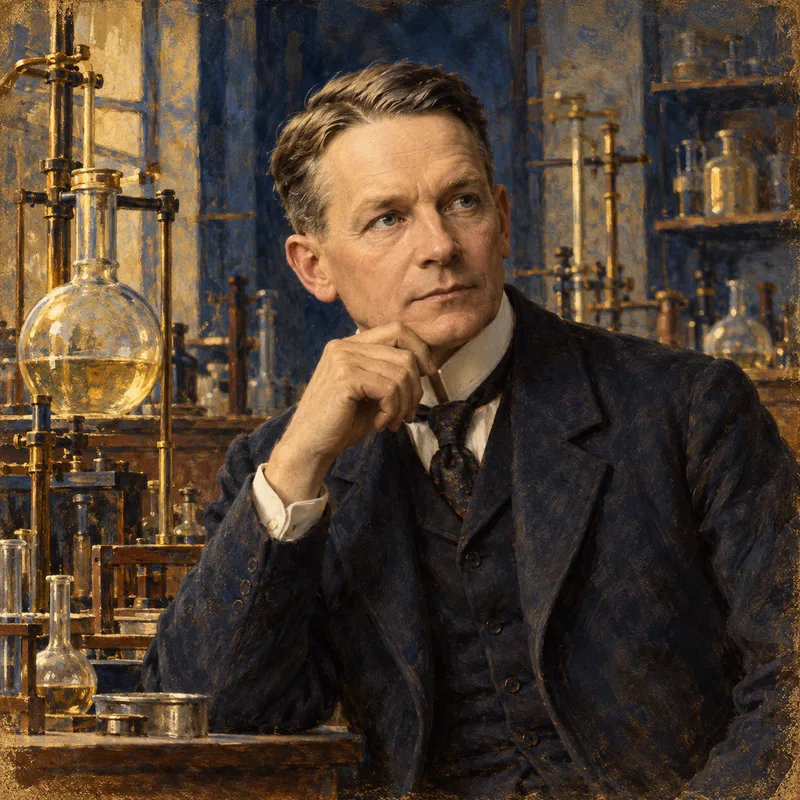
About the chemist
Frederick Soddy
1877-1956 · United Kingdom · Nobel Chemistry 1921
Isotopes; radioactive decay theory