Biography · Chemist no. 12 of 350
Friedrich Wöhler: The Life of the Chemist Who Made Urea and Isolated Aluminium
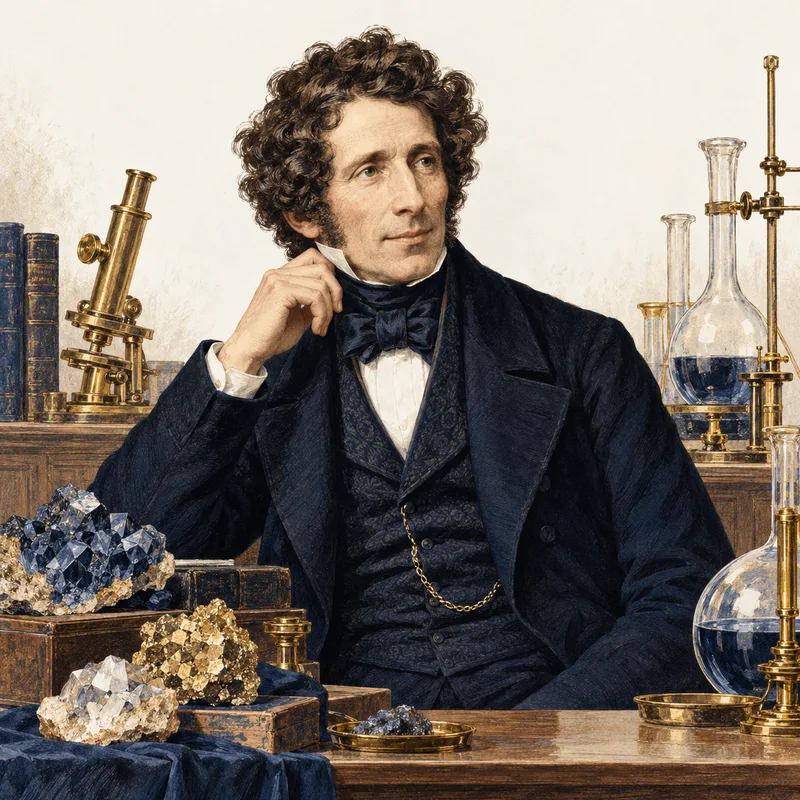
Friedrich Wöhler (1800-1882) was a German chemist, best known for the 1828 synthesis of urea from ammonium cyanate, which is often regarded as the start of modern organic chemistry. He also prepared metallic aluminium, beryllium and yttrium, found a way to make acetylene from calcium carbide, and taught a large number of students at the University of Göttingen. His legacy in one line: a gentle, curious and generous chemist whose experiments quietly changed how chemists think about life and matter.
Early Life and Family
Friedrich Wöhler was born on 31 July 1800 in Eschersheim, a village that is now part of Frankfurt am Main, Germany. His father, August Anton Wöhler, was a veterinarian and agricultural expert who served the local ruling house, and he also had wide interests in education and science. His mother was Anna Katharina Schröder. In his boyhood, Friedrich showed an early interest in mineral collecting, and in doing chemical experiments at home. His father supported these interests, and the family encouraged him to study. Wöhler later married his cousin Franziska Wöhler in 1830. She died in 1832 after the birth of their second child. In 1834 he married Julie Pfeiffer, and had a large family.
Education and Mentors
- He attended the gymnasium (high school) in Frankfurt and then studied medicine, first at Marburg and then at Heidelberg from 1821.
- At Heidelberg, he studied under the chemist Leopold Gmelin, who recognised his talent and encouraged him to follow chemistry. He earned his medical degree in 1823, and also did research on selenium and cyanogen compounds.
- Gmelin arranged for him to work with Jöns Jacob Berzelius in Stockholm in 1823-1824. Wöhler later said that his time in Berzelius's small laboratory was among the most important of his life. The two remained close friends, and Wöhler translated Berzelius's books and wrote to him regularly for 25 years.
Career Timeline
| Year | Event |
|---|---|
| 1800 | Born in Eschersheim near Frankfurt on 31 July |
| 1823 | Gets an MD from Heidelberg; goes to Stockholm to work with Berzelius |
| 1825 | Teaches at the Trade School (Gewerbeschule) in Berlin |
| 1827 | Isolates aluminium powder by reducing aluminium chloride with potassium |
| 1828 | Synthesises urea from ammonium cyanate; isolates beryllium and yttrium |
| 1831 | Moves to the Higher Trade School at Kassel |
| 1832 | Works with Liebig on the benzoyl radical |
| 1836 | Becomes professor of chemistry at the University of Göttingen |
| 1845 | Prepares aluminium in the form of small globules, allowing him to describe its properties |
| 1862 | Discovers that calcium carbide reacts with water to give acetylene |
| 1882 | Dies in Göttingen on 23 September |
Major Scientific Contributions
Synthesis of urea (1828). By heating ammonium cyanate, he obtained urea, showing that an organic compound produced in the body could be made from inorganic material. It also introduced the idea of isomerism. See our discovery post on Wöhler for the mechanism.
NH₄OCN → (NH₂)₂CO
Aluminium. He improved Hans Christian Ørsted's earlier method and, in 1827, obtained aluminium powder by heating anhydrous aluminium chloride with potassium. In 1845, he obtained small metal globules and described the lightness and other properties of the metal. For many years, aluminium was more precious than gold until the electrolytic method (Hall-Héroult) was developed in 1886.
Other elements. He isolated beryllium and yttrium in 1828 and worked on silicon, titanium and boron compounds. He prepared silicon hydrides and chlorides of silicon and studied crystalline boron.
Benzoyl radical (1832). With Justus von Liebig, he investigated oil of bitter almonds (benzaldehyde) and its derivatives, and found that a group of atoms, C₇H₅O, passes unchanged through a series of reactions. This supported the "radical theory" in organic chemistry.
Cyanates and fulminates. Wöhler found silver cyanate, and Liebig found silver fulminate, with the same composition. This was one of the first clear examples of isomerism, as pointed out by Berzelius.
Calcium carbide and acetylene (1862). He found that calcium carbide reacts with water: CaC₂ + 2H₂O → C₂H₂ + Ca(OH)₂. The method became industrially important decades later.
Awards, Honours and Nobel Prize
- Foreign Member of the Royal Society of London (1854).
- Copley Medal of the Royal Society (1872).
- Member of many academies, including the Göttingen Academy of Sciences and the French Academy of Sciences (as a foreign associate).
- No Nobel Prize, since the prizes began in 1901, after his death. The mineral wöhlerite is named in his memory.
Personality, Struggles and Lesser-Known Facts
- The famous letter. In his February 1828 letter to Berzelius, he wrote that he could make urea without needing a kidney, or even an animal. The tone of the letter was modest and humorous. He did not claim to have defeated vitalism, and he was more interested in the puzzle that two substances could have the same composition.
- A friendship with Liebig. Wöhler and Justus von Liebig first became connected through their work on silver fulminate and silver cyanate. They became close friends and collaborators for life. They wrote together many letters and visited each other often. When Liebig died in 1873, Wöhler was deeply affected.
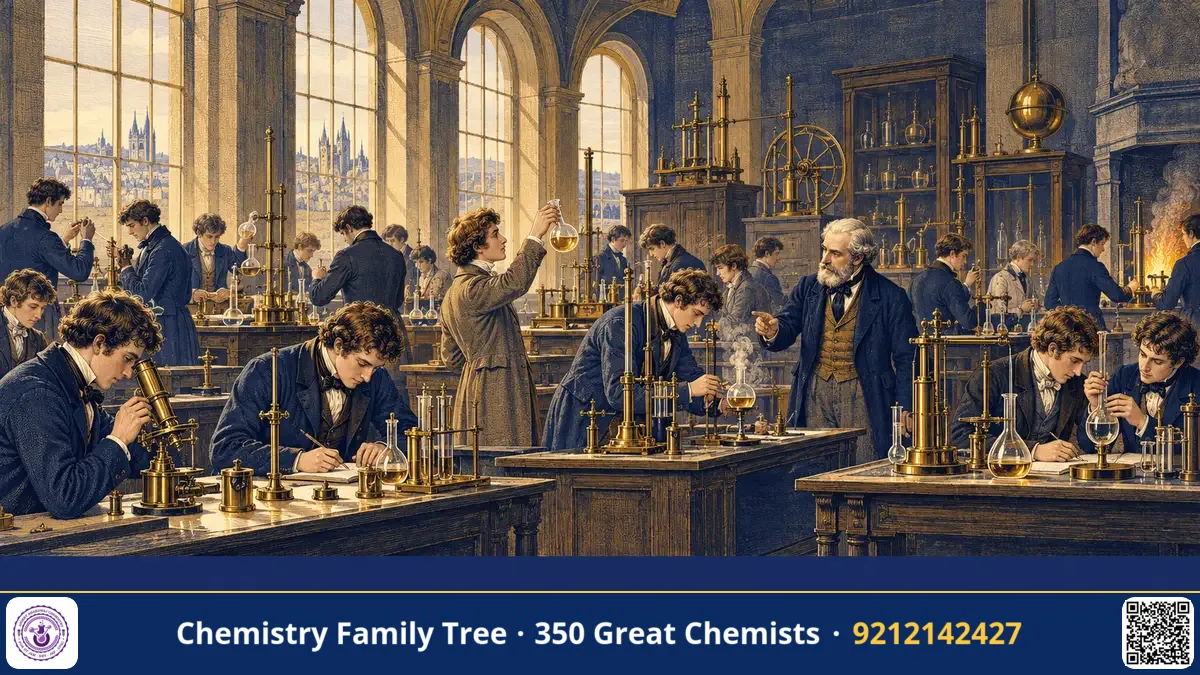
- A great teacher. At Göttingen he built a large teaching laboratory, in which hundreds of students studied analysis and synthesis. Students came from all over Europe and America. He was kind, patient and fair.
- Humour and a love of minerals. He collected minerals and meteorites all his life, and wrote on meteorite composition.
- Translator and writer. He translated Berzelius's textbooks into German, and wrote an influential textbook of organic and inorganic chemistry himself.
- Illness and loss. The early death of his first wife in 1832 was a deep sorrow, and he worked hard to bring up his children.
Legacy and Influence on Modern Chemistry
Wöhler's urea synthesis is remembered as the first step in the growth of synthetic organic chemistry, a field that today produces medicines, polymers, dyes and agrochemicals. It also led to a better understanding of isomerism, and helped chemists realise that structure, not only composition, determines properties. His work on aluminium opened the way for the metal to become common. His teaching style, combining lectures with student laboratory work, influenced the German university system, which was copied by many countries, including later in India. Wöhler is remembered as one of the great teachers of chemistry.
Lessons for Students
- Pay attention to surprises. He expected a salt but noticed that he had a different substance.
- Compare and verify. He compared his product with urea from urine in many ways.
- Value friendships. His partnership with Liebig made both stronger.
- Teach generously. Mentoring students multiplies your impact.
- Keep an open mind. A single experiment can overturn an entire belief system.
Quick Facts Box
- Born: 31 July 1800, Eschersheim (near Frankfurt), Germany
- Died: 23 September 1882, Göttingen, Germany
- Nationality: German
- Field: Organic and inorganic chemistry
- Famous for: Urea synthesis (1828), isolation of aluminium, beryllium and yttrium
- Nobel Prize: None (lived before 1901)
FAQ
Why is Wöhler famous?
He synthesised urea from ammonium cyanate in 1828, which is often seen as the beginning of synthetic organic chemistry, and he isolated aluminium and other elements.
Who was Wöhler's teacher?
He studied under Leopold Gmelin in Heidelberg and worked with Jöns Jacob Berzelius in Stockholm.
What was Wöhler's relationship with Liebig?
They were close friends and collaborators for life, and together they carried out the study of the benzoyl radical.
Did Wöhler win a Nobel Prize?
No. He died in 1882, before the Nobel Prizes were established in 1901.
Published by ABC Chemistry — IIT-JAM | CSIR-NET | GATE Chemistry Coaching. Visit abcchemistry.com
About the chemist
Friedrich Wöhler
1800-1882 · Germany
Synthesis of urea; isolated aluminium