The discovery, explained · Chemist no. 12 of 350
Wöhler's Synthesis of Urea: The Experiment That Shook the Theory of Vitalism
In the early 1820s, many chemists believed that substances made by living things, such as sugar, urea and acetic acid, could never be made in a laboratory from mineral matter. They thought a mysterious "vital force" was needed. In 1828, the young German chemist Friedrich Wöhler heated a salt called ammonium cyanate, which was considered inorganic, and found that it turned into crystals of urea, a well-known substance from urine. This simple experiment became a landmark: it was the first time that a natural organic compound was prepared from inorganic starting materials. It also showed, for the first time clearly, that two different substances can have the same formula, which led to the concept of isomerism.
The Scientific Problem Before the Discovery
At the beginning of the nineteenth century, chemistry was divided into two parts: inorganic chemistry (minerals, metals, salts) and organic chemistry (substances from plants and animals). Jöns Jacob Berzelius, the leading chemist of the time, expressed a widely held belief that organic compounds are produced under the influence of a "vital force" (vis vitalis) in living organisms, and that they cannot be made in a laboratory. This view is called vitalism. Another question concerned composition. Chemists believed that a given composition meant a single substance. If two samples had the same elements in the same proportions, they should be the same compound. Wöhler's work challenged both ideas.
The Discovery: Step by Step
- Studying cyanogen compounds (1820s). While working in Berlin and earlier in Stockholm, Wöhler studied cyanogen, (CN)₂, and cyanic acid, HOCN. He was trying to prepare ammonium cyanate, which was considered an inorganic ammonium salt.
- The reaction. He treated silver cyanate with ammonium chloride solution, and also combined cyanic acid with ammonia.
AgOCN + NH₄Cl → AgCl↓ + NH₄OCN
- The surprise. When he evaporated the solution of ammonium cyanate, he did not obtain the expected salt. Instead, he obtained colourless crystals that did not behave like a cyanate. They did not give the reactions of ammonium salts or of cyanates, but looked like urea, which had been isolated from urine by Rouelle in the eighteenth century and analysed by William Prout.
NH₄OCN → (NH₂)₂CO (on heating the aqueous solution)
- Confirmation. He compared the crystals with urea obtained from urine and found the properties to be identical, including crystal form and the products of reaction with nitric acid.
- The letter to Berzelius (February 1828). Wöhler wrote to his teacher that he could prepare urea without needing a kidney, or even an animal, whether human or dog. He published the result in Annalen der Physik und Chemie in 1828 under the title "On the artificial formation of urea".
The Chemistry Behind It
Isomers: same formula, different compounds
Both ammonium cyanate and urea have the molecular formula CH₄N₂O. This was a key puzzle. Berzelius soon accepted that two compounds can have the same composition but different properties, and in 1830 he proposed the term isomerism. Today we call ammonium cyanate and urea functional or structural isomers — an ionic salt (NH₄⁺ OCN⁻) and a covalent amide.
| Property | Ammonium cyanate | Urea |
|---|---|---|
| Formula | NH₄⁺ OCN⁻ | H₂N–CO–NH₂ |
| Bonding | Ionic salt | Covalent amide |
| Nitrogen content | Same total N | 46.7% N by mass |
| Type of isomerism | Functional group isomerism | |
Mechanism of the rearrangement
The conversion happens in steps. First, ammonium cyanate dissociates in solution into ammonia and isocyanic acid. Ammonia then acts as a nucleophile and attacks the electrophilic carbon of isocyanic acid, and a proton transfer gives urea.
NH₄⁺ OCN⁻  ⇌  NH₃ + HN=C=O
NH₃ + HN=C=O  →  H₂N–CO–NH₂
This is a nucleophilic addition to the C=N bond of an isocyanate, and it follows the same pattern as many modern organic reactions, such as the formation of ureas and carbamates from isocyanates.
Was vitalism really finished?
Historians point out that vitalism did not disappear overnight. Some argued that cyanate was itself derived from animal matter, and others said that urea was a "waste product" and not a true organic product. Over the next decades, Kolbe prepared acetic acid from its elements (1845), and Berthelot synthesised many organic compounds (1850s-1860s), which gradually convinced chemists that organic compounds follow the same laws as inorganic ones. Wöhler's work was an important start, not the final blow.
Other work by Wöhler
AlCl₃ + 3K → Al + 3KCl            (isolation of aluminium, 1827)
CaC₂ + 2H₂O → C₂H₂ + Ca(OH)₂      (acetylene from calcium carbide, 1862)
Applications Today
- Fertiliser. Urea contains 46% nitrogen and is the most widely used solid nitrogen fertiliser. India is one of the largest consumers, and the government mandates neem-coated urea to slow the release of nitrogen and reduce misuse.
- Industrial production. Urea is made from ammonia and carbon dioxide by the Bosch-Meiser process:
2NH₃ + CO₂ → NH₂COONH₄ (ammonium carbamate)
NH₂COONH₄ → (NH₂)₂CO + H₂O
- Plastics and resins. Urea-formaldehyde resins are used in plywood adhesives and moulded products.
- Medicine and cosmetics. Urea is used in moisturising creams for dry skin, and in diagnostic tests such as blood urea nitrogen (BUN) for kidney function.
- Pollution control. A urea solution is used in diesel vehicles in the selective catalytic reduction system to reduce nitrogen oxides (sold as AdBlue or diesel exhaust fluid).
- Laboratory reagent. Urea at high concentration (6-8 M) denatures proteins in biochemical studies.
Exam Corner
- Wöhler synthesis (1828): NH₄OCN → NH₂CONH₂ (heat). It is the first synthesis of an organic compound from an inorganic compound.
- Urea and ammonium cyanate are functional group isomers (formula CH₄N₂O). Urea has 46.67% nitrogen by mass (28/60).
- Urea on heating (about 150-160 °C) gives biuret and ammonia; biuret gives a violet colour with alkaline CuSO₄.
- Hydrolysis: (NH₂)₂CO + H₂O → 2NH₃ + CO₂ (urease enzyme in soil).
- Wöhler first isolated aluminium (1827), beryllium and yttrium (1828) and discovered calcium carbide route to acetylene (1862).
Common Misconceptions
- "Wöhler's experiment ended vitalism immediately." It did not. It began a gradual change in thinking.
- "Urea is an inorganic compound because it can be made from inorganic substances." Urea is an organic compound, because it contains carbon bonded to nitrogen in a covalent structure. Origin does not define whether a compound is organic.
- "The reaction is a simple heating of urea." It is the reverse: ammonium cyanate rearranges to urea.
Quick Revision Box
- Year: 1828. Wöhler heated ammonium cyanate and obtained urea.
- NH₄OCN → H₂N–CO–NH₂ (isomerisation).
- Challenged vitalism, supported by Berzelius.
- Led to the concept of isomerism (term by Berzelius, 1830).
- Urea: 46% N, key fertiliser; Bosch-Meiser process from NH₃ + CO₂.
- Wöhler also isolated aluminium (1827) and found CaC₂ route to acetylene.
FAQ
What did Wöhler actually do in 1828?
He prepared ammonium cyanate from inorganic substances and found that on evaporation it changed to urea, the same compound as found in urine.
What is vitalism?
It is the old belief that organic compounds are formed only by living organisms because of a special "vital force", and cannot be prepared from inorganic matter in the laboratory.
Why is the Wöhler synthesis an example of isomerism?
Because ammonium cyanate and urea have the same molecular formula, CH₄N₂O, but different structures and properties.
How is urea produced industrially today?
By reacting ammonia with carbon dioxide under high pressure and temperature to form ammonium carbamate, which then loses water to give urea.
Published by ABC Chemistry — IIT-JAM | CSIR-NET | GATE Chemistry Coaching. Visit abcchemistry.com
About the chemist
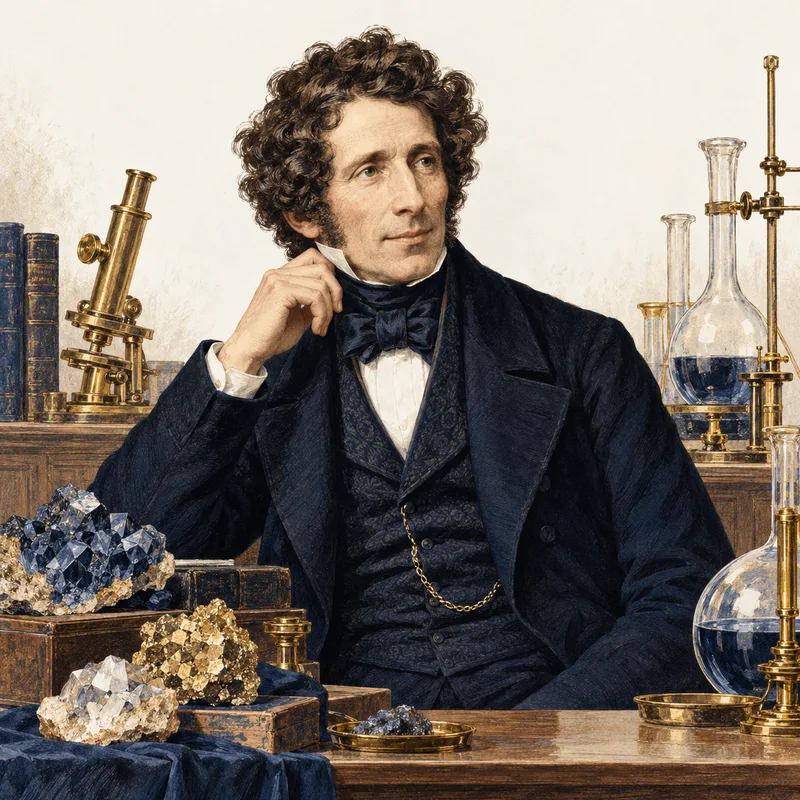
Friedrich Wöhler
1800-1882 · Germany
Synthesis of urea; isolated aluminium