Biography · Chemist no. 16 of 350
Fritz Haber: The Chemist Who Fed the World and Armed a War
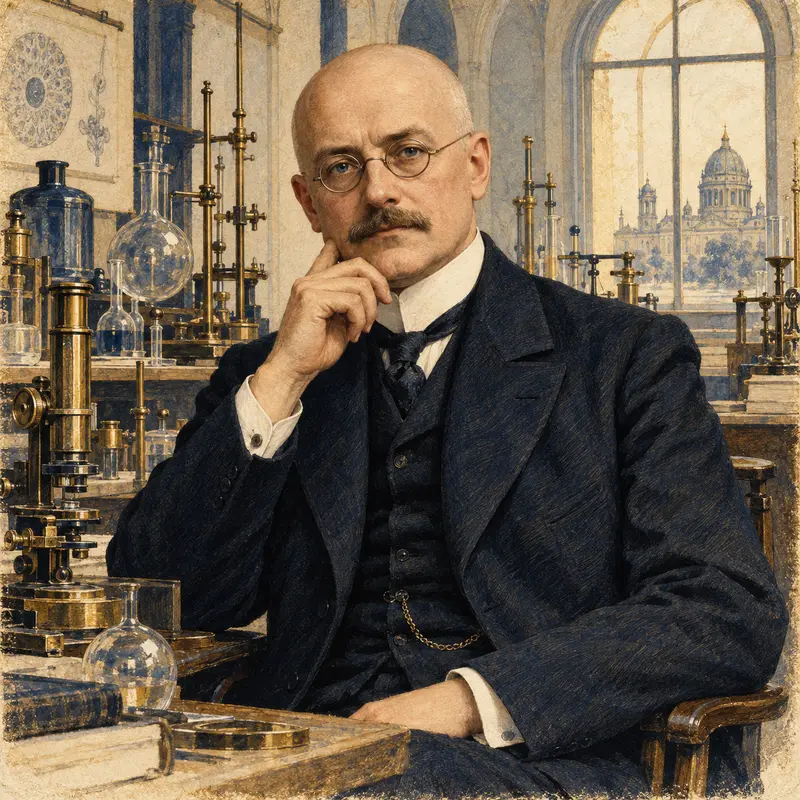
Fritz Haber (1868–1934) was a German physical chemist who invented the practical synthesis of ammonia from nitrogen and hydrogen, work for which he received the 1918 Nobel Prize in Chemistry. The process he began is still the main source of nitrogen fertiliser. He also led Germany's chemical weapons programme in the First World War, and his life is among the most difficult in the history of science. His legacy is both a great scientific achievement and a serious lesson in ethics.
Early Life and Family
Fritz Haber was born on 9 December 1868 in Breslau, then in Prussia (now Wrocław in Poland), into a Jewish family. His father, Siegfried Haber, was a successful dealer in dyes and chemicals. His mother, Paula, died shortly after giving birth to him, and the relationship with his father was often difficult. The family business exposed him early to chemicals and to the world of industry.
In 1901 Haber married Clara Immerwahr, a gifted chemist who held a doctorate, one of the first women in Germany to do so. They had a son, Hermann. Clara's own scientific career was limited by the expectations of the time, and she died on 2 May 1915. Later, in 1917, Haber married Charlotte Nathan; they had two children, and the marriage ended in divorce in 1927. Like many German Jews of his day, Haber converted to Protestant Christianity as a young man in the hope of an academic career.
Education and Mentors
Haber studied chemistry at the University of Berlin, at Heidelberg under Robert Bunsen, and at the Technical College in Charlottenburg, where he worked under Carl Liebermann. He took a doctorate in organic chemistry in 1891. He then gained practical experience in industry and worked in Zurich, before joining the Technical University of Karlsruhe in 1894. Here he moved from organic chemistry to physical chemistry and electrochemistry, and wrote an important book on the thermodynamics of technical gas reactions in 1905.
Career Timeline
| Year | Event |
|---|---|
| 1868 | Born in Breslau, 9 December |
| 1891 | Doctorate in organic chemistry |
| 1894 | Joins Karlsruhe Technical University |
| 1898 | Becomes professor of technical chemistry and electrochemistry |
| 1909 | Demonstrates continuous ammonia synthesis with Robert Le Rossignol |
| 1911 | Appointed director of the Kaiser Wilhelm Institute for Physical Chemistry and Electrochemistry in Berlin |
| 1915 | Directs the first large-scale chlorine gas attack at Ypres in April |
| 1918 | Awarded the Nobel Prize in Chemistry |
| 1933 | Resigns after Nazi laws against Jewish civil servants |
| 1934 | Dies in Basel, Switzerland, 29 January |
Major Scientific Contributions
- Ammonia synthesis. He identified the conditions of equilibrium, used a catalyst and introduced recycling. Read the chemistry in our discovery post on the Haber process.
- Born–Haber cycle. Together with Max Born, he developed the thermochemical cycle used to calculate lattice enthalpies of ionic compounds.
- Electrochemistry. He studied the reduction of nitrobenzene in stages and showed how electrode potential controls the products. He also helped develop the glass electrode for measuring acidity.
- Combustion and gas reactions. His book on the thermodynamics of technical gas reactions was a model for chemical engineering.
- Toxicology. His rule that toxic effect depends on the product of concentration and exposure time is known as Haber's rule.
Awards, Honours and Nobel Prize
Haber received the Nobel Prize in Chemistry for 1918 "for the synthesis of ammonia from its elements". It was presented in 1919, and the award caused protests, especially from scientists in France, Britain and the United States, who objected because of his role in poison gas. Haber also held the leadership of the Kaiser Wilhelm Institute that was later renamed in his honour as the Fritz Haber Institute in Berlin, and he was a member of the Prussian Academy of Sciences.
Personality, Struggles and Lesser-Known Facts
- Patriot and ambitious. Haber was deeply patriotic and wanted to serve Germany in the war. He believed that gas would end the war faster and save lives, an argument that most historians reject.
- Ypres and Clara's death. On 22 April 1915 chlorine gas was released near Ypres. About ten days later, on 2 May, Clara Immerwahr died by suicide. Many accounts link her death to her opposition to his war work, although the full reasons are debated.
- Peaceful research after the war. Haber tried to extract gold from sea water to help pay Germany's reparations. The concentration proved far too low, and the project was abandoned. He also worked on pest control, and his institute researched hydrogen cyanide as a fumigant.
- Exile. In 1933 the Nazi regime demanded dismissal of Jewish staff. Haber, himself a convert but of Jewish origin, resigned in protest. He left Germany, spent some months in Cambridge, and travelled in search of health and a new position. He died of heart problems in Basel in 1934.
- A tragic irony. A later insecticide product based on cyanide, Zyklon B, was misused by the Nazis during the Holocaust, and members of Haber's extended family were among the victims.
Legacy and Influence on Modern Chemistry
Haber's ammonia synthesis changed agriculture. Without synthetic fertiliser, global food production could support far fewer people. In India, the fertiliser industry and the success of high-yield wheat and rice depend on cheap nitrogen. The process also stimulated the development of high-pressure engineering, heterogeneous catalysis and surface science, leading to later Nobel Prizes for Carl Bosch (1931) and Gerhard Ertl (2007). At the same time, his name stands as a warning on the military misuse of chemistry. International law, in the form of the 1925 Geneva Protocol and the later Chemical Weapons Convention, restricts these weapons.
Lessons for Students
- Science has power to feed or to harm. Think about ethics, not only about technique.
- Combine theory with engineering: Haber's success came from equilibrium thermodynamics, catalysis and plant design working together.
- Credit teamwork. Le Rossignol, Bosch and Mittasch were essential to the story.
- Use Le Chatelier's principle as a practical tool, not only as an exam rule.
Quick Facts Box
- Born: 9 December 1868, Breslau, Prussia (now Wrocław, Poland)
- Died: 29 January 1934, Basel, Switzerland
- Nationality: German
- Field: Physical chemistry, electrochemistry
- Famous for: Synthesis of ammonia (Haber process); Born–Haber cycle
- Nobel: Chemistry, 1918
FAQ
Did Haber and Bosch share the Nobel Prize?
No. Haber received the 1918 prize alone for the synthesis. Carl Bosch shared the 1931 Nobel Prize in Chemistry with Friedrich Bergius for high-pressure methods.
Why was Haber's Nobel Prize criticised?
Many scientists felt that a man who organised chemical warfare should not be honoured, even though his ammonia synthesis was of great benefit.
What is the Born–Haber cycle?
It is a Hess's law cycle that connects the lattice enthalpy of an ionic solid with other measurable enthalpies such as sublimation, ionisation energy, bond dissociation and electron gain enthalpy.
What happened to Haber at the end of his life?
He left Germany in 1933 after antisemitic laws were introduced and died in Basel in January 1934.
Published by ABC Chemistry — IIT-JAM | CSIR-NET | GATE Chemistry Coaching. Visit abcchemistry.com
About the chemist
Fritz Haber
1868-1934 · Germany · Nobel Chemistry 1918
Haber process (ammonia synthesis)