The discovery, explained · Chemist no. 16 of 350
Fritz Haber and the Ammonia Synthesis: Bread from Air
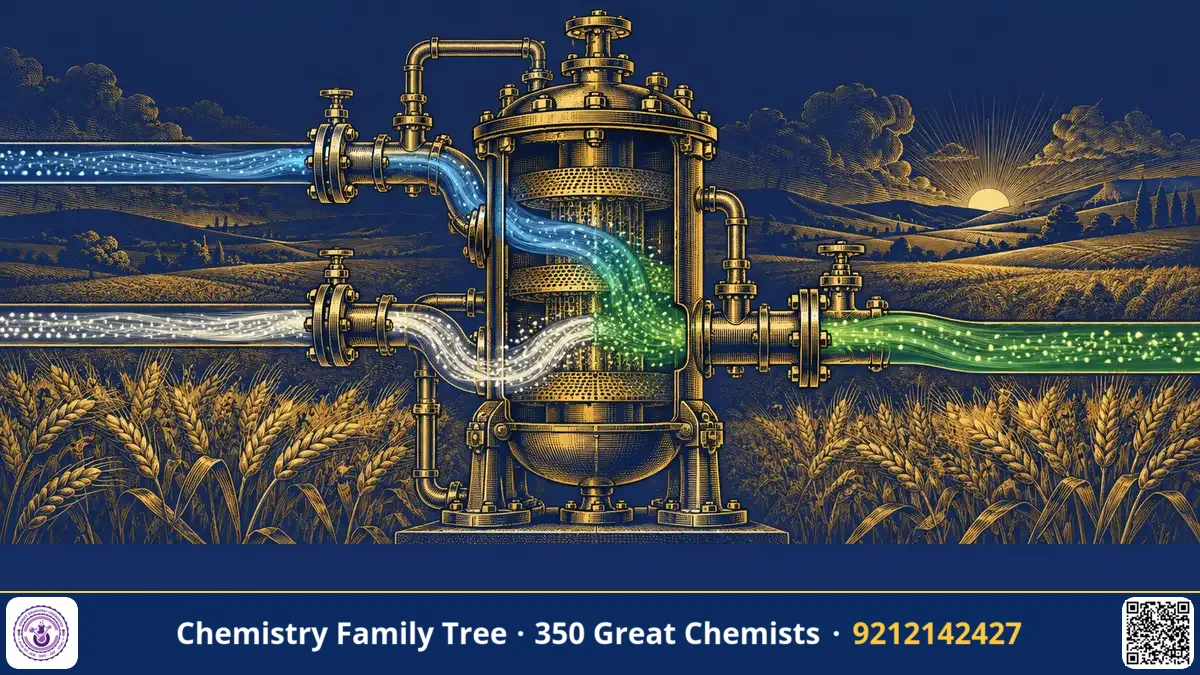
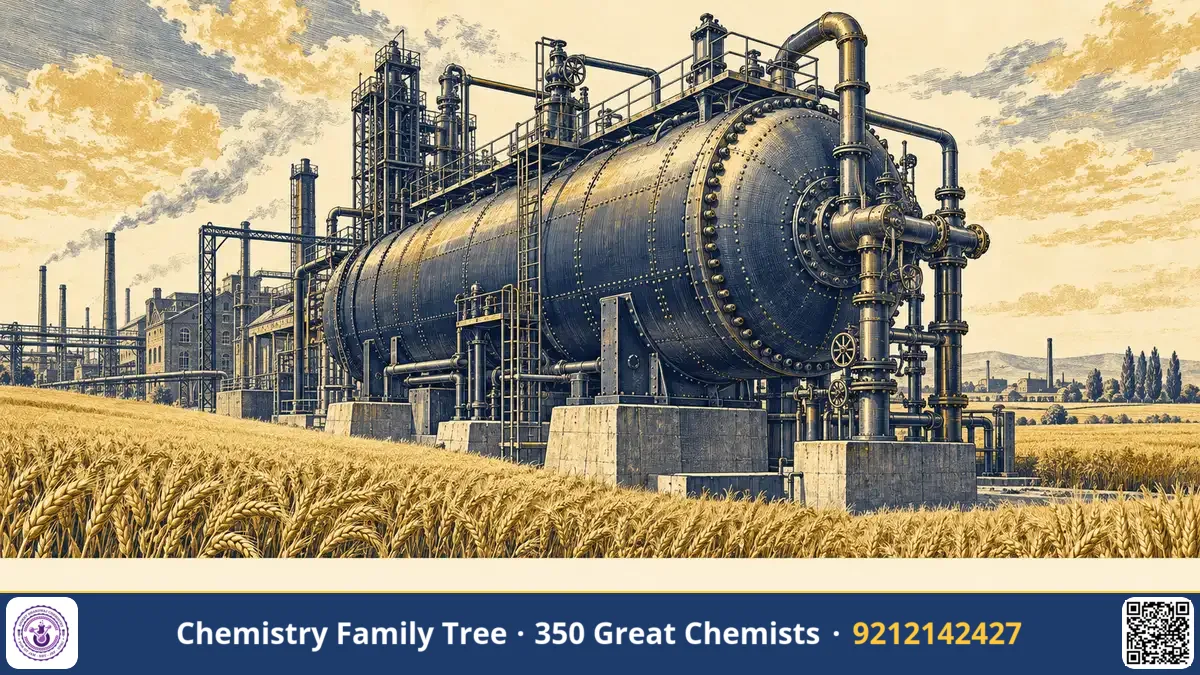
The air around us is 78% nitrogen, yet plants cannot use it. Nitrogen gas, N₂, has a very strong triple bond (about 945 kJ/mol), so it hardly reacts. Early in the twentieth century the German chemist Fritz Haber found a practical way to combine nitrogen with hydrogen to make ammonia. His method, later scaled up by Carl Bosch as the Haber–Bosch process, is now the basis of the world's nitrogen fertiliser industry. It is often said to have supported the growth of modern population more than any other chemical process. It is also a classic example of chemical equilibrium and catalysis, and a favourite in every exam.
The Scientific Problem Before the Discovery
By the late nineteenth century, farmers depended on natural nitrogen sources such as Chilean saltpetre (sodium nitrate) and guano. Scientists such as Sir William Crookes warned in 1898 that these deposits would run out and that the growing population of wheat-eating nations could face a shortage of food. The solution would be to "fix" atmospheric nitrogen, that is, to turn it into a usable compound.
Other methods existed, such as the Birkeland–Eyde arc process and the calcium cyanamide process, but they used large amounts of electricity. Chemists knew that nitrogen and hydrogen could in principle form ammonia, but at ordinary conditions the reaction was extremely slow and gave very little product. Haber wanted to understand the equilibrium and find conditions which gave a useful yield.
The Discovery: Step by Step
Haber began studying the reaction around 1904 at Karlsruhe. The key reaction is:
N₂(g) + 3H₂(g) ⇌ 2NH₃(g) ΔH = −92 kJ (for 2 mol NH₃)
His reasoning followed Le Chatelier's principle and thermodynamics:
- The reaction is exothermic, so low temperature favours a high equilibrium yield.
- Four moles of gas become two moles, so high pressure favours ammonia.
- But at low temperature the reaction is too slow, so a catalyst is required.
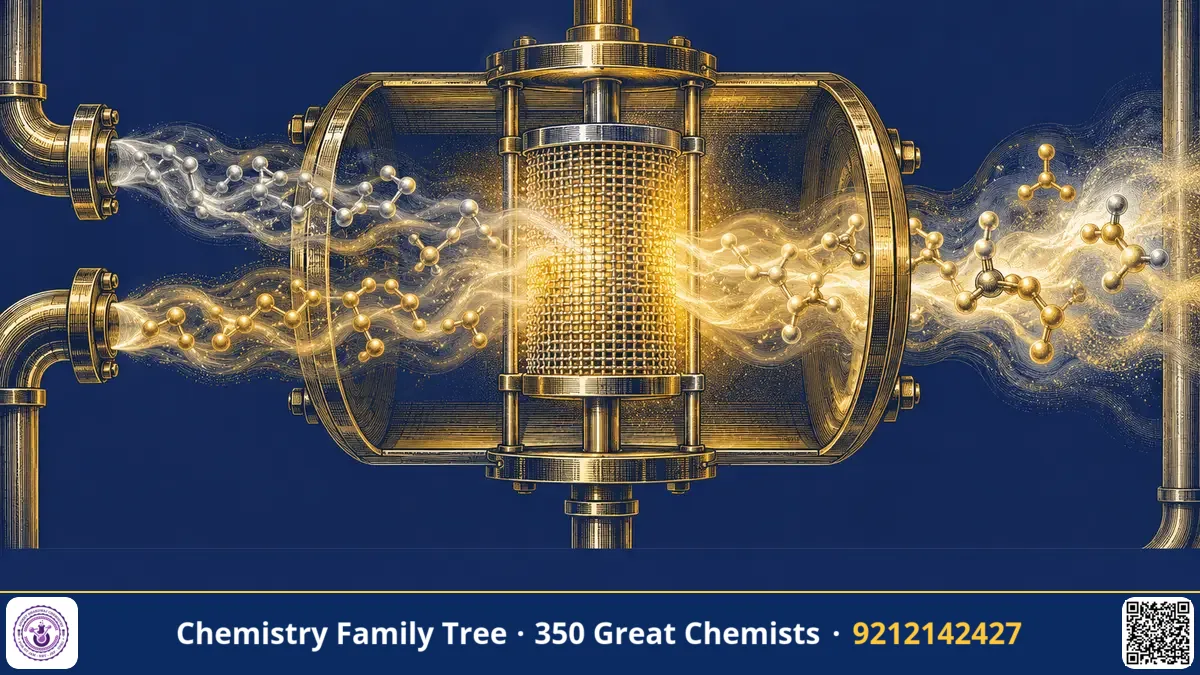
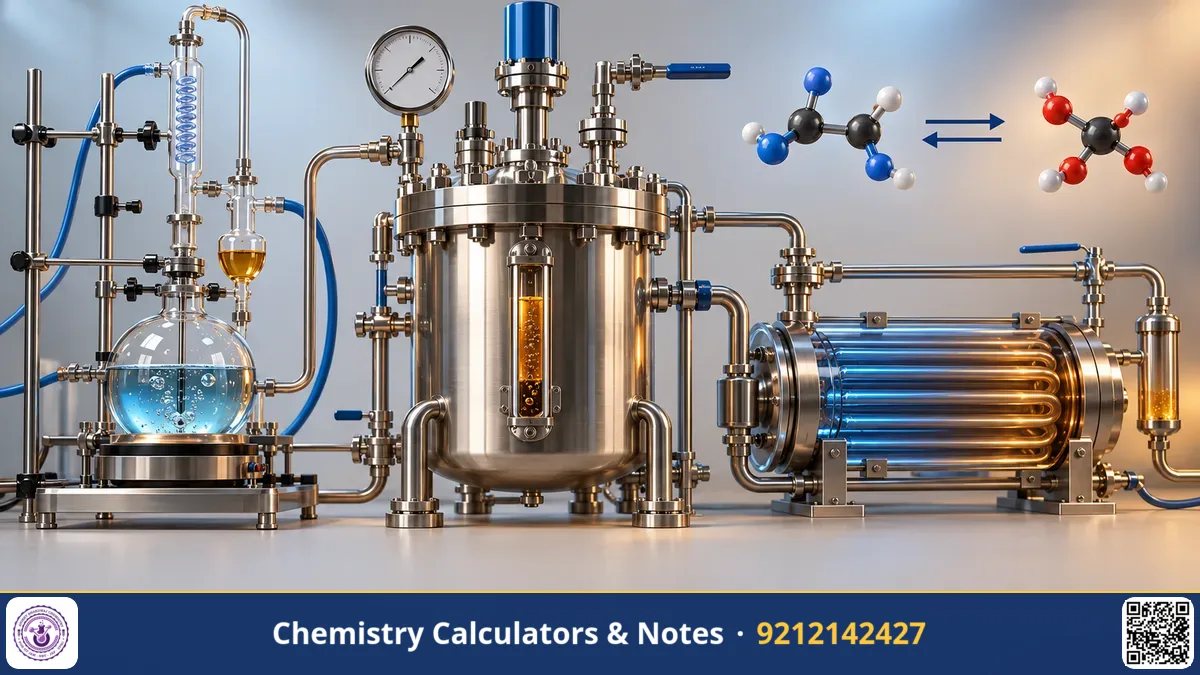
Haber and his assistant Robert Le Rossignol built a table-top apparatus with a high-pressure circuit. In 1909, using osmium as a catalyst at roughly 500 °C and about 200 atm, they produced liquid ammonia continuously, with the unreacted gases recirculated. A recycling design was Haber's key engineering idea, because only a few percent of the gas converts in a single pass. In a famous demonstration the apparatus ran and collected ammonia drop by drop.
The German company BASF took up the process. Carl Bosch led the effort to build high-pressure steel reactors that could survive hydrogen attack, and Alwin Mittasch tested thousands of catalysts, discovering a cheap iron-based catalyst with promoters. The first industrial plant started at Oppau in 1913.
The Chemistry Behind It
The equilibrium constant is:
Kp = (PNH₃)² / (PN₂ × (PH₂)³)
Because ΔH is negative, Kp decreases as temperature increases. The industrial compromise therefore has these typical conditions:
| Factor | Effect on yield | Typical industrial condition |
|---|---|---|
| Pressure | Higher pressure shifts equilibrium to NH₃ | 150–300 atm |
| Temperature | Lower temperature raises yield but slows the rate | about 400–500 °C |
| Catalyst | Speeds up both directions equally; no change in yield | Iron with K₂O and Al₂O₃ promoters |
| Removal of NH₃ | Liquefying ammonia shifts equilibrium forward | Condenser, recycle of N₂ and H₂ |
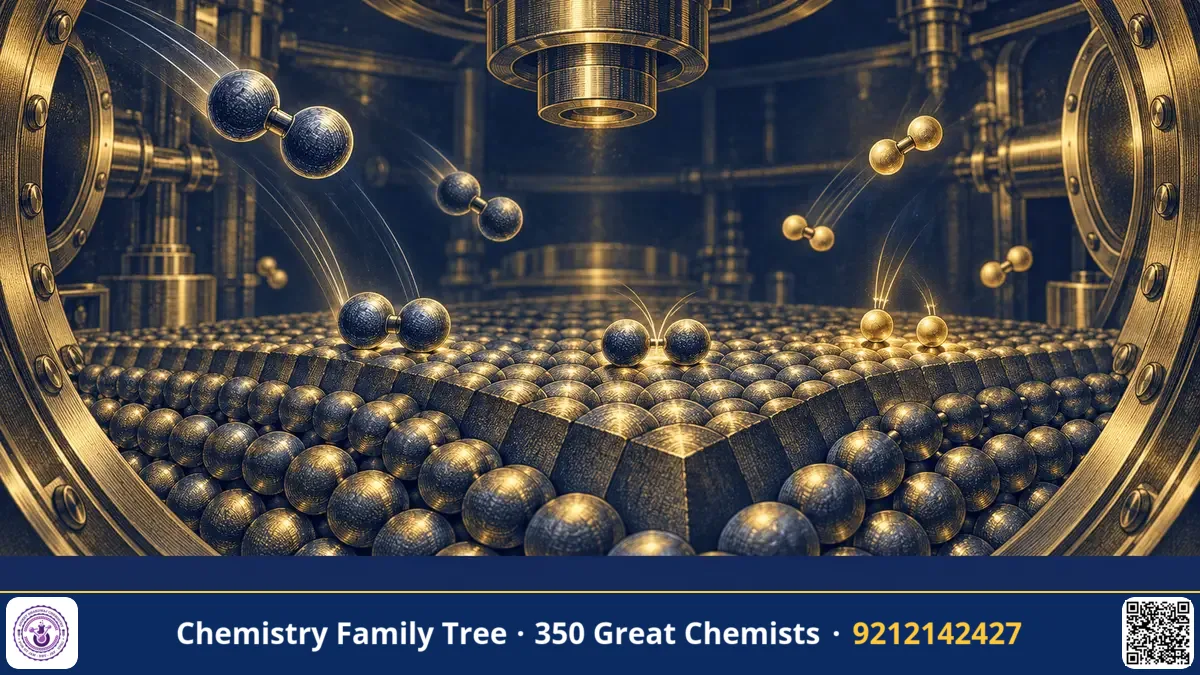
The catalyst works by adsorbing N₂ and H₂ on the iron surface. Dissociative adsorption of N₂ breaks the strong triple bond, which is the slowest step. The surface nitrogen atoms are then hydrogenated step by step to NH, NH₂ and finally NH₃, which desorbs. Hydrogen is obtained from natural gas by steam reforming:
CH₄ + H₂O → CO + 3H₂ (Ni catalyst, high temperature)
The ammonia is then converted to urea, ammonium nitrate and nitric acid. For example, in the Ostwald process, 4NH₃ + 5O₂ → 4NO + 6H₂O.
Applications Today
- Fertilisers: most nitrogen fertilisers, including urea (NH₂)₂CO, are derived from Haber–Bosch ammonia. Estimates suggest that a very large share of the world's food production, and about half of the nitrogen in the human body, comes from this source.
- India: India is one of the largest users of urea, and many Indian fertiliser plants produce ammonia from natural gas as the first step. Fertiliser demand is closely tied to the Green Revolution crops such as wheat and rice.
- Industry: ammonia is used to make nitric acid, explosives, nylon intermediates, refrigerants and cleaning products.
- Future energy: ammonia is being studied as a carrier for hydrogen and "green" fuel, using hydrogen from renewable electricity.
- Concerns: the process uses a few percent of the world's energy and releases CO₂, while excess fertiliser causes water pollution and nitrous oxide emissions.
Exam Corner
- Reaction: N₂ + 3H₂ ⇌ 2NH₃, ΔH = −92 kJ/mol; Δn = −2 so Kp = Kc(RT)−2.
- Optimum conditions: about 200 atm, 450 °C, Fe catalyst with K₂O/Al₂O₃ as promoters.
- A catalyst does not change the equilibrium constant or yield; it only reaches equilibrium faster.
- Promoters increase the activity of the catalyst; poisons such as H₂S, CO and arsenic compounds reduce it.
- Haber also appears in the Born–Haber cycle used to calculate lattice enthalpy.
Common Misconceptions
- "High temperature gives more ammonia." It does not. It only makes the reaction faster. The equilibrium yield decreases at higher temperature.
- "The catalyst increases the yield." It does not, as it speeds up forward and backward reactions equally.
- "Haber alone built the industrial process." Bosch and Mittasch solved the engineering and catalyst problems, and both were recognised separately (Bosch received a Nobel Prize in 1931).
Quick Revision Box
- Laboratory demonstration of ammonia synthesis: 1909, by Haber and Le Rossignol.
- Industrial scale-up by Carl Bosch at BASF; first plant Oppau, 1913.
- N₂ + 3H₂ ⇌ 2NH₃; exothermic; fewer moles of gas on the product side.
- Conditions: about 200 atm, 400–500 °C, iron catalyst.
- Unreacted gases are recycled; ammonia is liquefied and removed.
- Nobel Prize in Chemistry for Haber: 1918 (awarded in 1919).
FAQ
What is nitrogen fixation?
It is the conversion of atmospheric N₂ into compounds such as ammonia or nitrates that plants can use. It occurs naturally by lightning and by bacteria, and industrially by the Haber process.
Why is a compromise temperature used?
Low temperatures favour ammonia but the reaction is too slow. About 450 °C with a catalyst gives a reasonable rate and acceptable yield.
What is the typical single-pass yield?
Only about 10–20% of the gas turns into ammonia in one pass, so the mixture is cooled, ammonia is removed and the remaining gas is recycled.
Why is Haber's work controversial?
The same man who helped to feed the world also directed chemical warfare research during the First World War. His life is discussed in our biography post.
Published by ABC Chemistry — IIT-JAM | CSIR-NET | GATE Chemistry Coaching. Visit abcchemistry.com
About the chemist
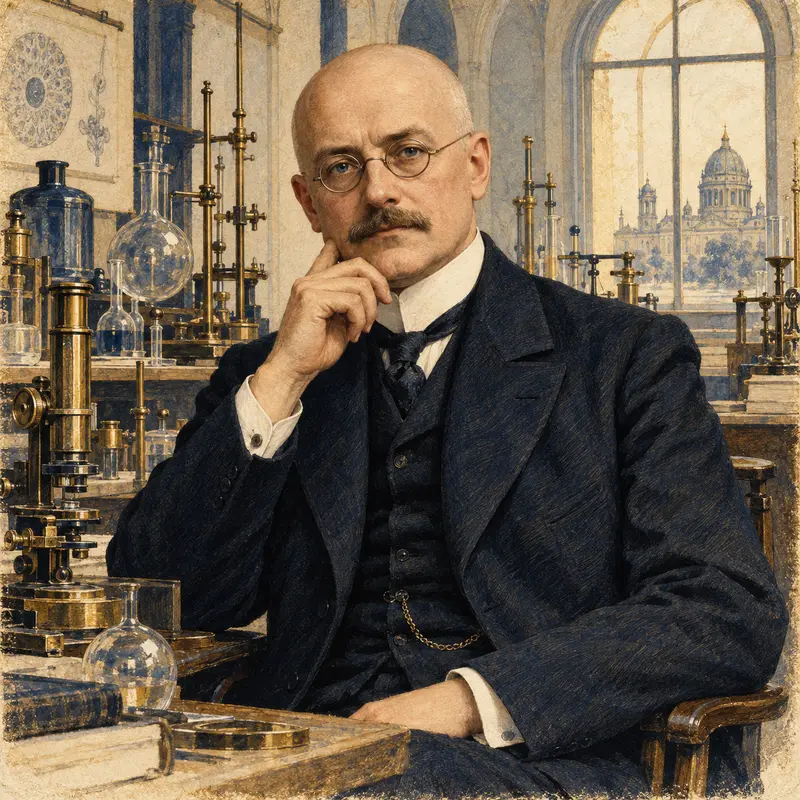
Fritz Haber
1868-1934 · Germany · Nobel Chemistry 1918
Haber process (ammonia synthesis)