The discovery, explained · Chemist no. 314 of 350
Fritz Lipmann: ATP, the Energy Currency, and Coenzyme A
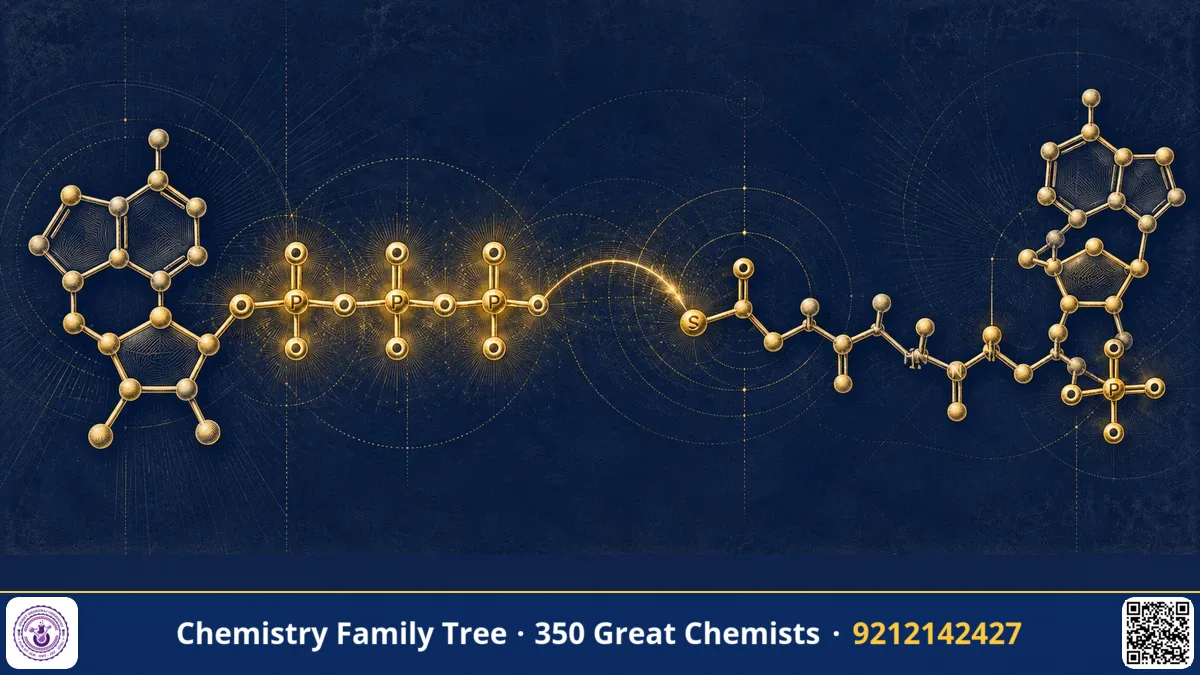
Every second, each cell in your body breaks down and rebuilds millions of molecules of ATP. This molecule is the universal energy currency of life. The scientist who explained how cells use it, and who discovered the carrier of acetyl groups in metabolism, was the German-American biochemist Fritz Albert Lipmann. In 1941 he proposed that energy from food oxidation is stored in "energy-rich phosphate bonds" and passed on through ATP. In the 1940s he discovered coenzyme A (CoA), the cofactor that carries acyl groups in the metabolism of carbohydrates, fats and amino acids. For the discovery of coenzyme A and its importance for intermediary metabolism, he shared the 1953 Nobel Prize in Physiology or Medicine with Hans Krebs. This was a prize in Physiology or Medicine, not in Chemistry, but the chemistry is at the centre of it.
The Scientific Problem Before the Discovery
By the 1930s, biochemists had mapped parts of glycolysis and had found that phosphorylated sugars appear during fermentation and muscle contraction. Karl Lohmann discovered ATP in muscle in 1929. Yet two big questions remained. First, how does the cell link energy-releasing reactions (such as oxidation of glucose) to energy-demanding ones (such as synthesis of proteins, or muscle contraction)? Second, how is the two-carbon acetyl fragment, produced from sugars and fats, activated for entering synthetic reactions? The enzyme-catalysed reactions needed a cofactor that no one had identified, and its chemical nature was unknown.
The Discovery: Step by Step
Part 1: The energy-rich phosphate bond and ATP (1941)
Lipmann, who had studied fermentation and phosphorylation in Copenhagen, summarised the evidence in a famous 1941 review. He pointed out that some phosphate compounds, such as ATP and creatine phosphate, release a large amount of free energy on hydrolysis, while others, such as glucose-6-phosphate, release much less. He suggested that ATP acts as the common link between energy-yielding and energy-requiring reactions, and he introduced the squiggle symbol ~P for the "high-energy" phosphate group. A simple cycle summarises his idea:
ATP + H₂O → ADP + Pᵢ        ΔG°′ ≈ −30.5 kJ/mol  (about −7.3 kcal/mol)

Energy-yielding reactions (oxidation of food)  →  ADP + Pᵢ → ATP
ATP → ADP + Pᵢ  →  Energy-requiring reactions (biosynthesis, muscle work, transport)
Lipmann's term "energy-rich bond" was later criticised: the energy is not stored in the bond itself (breaking any bond requires energy), but arises from the difference in free energy between reactants and products, including resonance stabilisation of the products, relief of charge repulsion in the polyphosphate chain and better solvation. Nevertheless, the concept of ATP as the currency of energy transfer has stood the test of time.
Part 2: Acetyl phosphate and the search for the "active acetate" (1940s)
Lipmann found that in some bacteria the oxidation of pyruvic acid produced acetyl phosphate, a compound that could transfer an acetyl group:
CH₃COCOOH + Pᵢ + [O] → CH₃CO–OPO₃²⁻ + CO₂ + H₂O
CH₃CO–OPO₃²⁻ + ADP ⇌ CH₃COO⁻ + ATP         (acetate kinase)
This showed that acyl groups can be activated in a manner similar to phosphate groups. In animal tissues, however, the acetylation of compounds such as sulphanilamide and choline required a heat-stable cofactor that no one had identified.
Part 3: Coenzyme A (1945–1953)
While studying the enzymatic acetylation of sulphonamides in pigeon liver extracts at Massachusetts General Hospital, Lipmann and his co-workers isolated a heat-stable cofactor and called it coenzyme A, where the A stood for "activation of acetate". Careful purification and chemical analysis, with the help of colleagues such as Nathan Kaplan and others, showed that it contained pantothenic acid (a B vitamin), β-mercaptoethylamine (cysteamine) and adenosine 3′-phosphate 5′-pyrophosphate. The structure was settled in the early 1950s. The reactive part is the –SH (thiol) group of cysteamine, which forms a thioester with acyl groups:
CoA–SH + CH₃CO–X → CH₃CO–S–CoA (acetyl-CoA)
Acetyl-CoA + H₂O → CoA–SH + CH₃COO⁻ + H⁺     ΔG°′ ≈ −31.4 kJ/mol
Acetyl-CoA is a high-energy thioester, with a hydrolysis energy similar to or even slightly larger than that of ATP. This makes the acetyl group a powerful acyl donor.
The Chemistry Behind It
Why are thioesters energy-rich? In an ordinary ester (R–CO–OR′), the oxygen lone pair is delocalised into the carbonyl group, which gives resonance stabilisation. In a thioester (R–CO–SR′), the sulphur 3p orbital overlaps poorly with the carbon 2p orbital, so the resonance stabilisation is much smaller. The thioester is therefore less stable and more reactive, with a more electrophilic carbonyl carbon and a better leaving group (RS⁻, a weaker base than RO⁻). Acetyl-CoA can then transfer its acetyl group in reactions such as:
- Citric acid cycle: acetyl-CoA + oxaloacetate → citrate + CoA (citrate synthase).
- Fatty acid synthesis and breakdown: two-carbon units are added or removed as acyl-CoA compounds in β-oxidation and in synthesis via malonyl-CoA.
- Acetylcholine synthesis: acetyl-CoA + choline → acetylcholine + CoA.
- Cholesterol and steroid synthesis: via acetoacetyl-CoA and HMG-CoA.
- Histone acetylation: acetyl-CoA is the source of the acetyl groups used in epigenetic regulation.
| Compound | ΔG°′ of hydrolysis (kJ/mol, approx.) |
|---|---|
| Phosphoenolpyruvate | −61.9 |
| 1,3-Bisphosphoglycerate | −49.3 |
| Creatine phosphate | −43.1 |
| Acetyl-CoA (thioester) | −31.4 |
| ATP (to ADP + Pᵢ) | −30.5 |
| Glucose-6-phosphate | −13.8 |
Applications Today
- Understanding metabolism: The citric acid cycle, fatty acid oxidation and many biosynthetic pathways are explained through acetyl-CoA and ATP coupling.
- Medicine: Statins block HMG-CoA reductase to lower cholesterol; vitamin B₅ (pantothenic acid) deficiency affects CoA synthesis.
- Metabolic disease: Diabetes, obesity and inherited disorders of fatty acid oxidation involve acyl-CoA metabolism.
- Biotechnology: Engineering microbes to produce biofuels, bioplastics and drugs relies on manipulating acetyl-CoA pools.
- Sports and nutrition: Energy metabolism and ATP regeneration through creatine phosphate underlie training and supplement discussions.
Exam Corner: 5 Likely Points
- ATP + H₂O → ADP + Pᵢ, ΔG°′ ≈ −30.5 kJ/mol; the "high-energy" nature comes from resonance, charge repulsion and solvation, not bond energy as such.
- Coenzyme A contains pantothenic acid (vitamin B₅), cysteamine (–SH) and 3′-phosphoadenosine 5′-diphosphate.
- Acetyl-CoA is a thioester; it links glycolysis, fatty acid oxidation and the TCA cycle.
- Lipmann and Krebs shared the 1953 Nobel Prize in Physiology or Medicine.
- Substrate-level phosphorylation example: phosphoenolpyruvate + ADP → pyruvate + ATP (pyruvate kinase).
Common Misconceptions
- "Energy is stored in the P–O bond of ATP." Breaking a bond always needs energy. Energy is released because the products are more stable than the reactants.
- "ATP is stored in large quantities." The body contains only a small amount and recycles it, turning over roughly its own body weight in ATP per day.
- "CoA is a vitamin." Pantothenic acid (B₅) is the vitamin; CoA is a coenzyme made from it.
Quick Revision Box
- Lipmann (1941): ATP as the energy currency and the ~P concept.
- Coenzyme A discovered in the 1940s; structure: pantothenate + cysteamine + 3′,5′-ADP.
- Acetyl-CoA is a thioester with ΔG°′ of hydrolysis ≈ −31 kJ/mol.
- Thioesters are reactive because of weak resonance (S 3p – C 2p overlap).
- Nobel Prize in Physiology or Medicine, 1953, shared with Hans Krebs.
- ATP was discovered in 1929 by Karl Lohmann (and independently by Fiske and Subbarow).
FAQ
What does the A in CoA stand for?
It stands for acetylation or "activation of acetate", the function that led to its discovery.
Why is ATP called the energy currency?
Because it carries energy from reactions that release energy to reactions that need it, much as money is used to exchange goods.
Is the Lipmann prize in chemistry?
No. It is the Nobel Prize in Physiology or Medicine (1953), shared with Hans Krebs.
Why are thioesters more reactive than oxygen esters?
Poor overlap between sulphur and carbon orbitals gives less resonance stabilisation, and thiolate is a better leaving group.
Published by ABC Chemistry — IIT-JAM | CSIR-NET | GATE Chemistry Coaching. Visit abcchemistry.com
About the chemist
Fritz Lipmann
1899-1986 · United States · Nobel Physiology/Medicine 1953
Coenzyme A; ATP as energy currency