Biography · Chemist no. 314 of 350
Fritz Lipmann (1899–1986): The Biochemist Who Explained How Cells Spend Energy
Fritz Albert Lipmann was a German-American biochemist whose work on ATP and coenzyme A helped create the modern picture of cell metabolism. He was awarded the Nobel Prize in Physiology or Medicine in 1953 (shared with Hans Krebs). His career took him across three continents because of the political changes in twentieth-century Europe. His legacy in one line: he showed that life runs on a cycle of ATP and gave us the carrier, coenzyme A, that links the metabolism of sugars, fats and proteins.
Early Life and Family
Lipmann was born on 12 June 1899 in Königsberg, then in East Prussia, Germany (now Kaliningrad, Russia). His family was Jewish. He grew up in a well-educated and cultured household, and he had a deep love of music throughout his life. As a youth he was interested in science, but the family tradition and the times pushed him towards a professional course of study.
Education and Mentors
Lipmann studied medicine at the universities of Königsberg, Berlin and Munich, and received his medical degree in Berlin in 1924. He then turned to chemistry and went on to earn a doctorate in chemistry in Berlin in 1927. A turning point came when he joined Otto Meyerhof, who later received the 1922 Nobel Prize in Physiology or Medicine, at the Kaiser Wilhelm Institute for Biology in Berlin-Dahlem. Meyerhof's studies on muscle and fermentation trained Lipmann in the study of energy exchange in living cells. He also visited the Rockefeller Institute in New York in 1931–32, where he worked with Phoebus Levene on the chemistry of nucleic acids.
Career Timeline
| Year | Event |
|---|---|
| 1899 | Born in Königsberg, Germany |
| 1924 | Medical degree, Berlin |
| 1927 | Doctorate in chemistry, Berlin |
| 1927–1931 | Works with Otto Meyerhof in Berlin-Dahlem |
| 1931–1932 | Visits the Rockefeller Institute, New York |
| 1932–1939 | Leaves Germany; works in Copenhagen, including the Carlsberg Laboratory; studies the Pasteur effect and phosphorylation |
| 1939 | Moves to the United States and joins Cornell University Medical College |
| 1941 | Publishes the review proposing ATP as the central energy carrier and the ~P concept |
| 1941–1957 | Works at Massachusetts General Hospital and Harvard Medical School in Boston; discovers coenzyme A |
| 1953 | Nobel Prize in Physiology or Medicine (shared with Hans Krebs) |
| 1957 | Moves to the Rockefeller Institute (later Rockefeller University) |
| 1960s | Studies the role of GTP and elongation factors in protein synthesis |
| 1986 | Dies on 24 July in Poughkeepsie, New York |
Major Scientific Contributions
1. ATP as the energy currency. His 1941 paper stated clearly that ATP is the common intermediate between energy-yielding and energy-requiring reactions, and he introduced the squiggle ~P notation for high-energy phosphate groups.
2. Acetyl phosphate and coenzyme A. He found acetyl phosphate in bacteria and discovered coenzyme A in animal tissues, determining that it carries acyl groups as thioesters. The detailed chemistry is in the companion discovery article.
3. Sulphate activation and other pathways. His laboratory worked on activated sulphate (PAPS, 3′-phosphoadenosine 5′-phosphosulphate) and on the activation of amino acids and fatty acids by ATP, which are central to the understanding of biosynthesis.
4. Protein synthesis. At the Rockefeller University, he studied the role of GTP and the elongation factors, such as the translocation step catalysed by EF-G, in the ribosome, contributing to the molecular picture of translation.
Awards, Honours and Nobel Prize
In 1953, Lipmann shared the Nobel Prize in Physiology or Medicine with Hans Krebs "for his discovery of co-enzyme A and its importance for intermediary metabolism". (Krebs was honoured for the citric acid cycle.) It is important to remember that this was a Nobel Prize in Physiology or Medicine, although the work is biochemistry and chemistry. In 1966 he received the US National Medal of Science. Other honours and honorary degrees followed, but are not listed here since they cannot be fully verified.
Personality, Struggles and Lesser-Known Facts
- Forced to move. Because of the political situation in Germany and his Jewish background, Lipmann left Germany in the early 1930s and eventually settled in the United States in 1939. Many of the great biochemists of the time had similar journeys.
- Autobiography. He wrote the book "Wanderings of a Biochemist" (1971), in which he describes his life and the people he met, with insight and humour.
- Love of music. He was a serious music lover and played the piano, and he often compared scientific creativity with artistic creativity.
- A squiggle that stuck. The tilde-like ~P symbol he invented is still used in some textbooks, though the concept of "high-energy bond" has been refined.
- Moving with the field. He moved from the study of intermediary metabolism to protein synthesis in his sixties, showing that senior scientists can enter new fields.
Legacy and Influence on Modern Chemistry
The textbook diagrams of ATP-ADP cycles, the citric acid cycle with acetyl-CoA and the biosynthesis of fats all reflect Lipmann's ideas. His work built the bridge between organic chemistry, especially the reactivity of phosphates and thioesters, and cell biology. His students and collaborators went on to important careers. Today, the study of acetyl-CoA in epigenetics and in cancer metabolism continues to draw on the framework he created. For Indian students, ATP coupling and acetyl-CoA appear in the Class 11–12 biology syllabus as well as in biochemistry questions in JAM, NET and GATE (Life Sciences and Biotechnology).
Lessons for Students
- Unify scattered facts. His 1941 review brought together many observations into a single idea.
- Chemistry explains biology. Thioester reactivity or phosphate transfer are tools for understanding life.
- Adapt to change. He continued his work through exile, migration and new fields.
- Remember the Nobel category. Lipmann's prize was in Physiology or Medicine.
Quick Facts Box
- Born: 12 June 1899, Königsberg, Germany (now Kaliningrad, Russia)
- Died: 24 July 1986, Poughkeepsie, New York, USA
- Nationality: German-born American
- Field: Biochemistry
- Famous for: ATP as energy currency, ~P concept, discovery of coenzyme A
- Nobel: Physiology or Medicine, 1953 (shared with Hans Krebs)
FAQ
Did Lipmann win the Nobel Prize in Chemistry?
No. He won the Nobel Prize in Physiology or Medicine in 1953.
Who shared the 1953 Nobel Prize with him?
Hans Krebs, who was recognised for the discovery of the citric acid cycle.
What is the name of his autobiography?
"Wanderings of a Biochemist", published in 1971.
Why is he important for chemistry students?
Because ATP hydrolysis, group-transfer potential and thioester reactivity are core topics in biochemistry and bioorganic chemistry.
Published by ABC Chemistry — IIT-JAM | CSIR-NET | GATE Chemistry Coaching. Visit abcchemistry.com
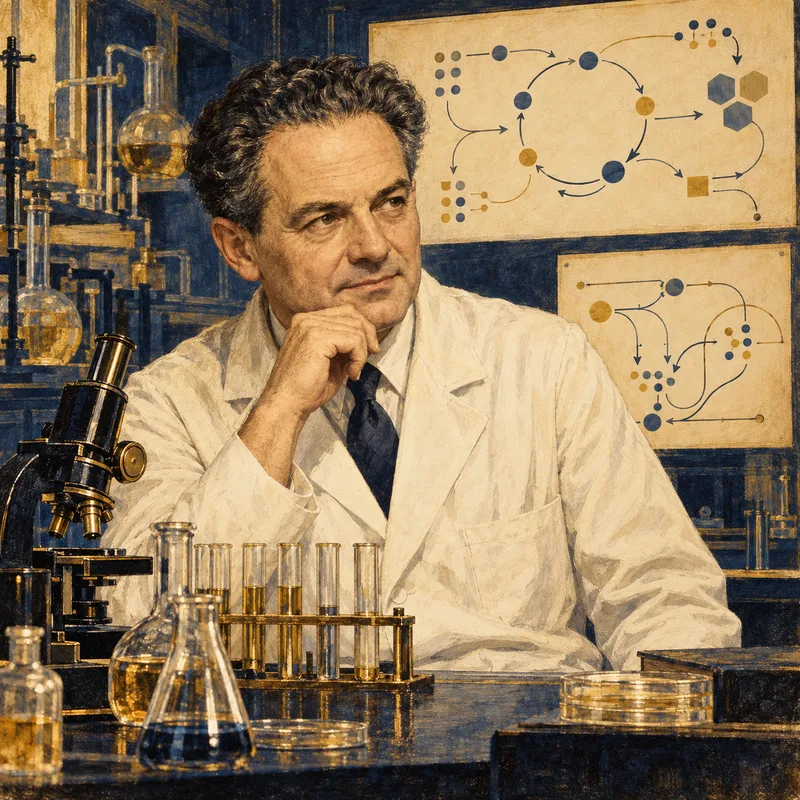
About the chemist
Fritz Lipmann
1899-1986 · United States · Nobel Physiology/Medicine 1953
Coenzyme A; ATP as energy currency