Biography · Chemist no. 105 of 350
Fritz Pregl: Complete Life and Legacy
Introduction
Fritz Pregl (1869–1930) was an Austrian physician who became one of the great analytical chemists. He started out in medicine and physiology, but a practical problem, how to analyse tiny amounts of natural products, led him to invent organic microanalysis. His methods let chemists determine the composition of a compound from just a few milligrams. In 1923 he received the Nobel Prize in Chemistry. He is the example of a scientist who changed a whole discipline not by a new theory, but by making measurement smaller, faster and more accurate.
Early Life and Family
Friedrich (Fritz) Pregl was born on 3 September 1869 in Laibach, then in the Austro-Hungarian Empire. The city is now Ljubljana, the capital of Slovenia. His parents were Raimund Pregl, who held a position as a bank official, and Friederike Schlacker. His father died when Fritz was still young, and his mother raised him with the support of the family. The family lived modestly.
He attended the Gymnasium in Laibach and finished school, before moving to Graz, in Austria, a city that would become his home. He grew up in a multi-ethnic, multilingual part of the empire, and in his later years he thought of Graz as his city. He had also a strong interest in music and was a singer with a fine voice, which he enjoyed all his life.
Education and Mentors
Pregl studied medicine at the University of Graz and received the degree of Doctor of Medicine in 1894. He was drawn to physiology, and after his degree he worked as an assistant to Alexander Rollett in the physiology institute at Graz. His early research concerned the physiological chemistry of bile and the structure of bile acids, which required him to purify and characterise small amounts of material.
To broaden his training, he visited Germany and Switzerland and worked for a short time with leading scientists, including the physical chemist Wilhelm Ostwald in Leipzig. He took the chemistry of proteins and bile acids seriously, and gradually he moved from medicine to chemistry. At Graz he became lecturer in physiological chemistry and later in medical chemistry.
Career Timeline
| Year | Event |
|---|---|
| 1869 | Born in Laibach (Ljubljana) on 3 September. |
| 1894 | Doctor of Medicine at the University of Graz. |
| 1890s | Works in physiology at Graz as assistant and lecturer. |
| 1910 | Appointed professor of medical chemistry at the University of Innsbruck. |
| 1910–1913 | Develops quantitative micro-methods; works out the microbalance method. |
| 1913 | Returns to the University of Graz as professor of medical chemistry. |
| 1917 | Publishes Die quantitative organische Mikroanalyse. |
| 1923 | Awarded the Nobel Prize in Chemistry. |
| 1930 | Dies in Graz on 13 December. |
Major Scientific Contributions
- Organic microanalysis: carbon, hydrogen, nitrogen, halogens, sulfur and other elements could be determined with 3–13 mg of material. See our discovery post for the combustion train and calculations.
- Microbalance method: showed that a balance sensitive to a microgram can be used in routine analytical practice.
- Micro-methods for functional groups: including methoxyl and ethoxyl determination (Zeisel method on small scale), acetyl groups, and molecular mass by micro-titration.
- Bile acids and proteins: his early research on cholic acid and on the breakdown products of proteins produced useful knowledge for biochemistry.
- Training: his courses in microanalysis trained chemists from many countries, who carried the method to their own laboratories.
Awards, Honours and Nobel Prize
The 1923 Nobel Prize in Chemistry was awarded to Fritz Pregl "for his invention of the method of micro-analysis of organic substances". The Nobel Prize came only after the First World War, once the scientific community was ready to recognise the method that had been published in 1917 and which was by then in use worldwide.
He was elected to many academies, including the Austrian Academy of Sciences, and received honorary degrees. He served as rector of the University of Graz. A prize for microanalysis in Austria carries his name.
Personality, Struggles and Lesser-Known Facts
- Doctor turned chemist. Pregl was a trained physician who never gave up his interest in medicine, but the lack of material in his bile-acid research pushed him into analytical chemistry.
- Passion for music. He was a gifted singer and loved music and, enjoyed singing throughout his life.
- Persistent tinkerer. He worked closely with glassblowers and instrument-makers, making small modifications to apparatus until it worked reliably.
- A teacher of analysts. He insisted on training students personally. Visitors from abroad came to Graz to learn microanalysis directly from him, because he believed technique had to be learned by hand.
- Never married. He was unmarried and devoted his life to science and teaching.
Legacy and Influence on Modern Chemistry
Almost every research paper in synthetic organic chemistry still carries a line like "Anal. Calcd for C12H16N2O: C, 70.56; H, 7.90; N, 13.71. Found: C, 70.40; H, 7.95; N, 13.60." This tradition comes straight from Pregl. His methods meant that a chemist no longer needed grams of a rare substance to establish its formula, and this accelerated progress in the study of vitamins, hormones, antibiotics and natural products in the 1920s to 1950s.
Today the principle has been automated, in CHN analysers that complete an analysis in a few minutes. The quantity of sample has come down further, to a milligram or less. The micro-scale approach also influenced the development of microchemistry in education, with small-scale laboratories that use less reagent and produce less waste, an idea that connects to green chemistry. In India, microanalytical laboratories at the CSIR institutes, IITs and the Indian Institute of Science provide elemental analysis services on the same basis.
Lessons for Students
- A good measurement method can be a breakthrough as important as a new theory.
- When faced with a limitation, such as too little sample, treat it as a research problem.
- Practical skill matters. Fine technique cannot be learned by reading alone.
- Cross disciplines: a physician became a leader of analytical chemistry.
- Share what you know. Pregl's open teaching spread his method to the world.
Quick Facts Box
- Born: 3 September 1869, Laibach (now Ljubljana, Slovenia), Austro-Hungarian Empire.
- Died: 13 December 1930, Graz, Austria.
- Nationality: Austrian.
- Field: Analytical chemistry, physiological chemistry.
- Famous for: Organic microanalysis; microbalance methods.
- Nobel: Chemistry, 1923.
FAQ
Was Fritz Pregl a doctor or a chemist?
Both. He trained as a medical doctor and worked in physiology before becoming a professor of medical chemistry, and his Nobel Prize was in Chemistry.
What did Pregl win the Nobel Prize for?
For his invention of the method of micro-analysis of organic substances, announced in the 1910s and published in his 1917 book.
How did his method help other scientists?
It allowed formulas of natural products available in minute amounts to be found, accelerating research on hormones, vitamins and alkaloids.
Where did he work?
Mainly at the University of Graz, with a period at the University of Innsbruck from 1910 to 1913.
Published by ABC Chemistry — IIT-JAM | CSIR-NET | GATE Chemistry Coaching. Visit abcchemistry.com
About the chemist
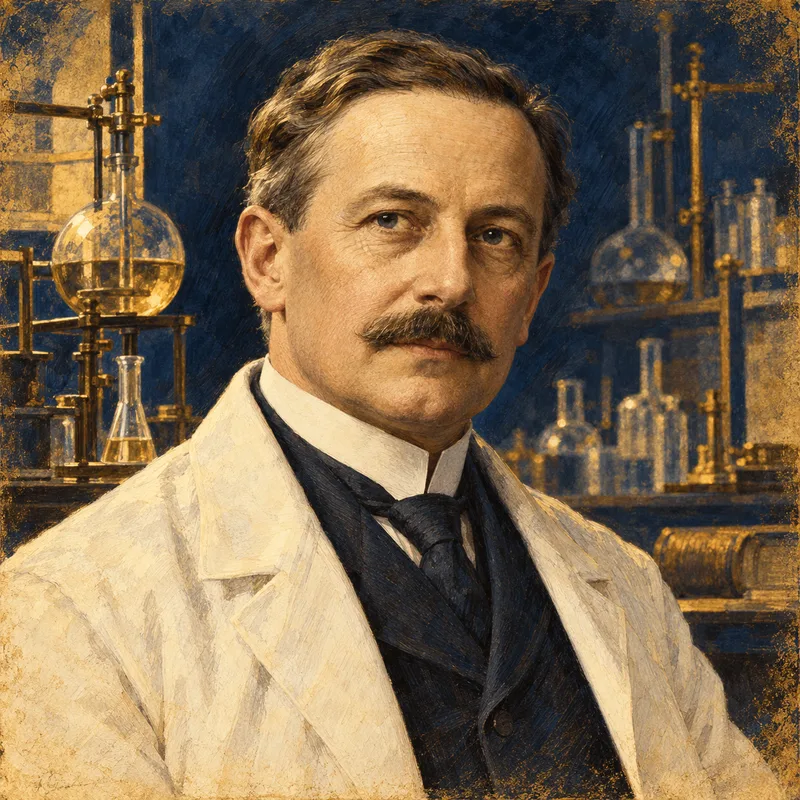
Fritz Pregl
1869-1930 · Austria · Nobel Chemistry 1923
Organic microanalysis