The discovery, explained · Chemist no. 105 of 350
Fritz Pregl and the Birth of Organic Microanalysis
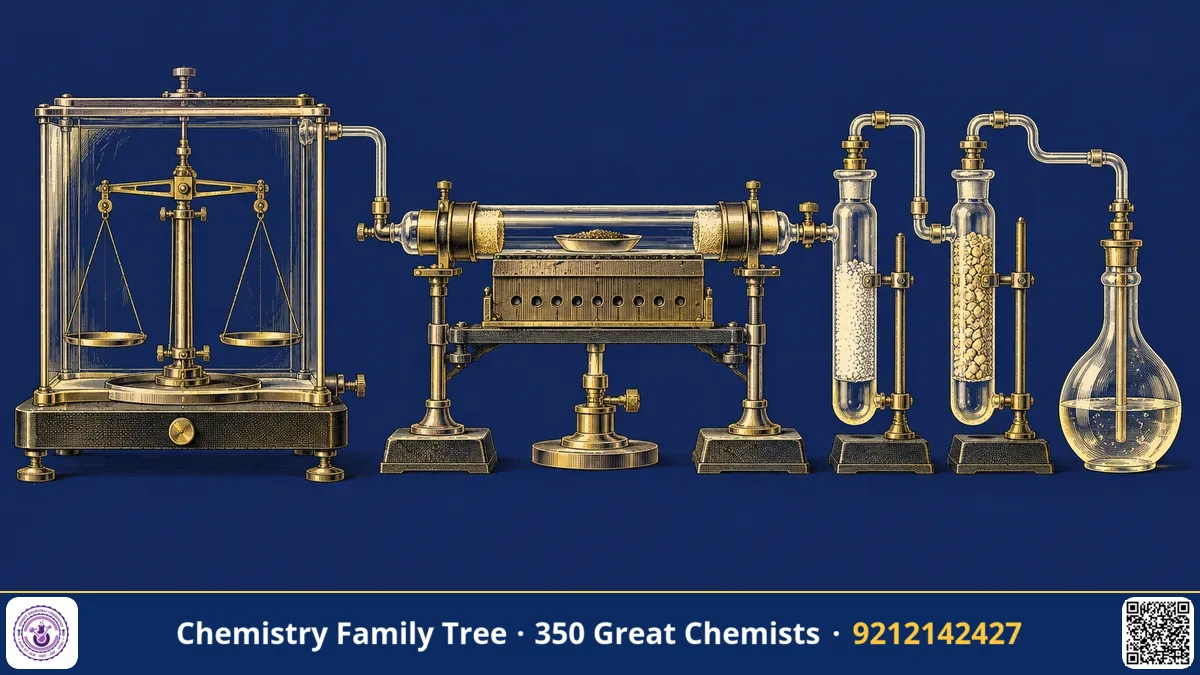
How do you find the formula of a new compound if you have only a few milligrams of it? In the early twentieth century, this was a serious problem. Biochemists were isolating hormones, bile acids and natural products in minute quantities, and the classical methods of elemental analysis needed 0.2 to 0.3 grams of pure substance, hundreds of times more than was often available. The Austrian chemist Fritz Pregl solved the problem. He redesigned the apparatus and the analytical procedures to work with only 3 to 13 milligrams, and he built a balance that could weigh to a microgram. For this contribution to quantitative organic microanalysis he was awarded the Nobel Prize in Chemistry in 1923.
The Scientific Problem Before the Discovery
Organic analysis rests on the work of Lavoisier, Gay-Lussac, and above all Justus von Liebig, who in the 1830s perfected the method of combustion analysis for carbon and hydrogen. A weighed sample is burned in oxygen, and the water and carbon dioxide formed are absorbed and weighed. Jean-Baptiste Dumas devised a method for nitrogen by converting it to N2 gas, and Johan Kjeldahl in 1883 introduced a method for nitrogen by digestion with sulfuric acid.
These methods were reliable, but they required large samples. Many valuable compounds could only be isolated in tiny quantities: a hormone from glands, a pigment from bacteria, an alkaloid from a rare plant. Pregl himself faced this when he worked on bile acids as a young researcher in Graz, and could obtain only very small amounts of material. He realised that if the apparatus were scaled down, the same chemistry would work, provided that the weighing could be made far more accurate.
The Discovery: Step by Step
Pregl's work from about 1909 to 1917 consisted of three linked improvements: a better balance, a miniaturised combustion train and carefully tuned procedures.
- The micro-balance. Pregl worked with the instrument maker Paul Kuhlmann of Hamburg and adapted an existing balance design by Kuhlmann and Nernst. The final balance could carry a load of about 20 grams and weigh to 0.001 mg (one microgram), compared with 0.1 mg for an ordinary analytical balance.
- Miniature combustion tube. He used a small quartz or hard glass tube filled with platinum contact and lead dioxide, which retains interfering sulfur and halogens. The sample, 3 to 5 mg, was placed in a small platinum boat.
- Absorption tubes. Water was absorbed in a small tube of calcium chloride, and carbon dioxide in soda-lime or potassium hydroxide. The tubes were small enough to be weighed on the microbalance.
- Controlled flow. Oxygen or air was passed at a precisely controlled rate, about 3–4 mL per minute, using a bubble counter. The burner was moved slowly along the tube to ensure complete combustion.
- Weighing and calculation. The increase in weight of each absorption tube gave the mass of water and carbon dioxide; from these, the percentages of H and C were calculated.
- Other elements. Pregl also developed micro-methods for nitrogen (a micro version of Dumas' method), halogens and sulfur (by combustion in a Carius tube on small scale), methoxyl groups (Zeisel) and molecular weights.
He published the final methods in his book Die quantitative organische Mikroanalyse (1917), which went through many editions and translations.
The Chemistry Behind It
The underlying chemistry is simple combustion of an organic compound CxHyOz in excess oxygen:
CxHyOz + O2 → x CO2 + (y/2) H2O
The percentages are calculated from the masses:
% C = (mass of CO2 × 12 / 44) / (mass of sample) × 100
% H = (mass of H2O × 2 / 18) / (mass of sample) × 100
Oxygen is usually found by difference. For nitrogen, the Dumas method converts N-compounds into N2, which is collected over potassium hydroxide solution (to remove CO2) and measured as volume:
% N = (volume of N2 at STP in mL × 28 / 22400) / (mass of sample) × 100
The Kjeldahl method converts N to ammonium sulfate, from which NH3 is distilled and titrated with standard acid. Halogens are determined by the Carius method, in which the compound is heated with fuming nitric acid and silver nitrate to give silver halide precipitate. Sulfur is converted to barium sulfate.
From the percentages one derives the empirical formula: divide each percentage by atomic mass, divide by the smallest number, and round to whole numbers. With the molecular mass, one finds the molecular formula. This is a standard exam skill.
The challenge in micro-scale work is that errors in weighing, in gas flow, and in absorption efficiency are all magnified. Pregl solved these problems by precise training of the analyst, by blank experiments, and by rigorous standard procedures. He showed that accuracy better than 0.2 to 0.3% could be maintained with a few milligrams.
Applications Today
- CHN analysers: modern automated elemental analysers burn 1–3 mg of sample and detect CO2, H2O and N2 by thermal conductivity or infrared detectors. They are direct descendants of Pregl's method and are found in research laboratories at IITs and CSIR institutes.
- Purity criteria: journals still require elemental analysis (usually within 0.4% of the calculated value) to establish the purity of new compounds.
- Pharmaceutical analysis: checking composition of drug substances and intermediates.
- Environmental analysis: total organic carbon and total nitrogen in water and soil.
- Food and agriculture: protein content by Kjeldahl nitrogen (protein = N% × 6.25), including in Indian fertiliser, milk and grain quality testing.
- Biochemistry: micro-methods enabled the structure determination of vitamins, hormones and steroids in the 1920s–1930s.
Exam Corner
- Fritz Pregl received the Nobel Prize in Chemistry in 1923 for his invention of the method of micro-analysis of organic substances.
- In combustion analysis, H2O is absorbed by anhydrous CaCl2 (or Mg(ClO4)2) and CO2 by KOH (or soda-lime) solution or pellets. The order matters: water first, CO2 second.
- Formula: % C = (12/44) × (mass of CO2 / mass of compound) × 100; % H = (2/18) × (mass of H2O / mass of compound) × 100.
- Dumas method gives nitrogen as N2 gas collected over KOH; Kjeldahl converts N to NH4+ and does not work well for azo, nitro or nitroso compounds without modification.
- Carius method estimates halogens and sulfur; Zeisel's method estimates methoxy groups.
Common Misconceptions
- "Pregl invented elemental analysis." Liebig, Dumas and others did that. Pregl scaled it to milligram quantities.
- "Micro means less accurate." With a proper balance and technique, accuracy equals or beats the macro scale.
- "Oxygen is measured by absorbing it." It is normally computed by difference, though direct pyrolysis methods now exist.
Quick Revision Box
- Nobel Prize in Chemistry 1923: Fritz Pregl, for organic microanalysis.
- Sample size: 3–13 mg instead of 200–300 mg.
- Microbalance precision: about 1 microgram (0.001 mg).
- CHN: combustion; H2O absorbed in CaCl2, CO2 in KOH.
- Book: Die quantitative organische Mikroanalyse (1917).
- Modern CHN analysers follow the same principle.
FAQ
Why was a microbalance so crucial?
When the sample is only a few milligrams, the weight of the water and CO2 produced is also tiny. Only a balance sensitive to a microgram can measure it with a small percentage error.
Did Pregl also develop the balance himself?
He improved a design and worked closely with the instrument-maker Kuhlmann. His main contribution was the complete method that made the balance usable in organic analysis.
How do I get an empirical formula from percentages?
Divide each element's percentage by its atomic mass, divide all by the smallest result, and multiply to get whole numbers. That ratio is the empirical formula.
Is Pregl's work still in the syllabus?
Yes, the principles of Liebig, Dumas, Kjeldahl and Carius methods are frequently asked in organic chemistry and analytical chemistry questions at all levels.
Published by ABC Chemistry — IIT-JAM | CSIR-NET | GATE Chemistry Coaching. Visit abcchemistry.com
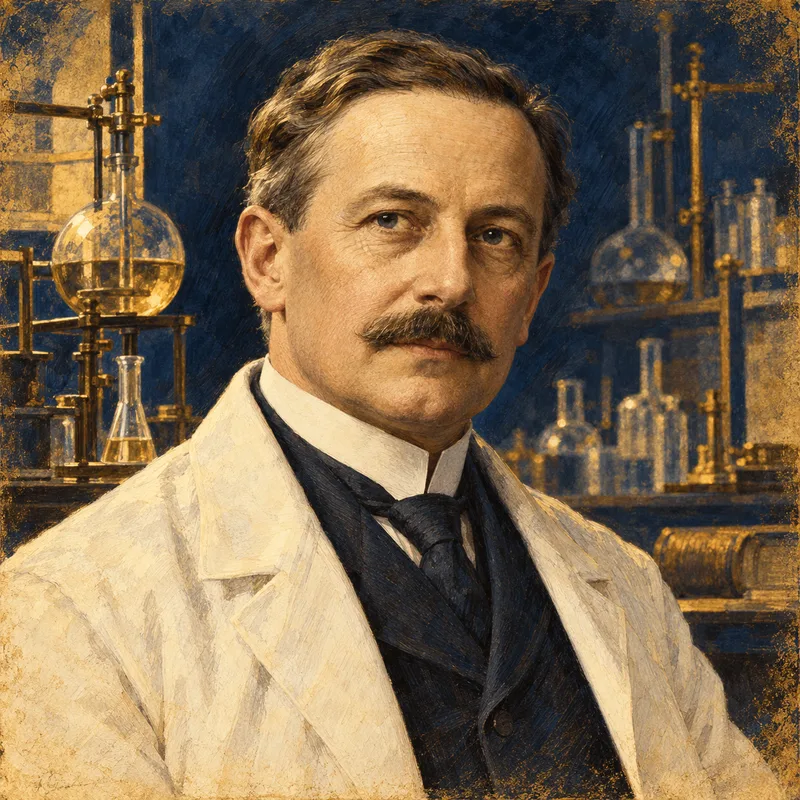
About the chemist
Fritz Pregl
1869-1930 · Austria · Nobel Chemistry 1923
Organic microanalysis