Biography · Chemist no. 275 of 350
Fritz Strassmann (1902–1980): The Chemist of Integrity Behind Nuclear Fission
Friedrich Wilhelm "Fritz" Strassmann was a German analytical and nuclear chemist who, with Otto Hahn, discovered nuclear fission in 1938. He is also remembered as a man of principle: he refused to join Nazi organisations even though this hurt his career, and he hid a Jewish friend in his home during the Second World War. His life links excellent chemistry with moral courage.
Early Life and Family
Fritz Strassmann was born on 22 February 1902 in Boppard on the Rhine, Germany. His family was of modest means, and the economic troubles in Germany after the First World War made his path to higher education and a career harder. He grew up in the Rhineland.
Education and Mentors
He studied chemistry at the Technical University of Hannover from 1920. His doctoral work, completed in 1929, was on the solubility of gases, in physical chemistry. In Hannover he developed a special skill in analytical methods, including the study of fine differences in the composition of mixtures. After the doctorate, he faced a poor job market. In 1929 he went to the Kaiser Wilhelm Institute for Chemistry in Berlin-Dahlem to work with Otto Hahn, who became his chief mentor and colleague. There he learned radiochemistry and applied his analytical skill to it.
Career Timeline
| Year | Event |
|---|---|
| 1902 | Born in Boppard, Germany (22 February). |
| 1929 | Doctorate at Hannover; joins Otto Hahn at the Kaiser Wilhelm Institute for Chemistry, Berlin. |
| 1930s | Works on radiochemistry and on geochemical dating, including the rubidium–strontium method (with Hahn). |
| 1933 onwards | Refuses to join Nazi-controlled organisations; loses chances of a better position. |
| 1938 | With Hahn finds barium among the products of neutron-irradiated uranium (December). |
| 1939 | Hahn–Strassmann paper on fission is published (January). |
| 1943–1945 | Hides Andrea Wolf, a Jewish friend, in his Berlin apartment. |
| 1946 | Appointed professor of inorganic and nuclear chemistry at the University of Mainz. |
| 1953 | Founds the Institute for Nuclear Chemistry at Mainz. |
| 1966 | Receives the Enrico Fermi Award with Hahn and Lise Meitner. |
| 1980 | Dies in Mainz (22 April). |
Major Scientific Contributions
Discovery of nuclear fission. Strassmann's meticulous radiochemical analysis showed that radium-like activity in irradiated uranium was in fact barium. He also made the control experiments that excluded errors. See our discovery article for the full reasoning.
²³⁵U + n → ¹⁴¹Ba + ⁹²Kr + 3n + about 200 MeV
Dating methods. In the 1930s, Hahn and Strassmann developed methods to date rocks and minerals by measuring the ratio of strontium to rubidium (from the beta decay of ⁸⁷Rb to ⁸⁷Sr) and similar approaches using other radioactive systems. This helped establish radiometric geology.
Radiochemical analysis. He was among those who established the use of tracers and carriers to follow elements present in very small quantities, a method now used throughout environmental and biomedical science.
Education in nuclear chemistry. At Mainz, he created one of Germany's leading centres for nuclear chemistry. His institute trained many of the researchers who later worked in nuclear chemistry in Germany and abroad.
Awards, Honours and Nobel Prize
The 1944 Nobel Prize in Chemistry was awarded (in 1945) to Otto Hahn alone "for his discovery of the fission of heavy nuclei". Strassmann did not share it, and neither did Lise Meitner. Strassmann was awarded the Enrico Fermi Award in 1966 jointly with Hahn and Meitner, which was the highest honour of the US Atomic Energy Commission. In 1999, many years after his death, Yad Vashem recognised him as one of the Righteous Among the Nations for protecting a Jewish friend.
Personality, Struggles and Lesser-Known Facts
- Refusing the party. After 1933 he declined to join Nazi-affiliated organisations, and as a result was put on a blacklist for jobs in chemistry. Hahn helped him to stay at the institute.
- Hiding a friend. From 1943, he and his wife Maria sheltered Andrea Wolf, a Jewish woman, in their small apartment, at serious risk to their own lives. She survived the war.
- Building after the war. Instead of dwelling on missing the Nobel Prize, he devoted himself to teaching and to building his institute in Mainz.
- Moral concerns. After the war, he took part in public discussions about the dangers of nuclear weapons, and supported calls by German scientists for peaceful uses of atomic energy.
- A shared prize, a shared story. At the 1966 Fermi Award he stood with Hahn and Meitner, the three people most associated with the discovery.
Legacy and Influence on Modern Chemistry
Fission gave humanity nuclear power, now supplying a notable part of the world's electricity, as well as nuclear medicine and unfortunately nuclear weapons. In India, the nuclear power programme, from Tarapur onwards, rests on this science. Strassmann's precision shows why analytical chemistry stands behind many big discoveries. The Mainz institute he founded continues as one of the main centres for nuclear and radiochemistry in Europe.
Lessons for Students
- Never skip control experiments. Strassmann's control with known radium made the barium result trustworthy.
- Ethics and science go together: his refusal to compromise is as important as his experiments.
- A discovery team is more than the one person who receives the prize.
- Believe in your data even when it contradicts established belief.
Quick Facts
- Born: 22 February 1902, Boppard, Germany.
- Died: 22 April 1980, Mainz, Germany.
- Nationality: German.
- Field: Analytical, radio- and nuclear chemistry.
- Famous for: Co-discovery of nuclear fission (1938).
- Nobel Prize: None (Hahn alone received the 1944 Chemistry prize).
FAQ
Who worked with Strassmann on fission?
Otto Hahn, at the Kaiser Wilhelm Institute for Chemistry in Berlin. Lise Meitner and Otto Frisch explained the physics.
Why did he not get the Nobel Prize?
The Nobel Committee gave the 1944 prize to Hahn alone. Historians still debate why Strassmann and Meitner were not included.
What did he do during the war?
He refused to join Nazi organisations and hid a Jewish friend, Andrea Wolf, in his home.
Where did he teach after the war?
At the University of Mainz, where he founded the Institute for Nuclear Chemistry.
Published by ABC Chemistry — IIT-JAM | CSIR-NET | GATE Chemistry Coaching. Visit abcchemistry.com
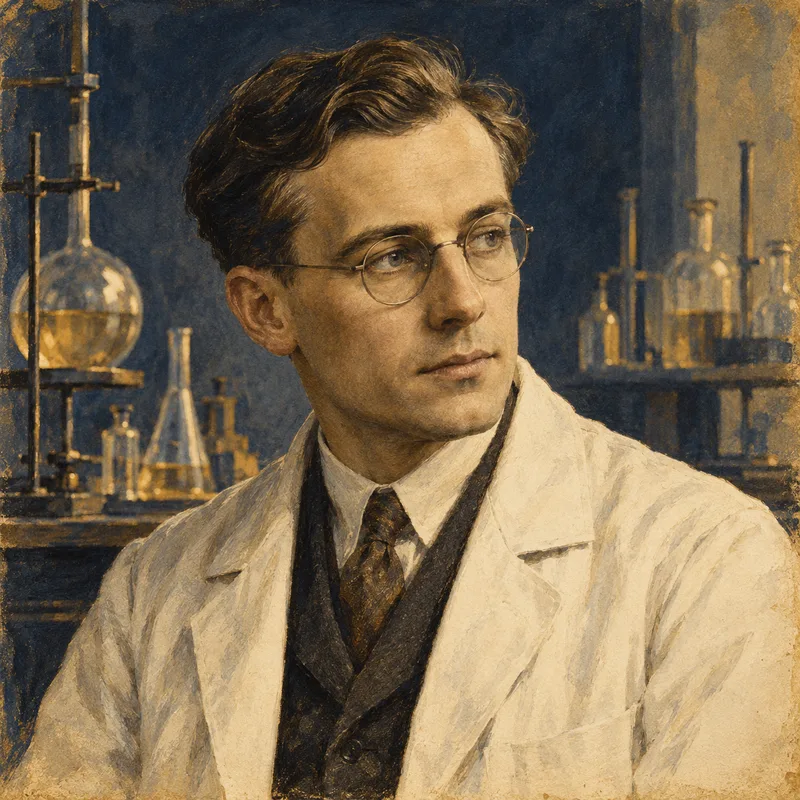
About the chemist
Fritz Strassmann
1902-1980 · Germany
Co-discovered nuclear fission