The discovery, explained · Chemist no. 275 of 350
Fritz Strassmann and the Discovery of Nuclear Fission: The Chemistry That Found Barium
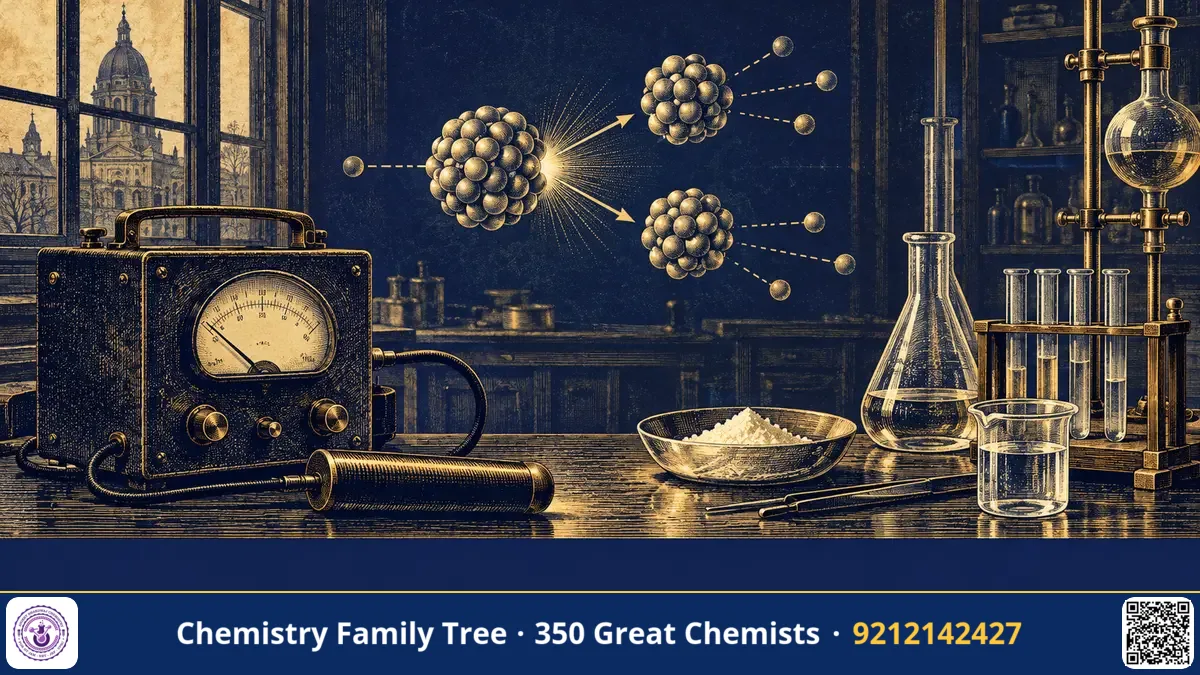
In December 1938, in a Berlin laboratory, two chemists found something that physicists had thought impossible. When uranium was bombarded with neutrons, one of the products was barium, an element with an atomic number of 56, about half that of uranium (92). The uranium nucleus had split. Fritz Strassmann, a young analytical chemist, and his senior colleague Otto Hahn had discovered nuclear fission. Hahn alone received the 1944 Nobel Prize in Chemistry, but historians agree that Strassmann's careful chemical analysis was essential. This article explains the experiment and the chemistry behind it.
The Scientific Problem Before the Discovery
In 1934, Enrico Fermi bombarded uranium with neutrons and observed new radioactivities. He believed he had made transuranic elements, with atomic number above 92. Many laboratories followed up, including Hahn, Lise Meitner and Strassmann in Berlin, and Irène Curie with Pavle Savić in Paris. The results were confusing: the number of different half-lives grew and the chemistry did not fit. Some products behaved like radium; others seemed like actinium. The transuranic assignments could not be right, but the nucleus was thought to change only a little at a time, by emission of an alpha particle or a proton. Splitting into two big pieces had been suggested (by Ida Noddack in 1934), but it was not taken seriously.
The Discovery: Step by Step
By 1938, Lise Meitner, who was Austrian-Jewish, had to flee Germany to Sweden in July of that year. Hahn and Strassmann continued the work in Berlin at the Kaiser Wilhelm Institute for Chemistry. Strassmann was an expert in analytical chemistry and the careful separation of tiny amounts of radioactive substances.
- Irradiation: A uranium sample was bombarded with slow neutrons. Neutrons were slowed down by paraffin wax to make capture more likely.
- Carrier technique: Radioactive atoms in the sample are present in unweighable amounts, so a "carrier" is added. Barium salts were added to carry down radium isotopes, because radium is chemically very similar to barium (both are Group 2 elements).
- Fractional crystallisation: They tried to separate the "radium" from barium by repeated crystallisation of the chlorides or bromides, a method which works for radium and barium because radium salts are slightly less soluble. Marie Curie had used it years earlier.
- The surprise: The "radium" could not be separated from barium, no matter how many times they repeated the process. Strassmann carried out check experiments with known radium isotopes as a control; these did separate from barium. The activity therefore stayed with barium because it was barium, a radioactive isotope of barium.
- Conclusion (December 1938): The products were isotopes of barium (Z = 56) and, by implication, the lighter partner such as krypton (Z = 36). They sent the paper to the journal Naturwissenschaften, and it appeared in January 1939.
Hahn wrote to Meitner about the result. Meitner, with her nephew Otto Frisch, explained the process using the liquid drop model of the nucleus, in which a neutron makes the nucleus oscillate and split in two. Frisch borrowed the word fission from biology. They also calculated the energy release as about 200 MeV per nucleus, using E = mc².
The Chemistry Behind It
The typical fission reaction of uranium-235 is:
²³⁵₉₂U + ¹₀n → ²³⁶₉₂U* → ¹⁴¹₅₆Ba + ⁹²₃₆Kr + 3 ¹₀n + energy (about 200 MeV)
The nucleus splits in many different ways. Besides barium and krypton, many other pairs are formed, such as strontium–xenon, so there are over 200 different fission products, mostly radioactive and rich in neutrons. They decay by beta emission to form stable isotopes.
Important points:
- Mass defect: The sum of the masses of the products is slightly less than the mass of the uranium nucleus plus neutron. The difference Δm gives energy by E = Δmc². One kilogram of ²³⁵U gives about 8 × 10¹³ J, millions of times more than burning 1 kg of coal.
- Chain reaction: The 2–3 neutrons released per fission can cause more fissions. If, on average, at least one neutron from each fission causes another, the reaction continues. A control rod of cadmium or boron absorbs neutrons in a reactor.
- Slow neutrons: ²³⁵U fissions with slow (thermal) neutrons; ²³⁸U only with fast neutrons, and mostly captures neutrons to form ²³⁹Pu after beta decays:
²³⁸U + n → ²³⁹U → ²³⁹Np + β⁻ → ²³⁹Pu + β⁻
The chemistry lesson is that radiochemical identification depends on controls and on the question: does this activity follow the chemistry of the carrier? Strassmann's rigorous controls made the result convincing.
Applications Today
- Nuclear power: Fission reactors produce electricity. India operates pressurised heavy water reactors (PHWRs) using natural uranium and heavy water, as at Tarapur, Kakrapar and Rawatbhata, and aims to use its large thorium reserves in a three-stage programme: ²³²Th + n → ²³³Th → ²³³Pa → ²³³U.
- Nuclear medicine: Fission products such as molybdenum-99 (the parent of technetium-99m) and iodine-131 are used in diagnosis and treatment.
- Research reactors: Used to produce isotopes and for neutron scattering studies.
- Nuclear weapons: Fission was also the basis of the atomic bomb. Hahn, Strassmann and Meitner did not take part in weapons work in Germany, and later were strongly opposed to nuclear weapons.
- Radioactive waste management: Chemists work on separation of fission products and long-term storage, a major modern research field.
Exam Corner
- Nuclear fission was discovered by Otto Hahn and Fritz Strassmann (December 1938) and explained by Lise Meitner and Otto Frisch (1939).
- Typical reaction: ²³⁵U + n → ¹⁴¹Ba + ⁹²Kr + 3n + about 200 MeV.
- Chain reaction needs multiplication factor k ≥ 1; moderators (heavy water, graphite) slow neutrons; control rods (Cd, B) absorb them.
- Fertile materials: ²³⁸U → ²³⁹Pu; ²³²Th → ²³³U.
- Binding energy per nucleon peaks near iron (Fe-56); heavy nuclei release energy when splitting, light nuclei when fusing.
Common Misconceptions
- "Hahn discovered fission alone." The paper was by Hahn and Strassmann; Meitner and Frisch gave the physical explanation.
- "Fission always gives barium and krypton." That is only one of many fission modes.
- "Fission is a chemical reaction." It is a nuclear reaction, in which the nucleus changes; energy per atom is about a hundred million times that of a chemical reaction.
Quick Revision Box
- Fission discovered December 1938 by Hahn and Strassmann, Berlin; published January 1939.
- Key evidence: radioactive barium (Z = 56) from uranium.
- Method: radiochemical separation with barium carrier and control experiments.
- Energy per fission about 200 MeV; 2–3 neutrons released.
- Meitner and Frisch named the process "fission".
- Hahn alone received the 1944 Nobel Prize in Chemistry.
FAQ
Why did Strassmann not receive the Nobel Prize?
The 1944 prize for the discovery of fission was given to Otto Hahn alone. Many historians feel that Strassmann and Meitner should have been honoured too.
Why did barium surprise them?
Barium has about half the atomic number of uranium. Chemists then expected only small changes in Z, not a split.
What is a carrier in radiochemistry?
A stable, inactive form of an element added to a solution so that a tiny amount of a radioactive isotope of the same element can be precipitated with it.
Is fission relevant to the JAM and GATE syllabus?
Yes, particularly nuclear chemistry questions on binding energy, chain reactions, reactor types and decay series.
Published by ABC Chemistry — IIT-JAM | CSIR-NET | GATE Chemistry Coaching. Visit abcchemistry.com
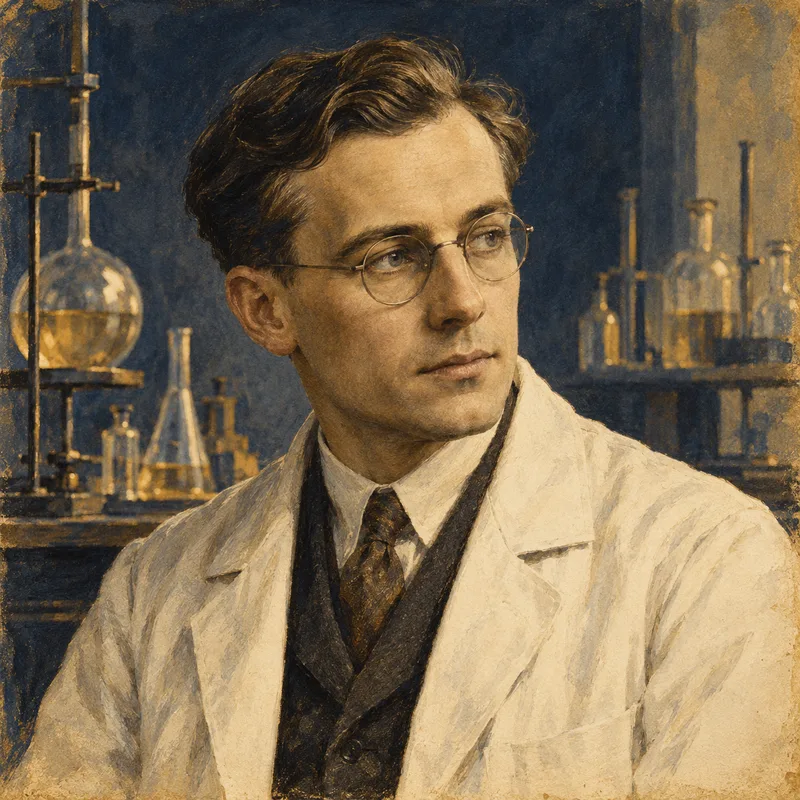
About the chemist
Fritz Strassmann
1902-1980 · Germany
Co-discovered nuclear fission