Biography · Chemist no. 331 of 350
G. N. Ramachandran: The Indian Scientist Who Mapped Protein Shapes
Introduction
Gopalasamudram Narayanan Ramachandran (1922–2001), known to colleagues as GNR, was an Indian physicist turned biophysicist. He is best known for the collagen triple helix and the Ramachandran plot, which every protein crystallographer and biochemist uses. He founded the school of molecular biophysics in India and helped to create a modern Indian approach to structural biology. His legacy in one line: he turned the geometry of a peptide chain into a tool for all of biology.
Early Life and Family
Ramachandran was born on 8 October 1922 in Ernakulam, in the present state of Kerala, into a Tamil family. His father, G. R. Narayanan Iyer, was a mathematics professor, and the home atmosphere encouraged learning. He was educated in Tiruchirappalli (Trichy), and showed early talent in mathematics and science. He had a strong interest in subjects ranging from physics to Sanskrit and Indian philosophy.
Education and Mentors
He studied at St Joseph's College, Tiruchirappalli, and began engineering at the Indian Institute of Science, Bangalore, but moved to physics when he met C. V. Raman, who was then at the Institute. He worked with Raman on the thermal vibrations of crystals and the X-ray diffraction of diamond and received his MSc and DSc from the University of Madras. Raman's influence taught him that physics could address deep questions in a simple way. He then went to Cambridge (Cavendish Laboratory), where he worked for his PhD with W. A. Wooster on the elastic properties of crystals. In Cambridge he came into contact with the new ideas in protein structure, and it was there that his interest turned towards biological molecules.
Career Timeline
| Year | Event |
|---|---|
| 1922 | Born in Ernakulam |
| 1940s | Studies and researches under C. V. Raman at the Indian Institute of Science |
| 1949 | Receives PhD from Cambridge; returns to Bangalore |
| 1952 | Becomes Professor of Physics at the University of Madras, later leads a new department |
| 1954 | With Gopinath Kartha proposes the triple helical structure of collagen |
| 1963 | With Ramakrishnan and Sasisekharan introduces the Ramachandran plot |
| 1970 | Moves to the Indian Institute of Science, Bangalore, to head the Molecular Biophysics Unit |
| 1980s | Works on methods in image reconstruction and tomography and on protein structure |
| 2001 | Dies in Chennai on 7 April |
Major Scientific Contributions
Collagen triple helix. The model that explained the structure of collagen with three chains and a glycine at every third position.
Conformational analysis. The Ramachandran plot and the idea that stereochemical constraints, particularly steric hindrance, determine the allowed conformations of polypeptides. The same ideas were later extended to polysaccharides and nucleic acids. See the companion discovery post.
Image reconstruction. With A. V. Lakshminarayanan, he developed a convolution back-projection algorithm for reconstructing three-dimensional images from two-dimensional projections. This is related to computed tomography (CT scanning) and appeared in the early 1970s.
Structural biology of proteins and peptides. His group studied the conformation of many peptides, including cyclic peptides, and the structure of proteins like lysozyme, and he took a keen interest in the hydration of biomolecules.
Awards, Honours and Nobel Prize
Ramachandran was elected a Fellow of the Royal Society (1977), a Fellow of the Indian Academy of Sciences and of the Indian National Science Academy, and received the Shanti Swarup Bhatnagar Prize in 1961. He did not win the Nobel Prize, though his work is regarded as worthy of one by many scientists.
Personality, Struggles and Lesser-Known Facts
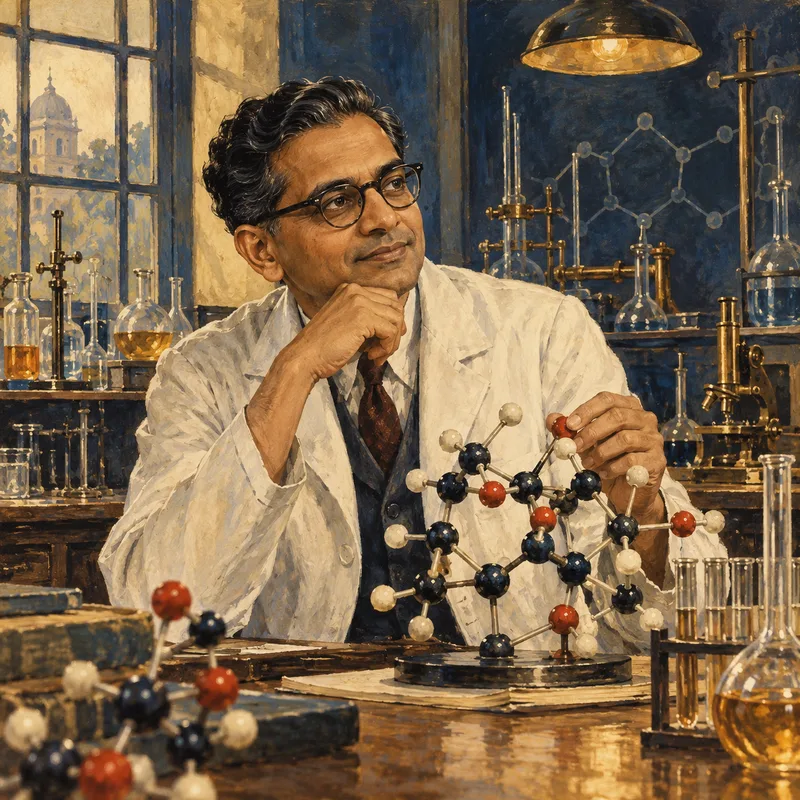
- Model builder. He believed in building physical models from van der Waals spheres and tubes, and in letting these models guide the mathematics.
- Raman's student. He began his research career with Raman in Bangalore on crystal physics and X-ray diffraction, and later carried the same rigorous style into biology.
- Wide interests. He had interests in Indian philosophy and the history of science, in Sanskrit and in music.
- Founder of a school. His Madras laboratory, the Centre of Advanced Study in Biophysics, trained many Indian structural biologists. His co-workers Sasisekharan, Ramakrishnan, Kartha and others went on to establish themselves in science.
- Left-field ideas. He was willing to take on difficult problems from X-ray crystallography to tomography, which most people would see as unrelated.
Legacy and Influence on Modern Chemistry
Almost every protein structure solved anywhere in the world is checked against a Ramachandran plot, whether by X-ray crystallography, NMR or cryo-EM. The idea that steric limits define allowed conformations underlies molecular mechanics and computational chemistry. The Molecular Biophysics Unit at IISc is his institutional legacy, and the Madras school he started is the root of much of Indian structural biology. In 2001 India lost a scientist who had been a link between physics, chemistry and biology.
Lessons for Students
- Cross the boundary between disciplines. A physicist solved a biochemical problem.
- Use simple models. Steric overlap in a ball model explained a complex phenomenon.
- Choose fundamental problems, even if they seem far from fashionable.
- Credit your team. Plots and models bear the names of many co-workers.
Quick Facts Box
- Born: 8 October 1922, Ernakulam, Kerala
- Died: 7 April 2001, Chennai
- Nationality: Indian
- Field: Biophysics, crystallography, structural biology
- Famous for: Collagen triple helix; Ramachandran plot
- Nobel: None; FRS 1977
FAQ
Why is G. N. Ramachandran included among chemists?
His plot and helix describe the conformations of molecules, which is central to chemistry and biochemistry. The topic appears in biochemistry and bioorganic chemistry syllabi.
Who worked with him on the Ramachandran plot?
C. Ramakrishnan and V. Sasisekharan co-authored the 1963 paper.
What is the link between GNR and CT scans?
He and Lakshminarayanan published an algorithm for tomographic reconstruction in 1971, which improved image quality in CT-type methods.
Where did he work?
Mostly at the University of Madras and later the Indian Institute of Science in Bangalore.
Published by ABC Chemistry — IIT-JAM | CSIR-NET | GATE Chemistry Coaching. Visit abcchemistry.com
About the chemist
G. N. Ramachandran
1922-2001 · India
Ramachandran plot; collagen triple helix