The discovery, explained · Chemist no. 44 of 350
Gay-Lussac's Laws: Gases Combine in Simple Whole-Number Ratios
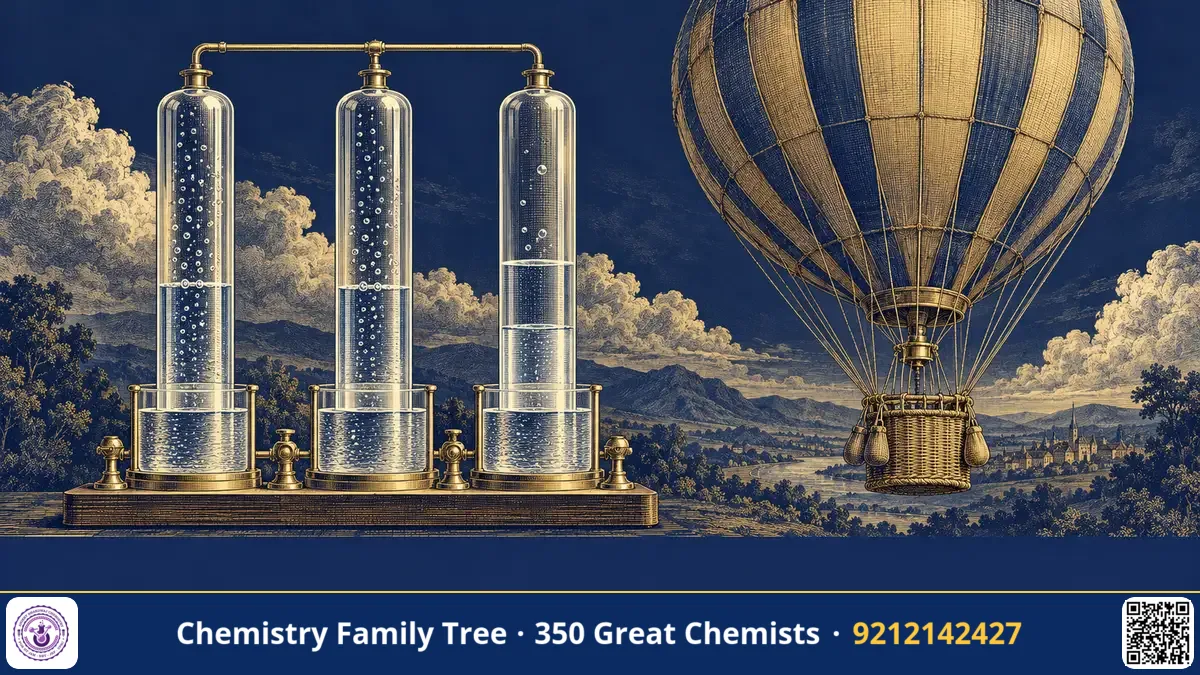
When hydrogen burns in oxygen to form steam, 2 litres of hydrogen need exactly 1 litre of oxygen and give 2 litres of steam, all measured at the same temperature and pressure. When hydrogen reacts with chlorine, 1 litre plus 1 litre give 2 litres of hydrogen chloride. These neat whole-number ratios were noticed and published in 1808 by the French chemist Joseph Louis Gay-Lussac. His law of combining volumes became the clue that led Avogadro to the idea of molecules. Gay-Lussac is also credited with the pressure-temperature law for gases, which you meet in Class 11 as "Gay-Lussac's law". This article covers both, with the exam angle for boards, IIT-JAM, CSIR-NET and GATE.
The Scientific Problem Before the Discovery
In 1808 John Dalton's atomic theory had just been published. It explained the laws of definite and multiple proportions by mass: compounds contain elements in fixed mass ratios because atoms combine in whole numbers. But there was a puzzle.
- Dalton believed that atoms of gases were surrounded by "caloric" and he assumed the simplest formulas, such as HO for water.
- Measurements of gas volumes did not seem to fit his picture. If one atom of hydrogen combines with one atom of oxygen, why do the volumes combine as 2:1?
- The behaviour of gases with pressure and temperature had been studied by Boyle (pressure-volume) and by Jacques Charles (volume-temperature), but Charles had not published his results, and the exact relation for pressure and temperature was unclear.
The Discovery: Step by Step
Part 1: Law of combining volumes (1808)
Gay-Lussac carefully measured the volumes of gases that react and the volumes of gaseous products, using glass tubes over mercury or water. He kept the temperature and pressure the same for all measurements. His observations:
H₂ + Cl₂ → 2HCl         1 vol : 1 vol : 2 vol
2H₂ + O₂ → 2H₂O(g)      2 vol : 1 vol : 2 vol
N₂ + 3H₂ → 2NH₃         1 vol : 3 vol : 2 vol
2CO + O₂ → 2CO₂         2 vol : 1 vol : 2 vol
He stated the law: when gases react, they do so in volumes that bear a simple whole-number ratio to each other and to the volumes of the gaseous products, provided all measurements are made at the same temperature and pressure. (The ammonia reaction is a later example for illustration; it was not part of his original data, but the same law applies.)
Part 2: Pressure-temperature law
Gay-Lussac also studied how gases expand on heating. In 1802 he published careful measurements showing that all gases he tested expand by the same fraction of their volume for each degree rise of temperature, a value close to 1/267 of the volume at 0 °C per °C, quite near the modern 1/273. He acknowledged Jacques Charles's earlier unpublished work. For a fixed mass of gas at constant volume, the pressure rises in proportion to the absolute temperature:
P ∝ T    (V and n constant)
P₁/T₁ = P₂/T₂
The temperature must be in kelvin. (The linear dependence of pressure on temperature was also seen earlier by Guillaume Amontons, so this relation is sometimes called Amontons's law.)
The Chemistry Behind It
How Avogadro explained the combining volumes
Dalton rejected Gay-Lussac's law because it seemed to require that one volume of nitrogen plus one volume of oxygen give two volumes of nitric oxide, which would mean splitting "atoms". In 1811 Amedeo Avogadro resolved the difficulty. He proposed that equal volumes of all gases at the same temperature and pressure contain the same number of molecules, and that elemental gases such as hydrogen and oxygen exist as diatomic molecules:
2H₂ + O₂ → 2H₂O
(2 molecules) (1 molecule) (2 molecules)
Volume ratio = molecule ratio = mole ratio. This idea was ignored for almost 50 years until Stanislao Cannizzaro revived it at the Karlsruhe Congress in 1860.
Why the pressure-temperature relation holds
From kinetic theory, pressure is due to molecular collisions with the walls. Average kinetic energy is proportional to T, so for a fixed volume and a fixed number of molecules, pressure rises in direct proportion to T. This is why a sealed aerosol can or LPG cylinder warns against heating.
Link with the ideal gas equation
Combine Boyle (P ∝ 1/V), Charles (V ∝ T), Gay-Lussac (P ∝ T) and Avogadro (V ∝ n):
PV = nRT R = 8.314 J K⁻¹ mol⁻¹ = 0.0821 L atm K⁻¹ mol⁻¹
A numerical example
A gas cylinder holds gas at 3.0 atm and 27 °C (300 K). If heated to 127 °C (400 K) at constant volume, the new pressure is P₂ = P₁ × T₂/T₁ = 3.0 × 400/300 = 4.0 atm.
Applications Today
- Safety of LPG and aerosol cans: pressure rises as temperature increases, so such containers must not be left in hot cars or near flames.
- Tyre pressure: pressure in car and bike tyres goes up after a long drive, and falls in winter.
- Stoichiometry of gases: in industrial gas reactions (ammonia, SO₃, syngas), volume ratios give the molar ratios directly.
- Pressure cookers: raising the temperature of steam in a closed vessel raises its pressure, and the higher boiling point cooks food faster, which is useful across Indian kitchens.
- Analytical chemistry: Gay-Lussac designed the burette, pipette and the volumetric methods still used in titration, including his method for estimating silver.
Exam Corner
- Law of combining volumes: gases combine in simple whole-number ratios at the same T and P; it supports Avogadro's hypothesis.
- Pressure law: P/T = constant at constant V and n; always use kelvin.
- Volume ratio for gases equals mole ratio, so 10 mL of CH₄ burns with 20 mL of O₂ to give 10 mL of CO₂ (water is liquid at room temperature).
- Gay-Lussac's law does not hold for solids or liquids as products; it applies to gaseous substances only.
- Combined gas law: P₁V₁/T₁ = P₂V₂/T₂.
Common Misconceptions
- "Gay-Lussac's law means volume is proportional to temperature." That is Charles's law. The pressure law relates P and T at fixed volume. Note that in some older textbooks the volume-temperature law is also credited to Gay-Lussac, so read the question carefully.
- "Temperature can be used in °C." It must be in kelvin; the proportionality fails for Celsius.
- "Combining volumes work for any phase." They apply to gases measured under the same conditions only.
Quick Revision Box
- Combining volumes law: 1808, whole-number volume ratios.
- Explained by Avogadro in 1811: equal volumes, equal numbers of molecules.
- Pressure law: P₁/T₁ = P₂/T₂ at constant V.
- H₂ + Cl₂ → 2HCl is 1:1:2 by volume; 2H₂ + O₂ → 2H₂O is 2:1:2.
- Use kelvin: T(K) = t(°C) + 273.15.
- Ideal gas equation: PV = nRT.
FAQ
Why is Gay-Lussac's volume law important?
It showed that simple numbers govern gas reactions, and it led directly to Avogadro's idea of diatomic molecules.
Is Gay-Lussac's law about pressure or volume?
In most modern textbooks it is the pressure-temperature law. The law of combining volumes is a separate law from 1808.
Why did Dalton reject the law of combining volumes?
Because it appeared to conflict with his assumption that elemental gases are single atoms; Avogadro's diatomic molecules solved this.
What happens to the pressure if the temperature is doubled in kelvin?
At constant volume and amount, the pressure also doubles.
Published by ABC Chemistry — IIT-JAM | CSIR-NET | GATE Chemistry Coaching. Visit abcchemistry.com
About the chemist
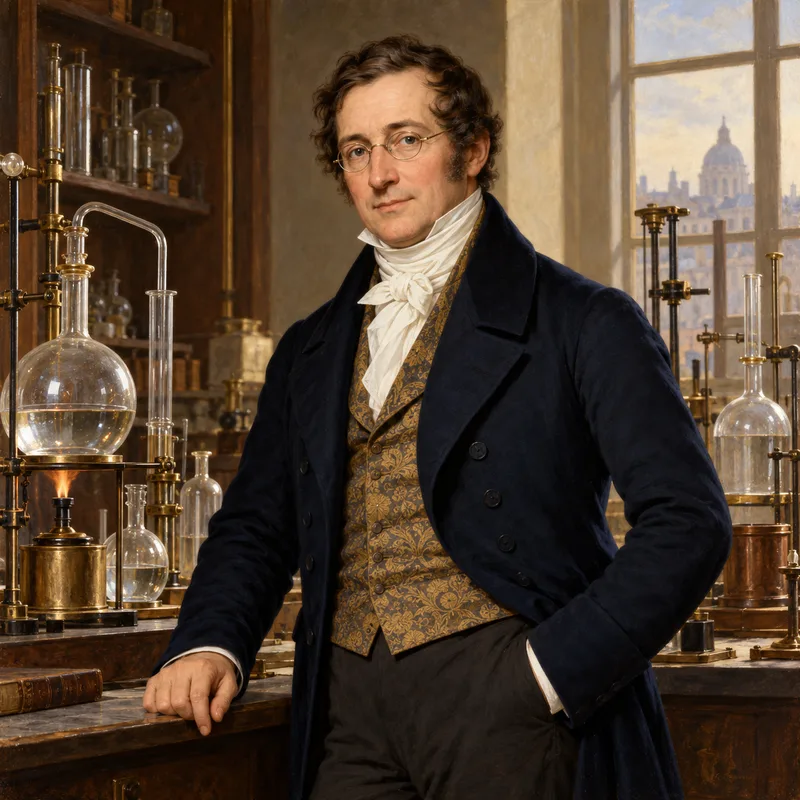
Joseph Louis Gay-Lussac
1778-1850 · France
Gas laws; law of combining volumes