Biography · Chemist no. 44 of 350
Joseph Louis Gay-Lussac: The Balloonist and Gas Chemist of France
Introduction
Joseph Louis Gay-Lussac (1778-1850) was a French chemist and physicist who is remembered for the law of combining volumes, the pressure law of gases, the discovery of boron, the study of cyanogen and iodine, and the invention of many tools of volumetric analysis. He was also a daring scientist who ascended in a balloon to study the atmosphere. Legacy in one line: he turned gas measurement into precise science and gave analytical chemistry its burettes and pipettes.
Early Life & Family
Gay-Lussac was born on 6 December 1778 in Saint-Léonard-de-Noblat, a small town in the Limousin region of central France. His father was a legal official. The family name was originally Gay, and "Lussac" was added later from a family property, so he became known as Gay-Lussac. His childhood fell in the years before and during the French Revolution (1789), a time of social turmoil, and his father was arrested for a time, and his education was continued with difficulty. Despite this, he showed a strong aptitude for mathematics and science, and was sent to Paris for further schooling.
Education & Mentors
In 1797 Gay-Lussac was admitted to the new École Polytechnique in Paris, which had been founded to train engineers and scientists for the French state. There he studied under distinguished teachers, among them the chemist Claude-Louis Berthollet, who noticed the young man's ability. After Polytechnique he went on to the École des Ponts et Chaussées, but Berthollet took him as a laboratory assistant at Arcueil, a village near Paris where Berthollet and Pierre-Simon Laplace held a famous scientific circle (the Society of Arcueil). Gay-Lussac became a leading member. This is where he learned precise experimental methods.
Career Timeline
| Year | Event |
|---|---|
| 1778 | Born in Saint-Léonard-de-Noblat, France |
| 1797 | Enters the École Polytechnique |
| 1802 | Publishes measurements on the thermal expansion of gases |
| 1804 | Balloon ascents in Paris, including a solo flight to about 7,000 m |
| 1808 | Law of combining volumes; with Louis Jacques Thénard isolates boron |
| 1809 | Professor of chemistry at the École Polytechnique; professor of physics at the Sorbonne |
| 1813-1814 | Shows that iodine is an element and studies its compounds |
| 1815 | Prepares and studies cyanogen, (CN)₂ |
| 1824 | Develops an alcoholometer for strength of spirits |
| 1827 | Designs the Gay-Lussac tower to recover nitrogen oxides in sulphuric acid manufacture |
| 1832 | Moves to the Muséum national d'histoire naturelle as professor of chemistry |
| 1850 | Dies in Paris on 9 May |
Major Scientific Contributions
- Gas laws: the law of combining volumes (1808) and the measurement of gas expansion (1802). See our article on Gay-Lussac's laws for equations and examples.
- Boron (1808): with Thénard he prepared impure boron by heating boric acid with potassium, around the same time Humphry Davy did the electrolytic work in England.
- Iodine and cyanogen: he proved iodine to be an element analogous to chlorine, and he prepared cyanogen, the first known "pseudohalogen", from mercury(II) cyanide. He also showed that hydrocyanic acid (HCN) contains no oxygen, supporting the view that acids need not contain oxygen, which was important for Davy's hydrogen theory of acids.
- Volumetric analysis: he improved the burette, the pipette and the use of indicators, and devised a classic method for the titration of silver with chloride.
- Industrial chemistry: the Gay-Lussac tower in the lead-chamber process absorbed nitrogen oxides with concentrated sulphuric acid, saving costly materials.
- Potassium and sodium: with Thénard he developed a chemical method to prepare potassium using iron at high temperature, which was cheaper than Davy's electrolysis.
Awards, Honours & Nobel Prize
There was no Nobel Prize in Gay-Lussac's lifetime, since the prizes began in 1901. He was elected to the Académie des Sciences in 1806 and became a member of the Royal Society of London as a foreign member. In 1839 he was named a peer of France, and he also served as a deputy in the French legislature. The name of Gay-Lussac is inscribed among the names of French scientists on the Eiffel Tower, and a lunar crater is named after him.
Personality, Struggles & Lesser-Known Facts
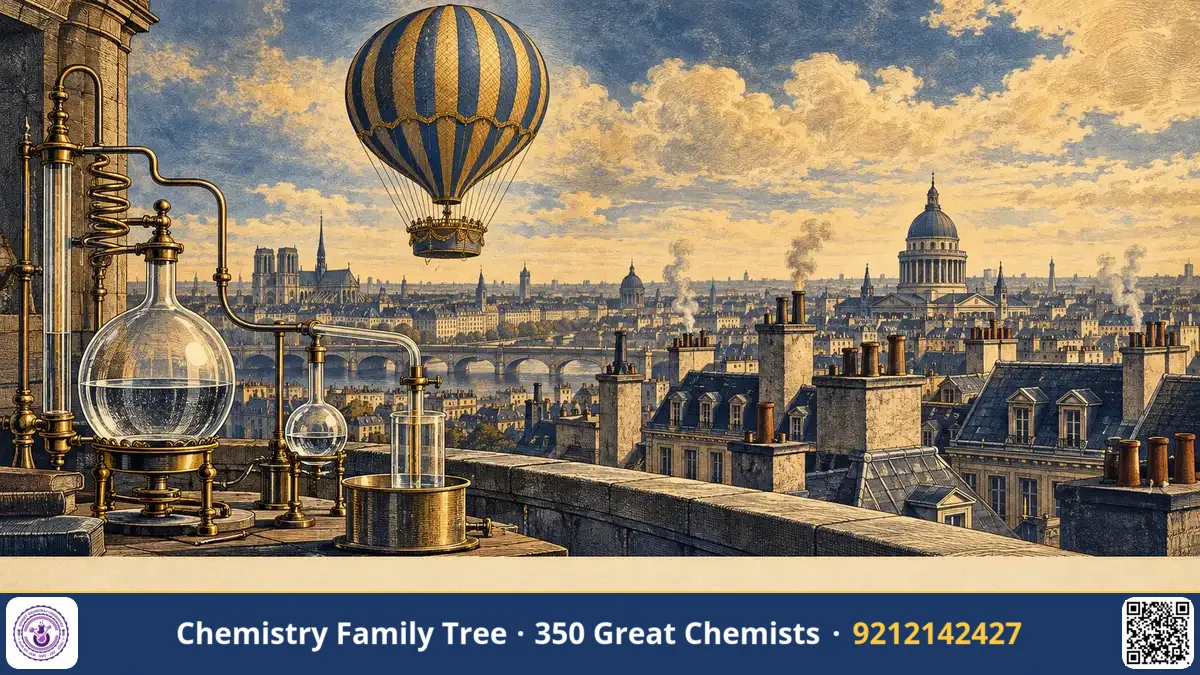
- The balloon flights. On 16 September 1804 Gay-Lussac went up alone in a balloon and reached an altitude of about 7,000 metres (the figure usually quoted is 7,016 m). At that height he measured the magnetic field, temperature, humidity and collected air samples. He found that the composition of air was the same as at ground level.
- Accidents in the laboratory. Like many chemists of his time he was injured by an explosion in his laboratory while working with potassium; in 1808 an explosion during his work with potassium temporarily injured his eyes.
- A rival and a friend. He competed with Humphry Davy in the race to understand new elements such as boron and iodine, but each recognised the other's skill.
- Co-worker Thénard. His long collaboration with Louis Jacques Thénard produced many results in the early 1800s, and they were close for decades.
- Politician and public servant. He advised the French government on technical questions and took part in politics after 1830, serving as a deputy.
Legacy & Influence on Modern Chemistry
Every titration in an Indian college laboratory descends from tools he refined. The idea that gases combine in simple ratios led to Avogadro's molecular hypothesis and to modern stoichiometry. His work on cyanogen opened the concept of pseudohalogens, and his study of HCN and HI supported the modern definition of acids. His work on gas expansion contributed to the absolute temperature scale. His students and colleagues, including Justus von Liebig, who worked in his laboratory in Paris in the 1820s, spread his precise methods across Europe.
Lessons for Students
- Measure carefully. His discoveries came from accurate volume measurements.
- Take intellectual risks. A balloon flight and work with explosive metals show his courage.
- Credit others. He acknowledged Charles's unpublished work on gas expansion.
- Combine theory and application. His laws and his sulphuric acid tower served both science and industry.
Quick Facts Box
- Born: 6 December 1778, Saint-Léonard-de-Noblat, France
- Died: 9 May 1850, Paris
- Nationality: French
- Field: Chemistry and physics (gases, analytical chemistry)
- Famous for: Law of combining volumes; boron; cyanogen; balloon ascents
- Nobel: None (lived before the prizes began)
FAQ
Which elements did Gay-Lussac help discover?
He isolated boron with Thénard and showed iodine to be an element; he also prepared the compound cyanogen.
Why is he called a balloonist?
Because he made scientific balloon ascents in 1804, one of them to a height of about 7 km.
Was he related to Charles's law?
He published precise measurements of gas expansion in 1802 and credited Jacques Charles with the earlier discovery, so the volume-temperature law is often called Charles's law.
What is the Gay-Lussac tower?
A tower used in sulphuric acid manufacture to recover nitrogen oxides from the exit gases of the lead chambers.
Published by ABC Chemistry — IIT-JAM | CSIR-NET | GATE Chemistry Coaching. Visit abcchemistry.com
About the chemist
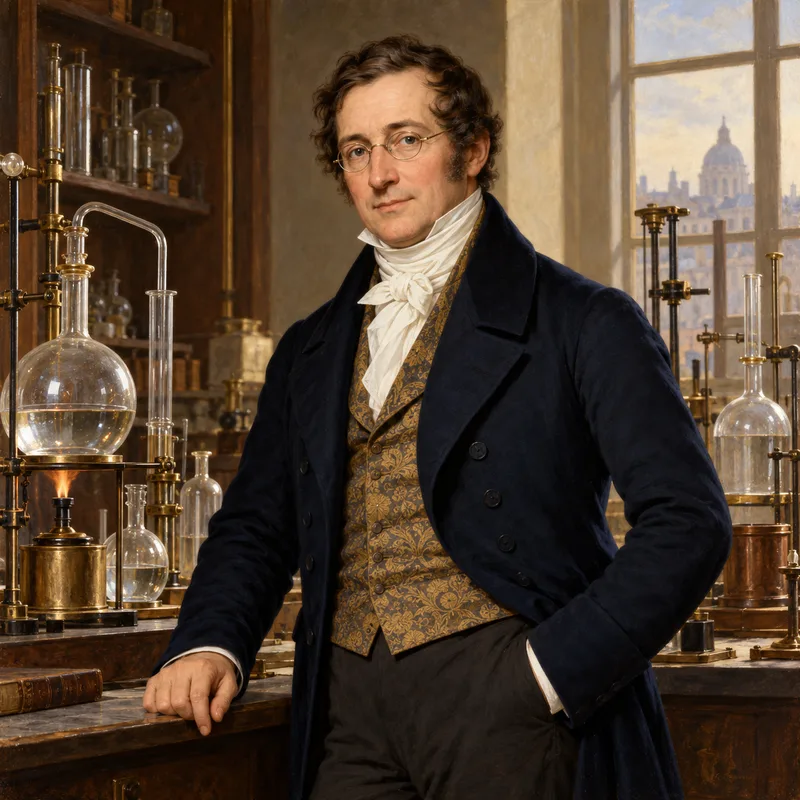
Joseph Louis Gay-Lussac
1778-1850 · France
Gas laws; law of combining volumes