Biography · Chemist no. 79 of 350
Geoffrey Wilkinson (1921-1996): The Chemist Who Taught Metals to Bond with Carbon Rings
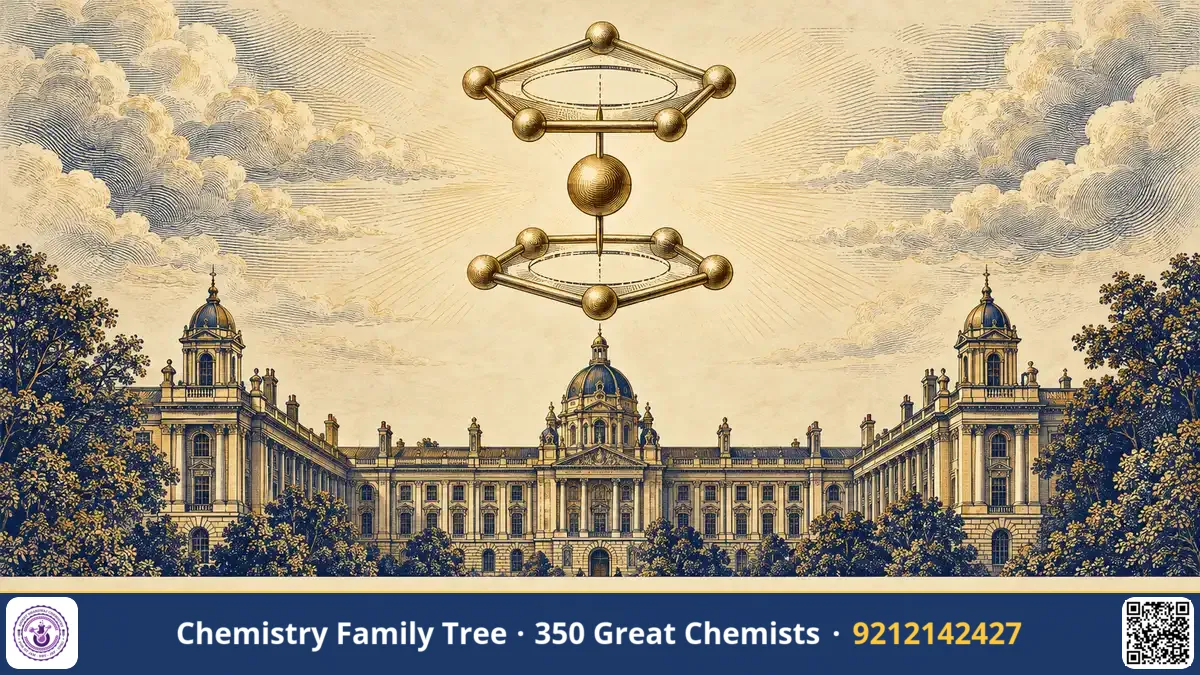
Sir Geoffrey Wilkinson (he was knighted in 1976) was an English inorganic chemist whose name now lives in textbooks through Wilkinson's catalyst, RhCl(PPh3)3, and through his role in explaining the sandwich structure of ferrocene. He shared the 1973 Nobel Prize in Chemistry with Ernst Otto Fischer. His legacy in one line: he helped turn organometallic chemistry from a curiosity into a central branch of modern chemistry. This blog tells his story for students who meet his name in Class 12 coordination chemistry, B.Sc. inorganic papers and competitive exams.
Early Life & Family
Geoffrey Wilkinson was born on 14 July 1921 in Todmorden, a mill town in the Pennines on the border of Yorkshire and Lancashire, in northern England. His family was of modest means, and he grew up in the years between the two World Wars, when education was the main route upward for talented children from working-class towns. Todmorden had already produced one famous scientist: John Cockcroft, who later shared the 1951 Nobel Prize in Physics for splitting the atom, was also born there. Two Nobel laureates from one small town is a remarkable fact, and it is a good reminder to students that talent can emerge from anywhere.
Education & Mentors
Wilkinson attended the local secondary school at Todmorden and won a scholarship to Imperial College London, where he studied chemistry. He completed his undergraduate degree in 1941 and stayed in research during the war years. At Imperial he was influenced by the inorganic chemistry tradition of the college, and he completed a doctorate there in the mid-1940s. During the Second World War he was sent to Canada and worked on the nuclear energy project at the Montreal Laboratory and the Chalk River site. This gave him experience in radiochemistry, handling radioactive materials, and careful experimental technique.
After the war he moved to the United States as a researcher at the University of California, Berkeley, in the group of Glenn Seaborg, famous for transuranium elements. He then took positions at the Massachusetts Institute of Technology and at Harvard University. At Harvard he met R. B. Woodward, one of the greatest organic chemists of the century, and that meeting changed the direction of his career.
Career Timeline
| Year | Event |
|---|---|
| 1921 | Born in Todmorden, England (14 July) |
| 1941 | Graduates in chemistry from Imperial College London |
| 1943-1946 | Works on nuclear research in Canada (Montreal and Chalk River) |
| 1950 | Researches at Berkeley, then joins MIT |
| 1951-1955 | At Harvard University; ferrocene work begins |
| 1952 | Wilkinson and Woodward and co-workers propose the sandwich structure of ferrocene |
| 1956 | Returns to Imperial College London as Professor of Inorganic Chemistry |
| 1962 | Publishes Advanced Inorganic Chemistry with F. A. Cotton |
| 1965 | Elected Fellow of the Royal Society; Wilkinson's catalyst work published about this time |
| 1973 | Nobel Prize in Chemistry, shared with E. O. Fischer |
| 1976 | Knighted for services to chemistry |
| 1996 | Dies in London (26 September) |
Major Scientific Contributions
- Sandwich structure of ferrocene: showing that the iron atom is bonded to all ten carbon atoms of two cyclopentadienyl rings, an 18-electron, diamagnetic molecule, Fe(η5-C5H5)2.
- Wilkinson's catalyst: homogeneous hydrogenation of alkenes at room temperature through oxidative addition, migratory insertion and reductive elimination.
- Rhodium hydroformylation catalysts: converting alkenes with CO and H2 into aldehydes under mild conditions.
- Metal alkyls and hydrides: he and his group prepared many new transition-metal alkyl, hydride and carbonyl complexes, including complexes with metal-carbon sigma bonds that were stable because of suitable ligands.
- Textbook writing: Advanced Inorganic Chemistry (with Cotton) trained generations of inorganic chemists worldwide, and Wilkinson also edited large reference works on coordination and organometallic chemistry.
For the chemistry in detail, including the catalytic cycle and electron counting, see the companion discovery blog on Wilkinson's catalyst and ferrocene.
Awards, Honours & Nobel Prize
The 1973 Nobel Prize in Chemistry was awarded jointly to Ernst Otto Fischer and Geoffrey Wilkinson "for their pioneering work, performed independently, on the chemistry of the organometallic, so called sandwich compounds". Wilkinson was elected a Fellow of the Royal Society in 1965 and received many other honours from chemical societies. Although he worked in a field that includes both academic and industrial relevance, his Nobel recognition was for the fundamental structural and bonding insights.
Personality, Struggles & Lesser-Known Facts
- He grew up in the same small town as Nobel physicist John Cockcroft, which is a nice historical coincidence.
- His wartime work in Canada meant he started his research life in nuclear chemistry, not in organometallic chemistry. He moved fields later, which shows that a good scientist can change direction.
- The ferrocene breakthrough happened because he talked to Woodward at Harvard. Collaboration between an inorganic chemist and an organic chemist solved a problem neither might have solved alone.
- Ferrocene had been prepared by other groups in 1951; Wilkinson's contribution was the structure, not the first synthesis. Credit in science often goes to the person who explains, not only to the person who first makes.
- His textbook with Cotton is still cited and has gone through many editions since the 1960s.
Legacy & Influence on Modern Chemistry
Almost every modern catalytic process involving transition metals uses the vocabulary Wilkinson helped establish: ligand dissociation, oxidative addition, migratory insertion, beta-hydride elimination, reductive elimination. Palladium cross-coupling reactions (Heck, Suzuki), olefin metathesis and asymmetric hydrogenation are all in the same conceptual family. Industrially, rhodium-phosphine systems are used in aldehyde manufacture. In education, the 18-electron rule he and his contemporaries popularised remains the first tool students use to predict the stability of organometallic complexes. He trained many students and postdoctoral researchers who later became leaders of inorganic chemistry in universities around the world.
Lessons for Students
- Be curious about a strange result. A stable orange powder with an unexpected formula led to a whole new field.
- Use simple evidence. Dipole moment, magnetism and an infrared spectrum were enough to reject a wrong structure.
- Cross the boundaries between subjects. Inorganic and organic chemistry were united in ferrocene.
- Write clearly. A good textbook can influence science as much as a good experiment.
Quick Facts Box
- Born: 14 July 1921, Todmorden, England
- Died: 26 September 1996, London
- Nationality: British
- Field: Inorganic and organometallic chemistry
- Famous for: Ferrocene structure; Wilkinson's catalyst RhCl(PPh3)3
- Nobel Prize: Chemistry, 1973 (shared with E. O. Fischer)
FAQ
Did Wilkinson discover ferrocene?
No. Ferrocene was first prepared in 1951 by other research groups. Wilkinson and Woodward proposed its correct sandwich structure in 1952.
Where did Wilkinson work for most of his career?
He spent most of his academic career at Imperial College London, after his years at Harvard in the early 1950s.
Why is he important for GATE and NET students?
Questions on the 18-electron rule, hapticity, ferrocene and catalytic cycles often use examples from his work.
What did he share the Nobel Prize for?
He shared it with E. O. Fischer for their independent pioneering work on organometallic sandwich compounds.
Published by ABC Chemistry — IIT-JAM | CSIR-NET | GATE Chemistry Coaching. Visit abcchemistry.com
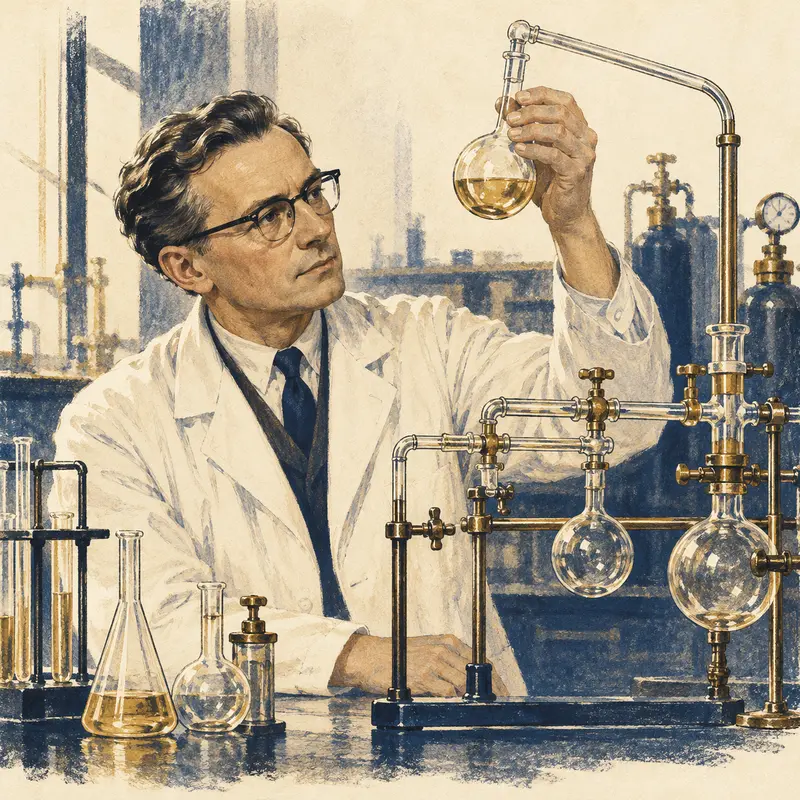
About the chemist
Geoffrey Wilkinson
1921-1996 · United Kingdom · Nobel Chemistry 1973
Organometallic sandwich compounds; Wilkinson's catalyst